Technical Deconstruction: The Lampas Weave as Avant-Garde Substrate
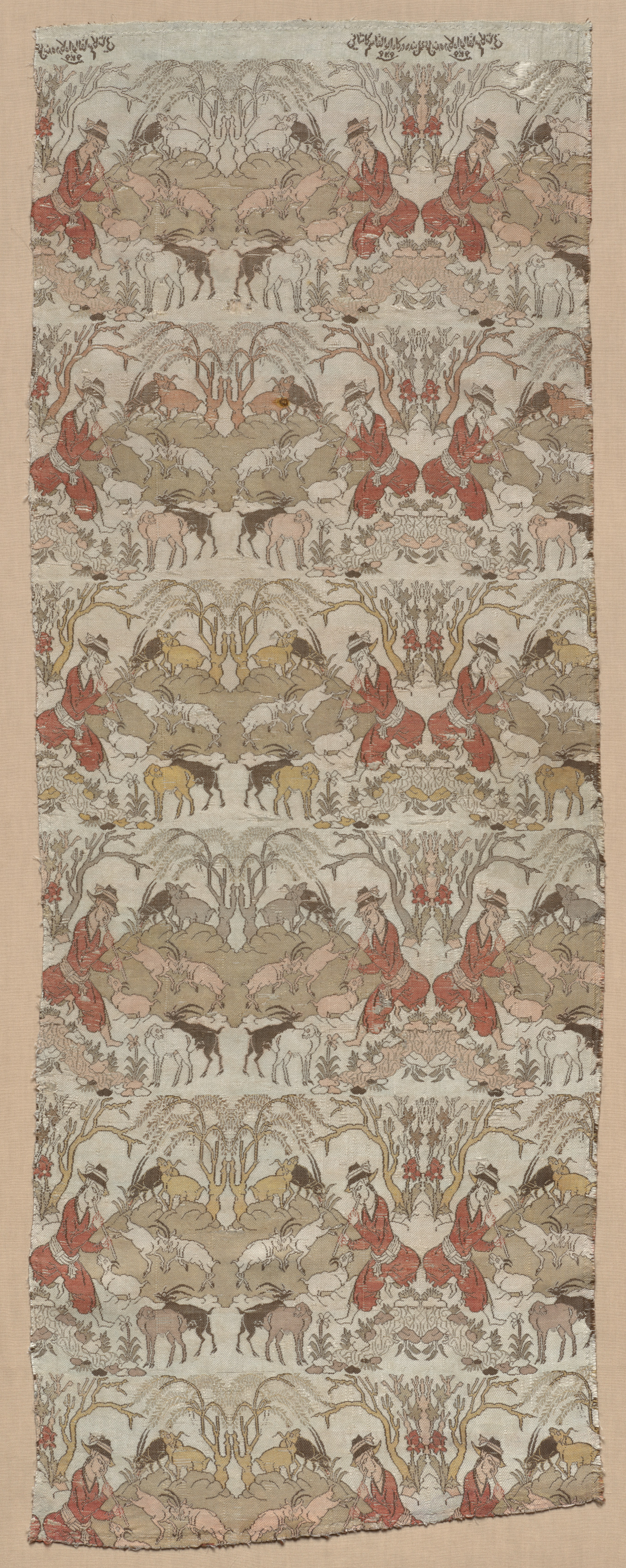
At Zoey Fashion Lab, our Chief Fabric Deconstructionist approaches the Iranian silk textile from Isfahan not as a historical artifact, but as a radical material manifesto. The lampas weave—a compound structure where a main warp and weft create the ground while a supplementary weft floats to form the pattern—is inherently a technology of layered narrative. In this 16th-17th century piece, the lampas technique is not merely decorative; it is a proto-avant-garde gesture. The supplementary wefts, often in lustrous silk, create a raised, almost sculptural surface that disrupts the planar logic of the fabric. This is not a flat image; it is a topographic map of power, where the goatherds and their landscape emerge as tactile, volumetric presences. For the avant-garde designer, this weave offers a literal depth of field—a material metaphor for the layered histories of the Silk Road, where Persian craftsmanship met Chinese motifs and Central Asian nomadic aesthetics.
The silk itself is a high-tensile, protein-based fiber with a natural luster that shifts under light—a property the lampas weave exploits to create optical dynamism. The ground weave, typically a plain or twill structure, provides a matte, stable backdrop, while the supplementary weft in glossy silk creates a chromatic vibration. This is not a static image; it is a kinetic textile, where the goatherds and trees seem to move as the viewer shifts perspective. In the context of Zoey Fashion Lab’s avant-garde ethos, this silk becomes a prototype for interactive fashion—a fabric that demands engagement, that refuses to be passive. The lampas technique, with its interplay of ground and figure, mirrors the avant-garde obsession with deconstructing the binary between background and foreground, subject and object.
Iconographic Analysis: Goatherds as Avant-Garde Agents
The goatherds in a landscape are not pastoral idylls; they are agents of disruption within the silk’s pictorial space. In Persian textile art, the goatherd is a liminal figure—part of nature yet distinct from it, a wanderer who embodies the nomadic flux that challenges settled empires. For the avant-garde, this figure is a proto-flâneur, a drifter who subverts the ordered geometry of the Isfahan court. The landscape itself—with its stylized trees, rolling hills, and flowing water—is not a realistic depiction but a symbolic topography. The trees, often cypress or plane, are vertical anchors in a horizontal field, creating a tension between stasis and movement. The goatherds, with their staffs and cloaks, are dynamic diagonals that cut across the weave’s grid, introducing a rhythmic irregularity that anticipates the avant-garde’s love for asymmetry.
This iconography is further radicalized by the lampas weave’s structural logic. The supplementary weft that forms the goatherds and landscape is not a continuous line but a series of interrupted floats, creating a pixelated effect that prefigures digital imaging. Each goatherd is a cluster of silk threads, a pointillist figure that dissolves into the ground at close range. This is a proto-deconstructivist move: the figure is never fully present, always in the process of becoming. For Zoey Fashion Lab, this suggests a fashion that resists fixed identity—garments that shift between pattern and ground, figure and field, as the wearer moves. The goatherd, as a fugitive figure, becomes a metaphor for the avant-garde subject: always in transit, never fully captured.
Cultural Resonance: Archive as Avant-Garde Catalyst
The archival note—“在人类文明的长河中,器物与绘画不仅是时代技艺的结晶,更是文化碰撞与美学交融的无声见证。十六至十七世纪...”—frames this textile as a silent witness to cultural collision. The 16th-17th century Isfahan silk industry was a globalized enterprise, drawing on Chinese silk techniques, Persian design, and European trade demands. This textile is not a pure Persian artifact; it is a hybrid object, a creole of aesthetics. For the avant-garde, this hybridity is not a compromise but a weapon against purity. The lampas weave, with its Chinese-influenced patterns and Persian iconography, is a textual palimpsest where multiple cultural scripts overwrite each other. The goatherds, often depicted in Safavid court textiles, are here rendered with a Mughal-inflected naturalism, their faces and postures echoing Indian miniatures. This is a transcultural avant-garde, centuries before the term existed.
Zoey Fashion Lab’s deconstructionist protocol reads this hybridity as a challenge to national fashion narratives. The textile’s archive resonance is not a nostalgic echo but a critical tool for dismantling the idea of a singular “Iranian” or “Islamic” aesthetic. Instead, it reveals a network of influences—a Silk Road of ideas where goatherds, landscapes, and weaves are nodes in a global system. This aligns with the avant-garde’s rejection of origin stories in favor of rhizomatic connections. The lampas weave, with its layered structure, becomes a material model for this network: each thread is a line of flight, connecting Isfahan to Hangzhou to Venice. The goatherd, as a wanderer, is the embodiment of this connectivity—a figure who belongs to no place and all places.
Avant-Garde Application: From Archive to Runway
For Zoey Fashion Lab, this silk textile is not a museum piece but a generative prototype. The lampas weave’s structural depth can be deconstructed and recombined into contemporary garments that challenge the body’s relationship to fabric. Imagine a deconstructed coat where the ground weave is the outer shell and the supplementary weft is cut away and reattached as floating panels, creating a second skin that moves independently. The goatherds, rendered in raised silk floats, become tactile appliqués that the wearer can rearrange, turning the garment into a participatory sculpture. The landscape, with its vertical trees and horizontal hills, can be mapped onto the body’s topography—the trees aligning with the spine, the hills curving over the hips, creating a wearable landscape that blurs the line between garment and environment.
The avant-garde aesthetic here is not about rejection but radical recontextualization. The silk’s historical luxury is weaponized against contemporary fast fashion’s disposability. The lampas weave, with its labor-intensive construction, becomes a statement of slowness, a critique of the accelerated temporality of modern production. The goatherds, as nomadic figures, challenge the sedentary logic of the fashion system, suggesting a mobile wardrobe that adapts to flux. The cultural hybridity of the textile offers a model for global fashion that is not homogenized but differentially connected. In this sense, the Isfahan silk is not an archive to be preserved but a catalyst for future making—a silent witness that speaks to the avant-garde’s eternal project: to make the past strange, to make the familiar uncanny, and to weave new worlds from old threads.