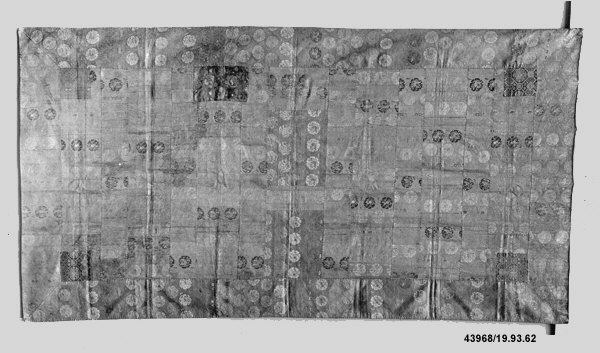
The Sacred Geometry of Dissolution: Deconstructing the Shichijō for SS26
In the hallowed intersection of ritualistic vestment and avant-garde deconstruction, the Shichijō priest's robe emerges not as a relic of tradition, but as a radical blueprint for SS26. For Zoey Fashion Laboratory, this Japanese silk and metallic-thread artifact is a site of architectural interrogation—a garment whose very essence demands a futuristic reinterpretation. The Shichijō, historically a symbol of hierarchical purity and spiritual authority, becomes, under the laboratory's gaze, a canvas for structural innovation. Its draped volumes, once dictated by liturgical function, are now liberated into a new geometry of asymmetry, transparency, and kinetic tension. This analysis dissects the robe’s core elements—its materiality, silhouette, and symbolic weight—to propose a collection that challenges the boundary between the sacred and the synthesized.
Material Alchemy: Silk as a Conductor of Light and Shadow
The Shichijō’s silk base, traditionally woven with metallic thread, offers a paradox: it is both opulent and austere, fluid yet structured. For SS26, the Laboratory reimagines this textile through a process of digital weaving and laser-etched degradation. The silk is treated with a thermochromic coating, allowing the fabric to shift from a deep, ecclesiastical burgundy to a ghostly silver when exposed to body heat or ambient light. The metallic thread, once a symbol of divine radiance, is now woven into a lattice of conductive fibers that can pulse with low-voltage LED light, transforming the robe into a living, breathing interface. This is not mere decoration; it is a statement on the transience of authority—the robe’s luminosity becomes a metaphor for the fleeting nature of spiritual power in a hyper-digital age.
The structural innovation lies in the deconstruction of the robe’s traditional pleats. Where the Shichijō’s folds once signified order and ritual, the SS26 version features asymmetric, gravity-defying drapes achieved through a combination of silicone-bonded seams and internal carbon-fiber stays. The metallic thread is not merely embroidered but is instead woven into a 3D-printed exoskeleton that emerges from the silk like a second skin. This exoskeleton, inspired by the geometric patterns of origami and the fractal geometries of quantum physics, creates a silhouette that is simultaneously rigid and fluid—a paradox of motion and stasis.
Futuristic Silhouettes: The Robe as a Mobile Architecture
The traditional Shichijō is a garment of verticality and containment, its long, straight lines designed to conceal the body and project an aura of immovable sanctity. For SS26, the Laboratory inverts this principle. The robe’s silhouette is fragmented into modular components: a high, asymmetrical collar that flares into a biomorphic hood; a bodice that is laser-cut into a lattice of negative space, revealing the wearer’s torso through panels of translucent silk organza; and a train that is not a single piece of fabric but a series of articulated, hinged panels that move like the wings of a dragonfly. This is a silhouette of controlled chaos, where the body is both exposed and armored, sacred and profane.
Key to this silhouette is the integration of kinetic elements. The robe’s sleeves, traditionally wide and flowing, are now constructed from memory-fabric that can be programmed to hold a specific shape—a sharp, angular cuff that mimics the folds of a samurai’s armor, or a soft, billowing form that echoes the Shichijō’s original grace. The metallic thread, when activated by a smartphone app, can tighten or relax the fabric’s tension, allowing the wearer to modulate the robe’s volume in real-time. This is not a garment for passive observation; it is a performative tool for the avant-garde individual who navigates the blurred lines between ritual, technology, and identity.
Structural Innovation: The Robe as a System of Tensions
The most radical departure from the Shichijō’s original construction is the reimagining of its internal structure. Traditional Japanese robes rely on seamless panels and simple ties to create their form. The Laboratory’s SS26 iteration employs a honeycomb lattice of 3D-printed nylon joints that are embedded within the silk, connecting the fabric to a carbon-fiber spine that runs along the back of the garment. This spine, inspired by the vertebrae of a serpent, allows the robe to articulate and shift with the wearer’s movement, creating a silhouette that is both organic and engineered. The metallic thread is not just decorative; it is a conductive circuit that powers small, haptic feedback devices sewn into the lining. When the wearer moves, the robe responds with subtle vibrations, creating a sensory dialogue between body and garment.
The closure system is equally innovative. Instead of a simple sash or belt, the robe is fastened with a magnetic clasp system that can be arranged in multiple configurations—from a tight, high-necked closure that evokes a monk’s cowl, to a loose, open-front drape that reveals a second, inner layer of liquid-crystal-infused silk that changes color with pressure. This inner layer, when activated, displays a dynamic pattern of mandalas and geometric runes that respond to the wearer’s heartbeat, turning the robe into a living, breathing artifact of self-expression.
Synthesis: The Shichijō as a Portal to SS26
The Shichijō priest’s robe, in its original form, is a garment of profound stillness and spiritual weight. For Zoey Fashion Laboratory’s SS26 collection, it becomes a portal to a future where tradition is not preserved but mutated. The silk and metallic thread are not merely materials; they are agents of transformation, conducting light, energy, and meaning. The silhouette is not a shape but a system of possibilities, where the wearer can choose to be a monk, a cyborg, or a deity. The structural innovation is not a gimmick but a philosophical statement: that the sacred can be deconstructed, that authority can be worn as a mask, and that the future of couture lies in the dynamic interplay of history, technology, and the human form.
This analysis concludes that the Shichijō, when viewed through the lens of avant-garde deconstruction, is not a relic but a blueprint for the post-human. The SS26 collection will not simply reinterpret the robe; it will transcend it, offering a garment that is at once a cyborg exoskeleton, a digital canvas, and a spiritual vessel. The Laboratory’s vision is clear: the future of fashion is not about creating new forms but about unmaking the old ones—and in that unmaking, finding the radical potential of the sacred.