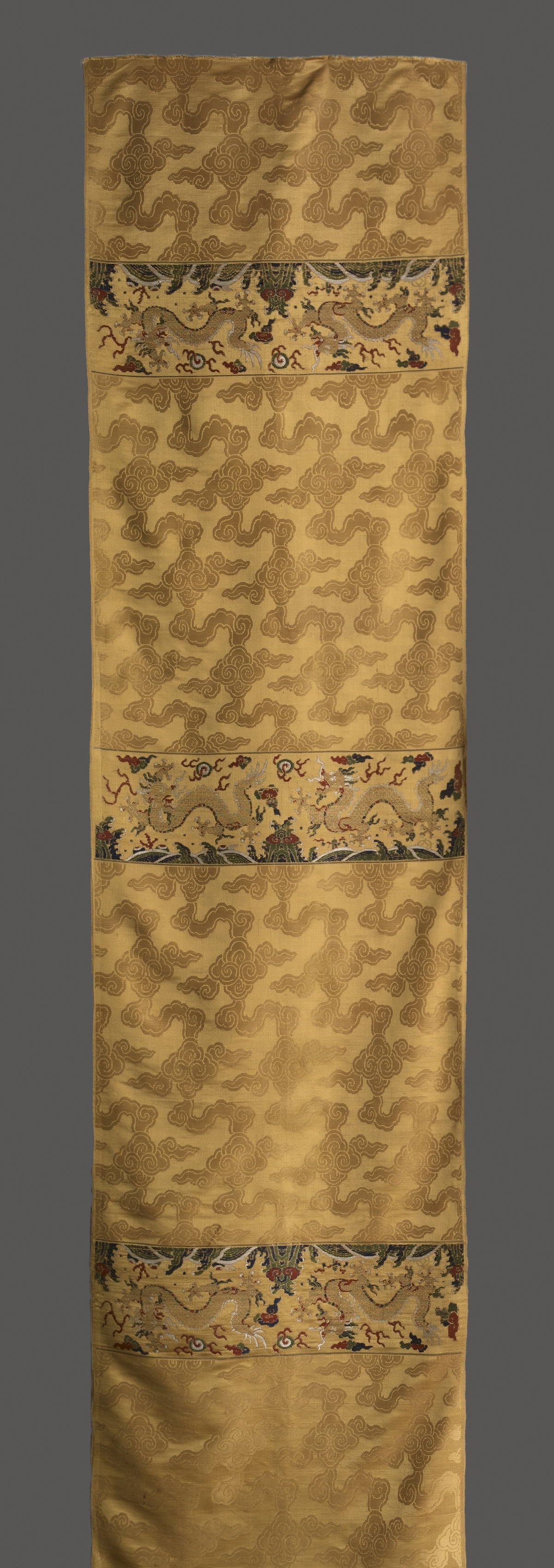
Deconstructing the Imperial Dragon: An Avant-Garde Analysis of a Qing Dynasty Silk Panel
At Zoey Fashion Lab, the act of deconstruction is not merely an exercise in material analysis; it is a dialogue between history and the future. Our latest subject, a silk panel from the Qing dynasty (1644-1911), originating from the Jiangnan Imperial Factory, presents a paradox of technical perfection and rigid symbolism. Woven with silk and metal thread in a precise Jacquard weave, this artifact is a monument to imperial authority. Yet, for the avant-garde, it is a new DNA strand—a genetic code waiting to be re-sequenced, fragmented, and re-expressed. This analysis will dissect the panel’s technical, symbolic, and structural DNA to propose a radical reinterpretation for the contemporary runway.
Technical DNA: The Jacquard Weave as a Proto-Programmable System
The panel’s construction via Jacquard weave is its most revolutionary technical feature. Invented by Joseph Marie Jacquard in 1804, this loom used punched cards to control individual warp threads, allowing for the mechanized reproduction of complex patterns. The Qing dynasty’s Jiangnan factories adopted this technology to weave imperial motifs with unprecedented precision. For Zoey Fashion Lab, the Jacquard weave is not just a historical technique; it is a proto-programmable system. Each thread is a data point, each pattern a line of code. The dragon and cloud motifs are not merely decorative; they are the output of a binary logic—thread up or thread down, pattern present or pattern absent.
In an avant-garde context, this technical DNA invites a radical act: de-programming. We propose to reverse-engineer the panel’s weave, treating the original pattern as a source code. By extracting the Jacquard card logic, we can generate new, chaotic iterations. Imagine a garment where the dragon’s scales are algorithmically randomized, or where the clouds dissolve into pixelated noise. The metal thread, once a symbol of imperial wealth, becomes a conductive element in a digital-physical hybrid. A dress might feature a bodice woven with the original dragon pattern, while the skirt is a glitched, distorted version—a visual representation of data corruption. This is not destruction; it is creative reprogramming, honoring the technical genius of the Jacquard loom while pushing it into the realm of generative design.
Symbolic DNA: The Dragon and Cloud as Avant-Garde Archetypes
The dragon and cloud motifs are deeply encoded with Qing dynasty ideology. The five-clawed dragon (long) represents the emperor’s supreme power, while the clouds (yun) signify celestial favor and the emperor’s role as the Son of Heaven. Together, they form a static hierarchy: the dragon dominates, the clouds support. For the avant-garde, this symbolic structure is a constraint to be subverted. The dragon is not a ruler; it is a liminal creature—a hybrid of snake, bird, and mammal that defies biological categories. The cloud is not a passive backdrop; it is a transient form—constantly shifting, unpredictable.
Our deconstruction focuses on disrupting the hierarchy. We propose a garment where the dragon is fragmented: its head appears on one sleeve, its claws on another, its body trailing down the back like a digital scar. The clouds are not woven as solid forms but as negative space—cutouts, laser-burned holes, or sheer overlays that reveal the wearer’s skin. This creates a visual tension: the imperial symbol is present but broken, its authority questioned. In an avant-garde collection, this panel could be reimagined as a deconstructed cheongsam, where the dragon motif is split across asymmetrical panels, or as a structured coat where the clouds are rendered in translucent organza, floating above the body like ghostly data streams. The metal thread, traditionally used for the dragon’s scales, is repurposed as raw, exposed stitching—a deliberate flaw in the perfect weave.
Structural DNA: The Panel as a Modular System
The original panel is a rectangular, self-contained unit—a complete composition intended for a robe or hanging. Its structure is closed, finite, and hierarchical. For the avant-garde, this structural DNA is a challenge to modularize. We view the panel not as a finished garment but as a kit of parts. Each element—the dragon’s head, the cloud swirls, the border motifs—can be extracted, scaled, and recombined. This approach aligns with the concept of the new DNA strand: the panel’s components are genes that can be spliced, edited, and expressed in novel forms.
Consider a modular jacket where the dragon’s head is a detachable collar, the cloud motifs are interchangeable patches, and the border pattern becomes a zipper tape. The wearer becomes a genetic engineer, rearranging the imperial code to suit their identity. Alternatively, the panel can be deconstructed into a series of wearable fragments: a single dragon claw as a shoulder armor piece, a cloud swirl as a handbag clasp, or a section of the weave as a choker. This modularity challenges the notion of the garment as a static object. It becomes a dynamic system, capable of evolution. The metal thread, when isolated, can be woven into a conductive mesh for embedded LEDs, allowing the dragon to “breathe” light—a living, programmable symbol.
From Artifact to Avant-Garde: A Proposed Collection
To translate this analysis into a tangible design, Zoey Fashion Lab proposes a capsule collection titled “Code of the Dragon.” The collection will feature three key pieces, each deconstructing a different aspect of the panel’s DNA:
1. The Reprogrammed Robe: A floor-length coat made from a digital print of the original panel, overlaid with laser-cut metal thread appliqués. The dragon is fragmented into a series of glitched, pixelated forms, while the clouds are rendered as negative-space cutouts. The garment is asymmetrical, with one sleeve fully woven and the other reduced to a network of exposed threads. This piece is a direct deconstruction of the imperial robe, transforming it into a commentary on data decay and power erosion.
2. The Modular Armor: A set of detachable panels—a dragon head collar, cloud swirl shoulder pads, and a border pattern belt—that can be attached to a base garment (a simple silk sheath dress) via magnetic clasps. The wearer can reconfigure the armor daily, creating new symbolic arrangements. The metal thread is used for the clasps, making each attachment point visible and functional. This piece emphasizes the wearer’s agency in rewriting the imperial code.
3. The Ghost Weave: A transparent organza dress with the dragon and cloud motifs woven in metallic thread only on the inner layer, creating a holographic effect. The outer layer is a deconstructed version of the original panel, with threads pulled and frayed to form a chaotic, cloud-like aura. This piece explores the tension between the hidden, original code (the inner weave) and its distorted, public expression (the outer fraying). It is a meditation on the ephemeral nature of power and the beauty of imperfection.
Conclusion: The Avant-Garde as a Genetic Laboratory
The Qing dynasty silk panel is not a relic to be preserved in a museum; it is a living genetic code that can be re-expressed in the avant-garde. By deconstructing its technical, symbolic, and structural DNA, Zoey Fashion Lab transforms an artifact of imperial authority into a tool for creative rebellion. The Jacquard weave becomes a programming language, the dragon becomes a liminal hybrid, and the panel becomes a modular system. In this process, we honor the craftsmanship of the Jiangnan Imperial Factory while dismantling its ideological constraints. The result is fashion that is not just wearable but readable—a text of deconstructed power, waiting to be rewritten by the wearer. This is the new DNA strand: a thread that connects the past to the future, the imperial to the individual, the weave to the unweaving.