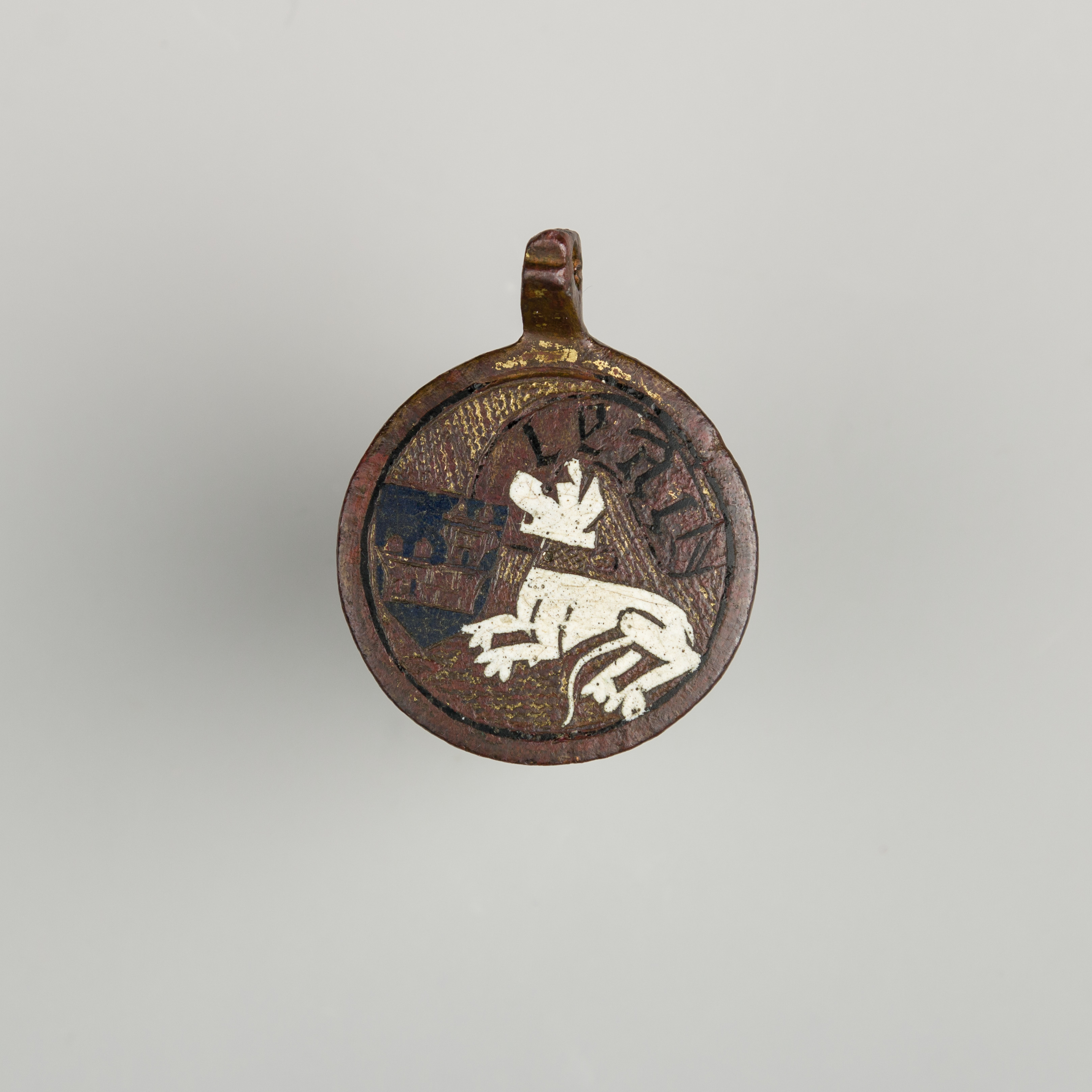
The Pendant as Proto-Cyborg: Deconstructing the Spanish Horse Trapping for SS26
The avant-garde imperative is not to replicate history, but to cannibalize its structural DNA and re-engineer it for a future that has not yet arrived. In Zoey Fashion Laboratory’s SS26 lens, the Spanish pendant for horse trappings—a copper alloy, enamel, and gold artifact from the 16th century—transcends its equestrian origins. It becomes a portable architecture, a fragment of a cyborgian exoskeleton that redefines the relationship between the human form, the animal, and the machine. This analysis dissects the pendant’s latent potential for deconstructive silhouettes and material innovation, proposing a collection where every accessory is a structural node in a biomechanical network.
Deconstructing the Artifact: From Equestrian Ornament to Wearable Interface
Historically, the pendant served as a marker of power and mobility, adorning the horse—a creature of speed, conquest, and labor. For SS26, we strip away the sentimental nostalgia and focus on its technical grammar: the interplay of copper alloy’s tensile strength, enamel’s chromatic rigidity, and gold’s malleable luminosity. The pendant is not a charm; it is a load-bearing component. Its original function—to be suspended, to swing with motion—suggests a kinetic potential that we exploit. The copper alloy base provides a structural chassis, the enamel offers a skin of color that resists time, and the gold acts as conductive trace, hinting at energy transfer. This triad becomes the foundation for a new modular system of garment architecture.
We propose a deconstructive silhouette where the pendant is multiplied and scaled. Imagine a jacket where the left sleeve is a lattice of copper alloy rings, each enameled in a gradient of oxidized greens and gold-leaf points, mimicking the original artifact’s patina. The right sleeve is absent, replaced by a floating harness that suspends a single, oversized pendant from the shoulder to the hip. This asymmetry is not arbitrary; it is a dialogue between the horse’s harness and the human skeleton, suggesting a hybrid form—a post-human rider who carries the memory of the animal without the animal itself. The garment becomes a structural exoskeleton, where the pendant is no longer an ornament but a counterweight that alters the wearer’s balance and posture.
Futuristic Silhouettes: The Pendant as Prosthetic Node
In SS26, the silhouette moves beyond the body’s natural contours into geometric abstraction. The pendant’s original form—often a symmetrical, shield-like shape—is fractured and reassembled into a parametric grid. We envision a dress constructed from dozens of small, enameled copper alloy plates, connected by gold hinges. Each plate is a pendant fragment, and the entire garment functions as a flexible armor. The silhouette is cellular: it expands and contracts with movement, creating a living surface that references both the horse’s caparison and a futuristic exosuit. The enamel colors—deep azure, vermilion, and emerald—are not decorative; they are chromatic signals, mapping the garment’s structural stress points.
Another silhouette explores negative space. A top is formed from a single, oversized pendant that wraps around the torso, leaving the back and shoulders exposed. The pendant’s gold edges are sharp, almost surgical, while the copper alloy core is hammered to a matte finish. This is a minimalist cyborg aesthetic: the pendant becomes a surgical implant that redefines the wearer’s silhouette from the inside out. The enamel is applied in a lacunar pattern, creating voids that reveal the skin beneath. This interplay of opacity and transparency challenges the traditional notion of coverage, proposing a future where clothing is selective structural intervention rather than full enclosure.
Material Innovation: The Alchemy of Copper, Enamel, and Gold
The material triad of copper alloy, enamel, and gold is not merely a historical curiosity; it is a blueprint for sustainable futurism. Copper alloy offers high recyclability and a natural patina that evolves with time—a living surface that records the wearer’s history. For SS26, we treat the copper as a base for bio-mimetic textures, etching it with patterns inspired by horse sinew and muscle fiber. The enamel is reimagined as a photoluminescent coating, absorbing light during the day and emitting a soft glow at night, transforming the garment into a wearable beacon. Gold, traditionally a symbol of wealth, is reduced to micro-thin circuitry, tracing the pendant’s original filigree into functional pathways that could, in future iterations, power sensors or haptic feedback systems.
The structural innovation lies in the joining techniques. Instead of traditional sewing, we propose cold connections: rivets, hinges, and magnetic clasps that allow the pendant components to be detached and reconfigured. This modularity aligns with the avant-garde ethos of garment as system, not static object. A skirt, for instance, could be assembled from pendant modules that clip onto a copper alloy waistband, allowing the wearer to adjust its length and density. The gold elements serve as conductive bridges, creating a network that unifies the disparate parts into a cohesive, kinetic whole. This is not fashion as decoration; it is fashion as engineering.
Conclusion: The Pendant as Proto-Future Artifact
In the context of Zoey Fashion Laboratory’s avant-garde practice, the Spanish horse-trapping pendant is a catalyst for radical reimagination. It is not a relic to be preserved but a tool for deconstruction. By extracting its structural logic—the interplay of metal, color, and suspension—we propose a future where garments are cyborgian interfaces, where every pendant is a node in a larger biomechanical system. The SS26 collection does not look backward; it looks through the artifact to a horizon where the human, the animal, and the machine converge. The pendant becomes a prototype for a new species of wearable architecture, one that honors the past only by violently transforming it into a blueprint for what comes next.