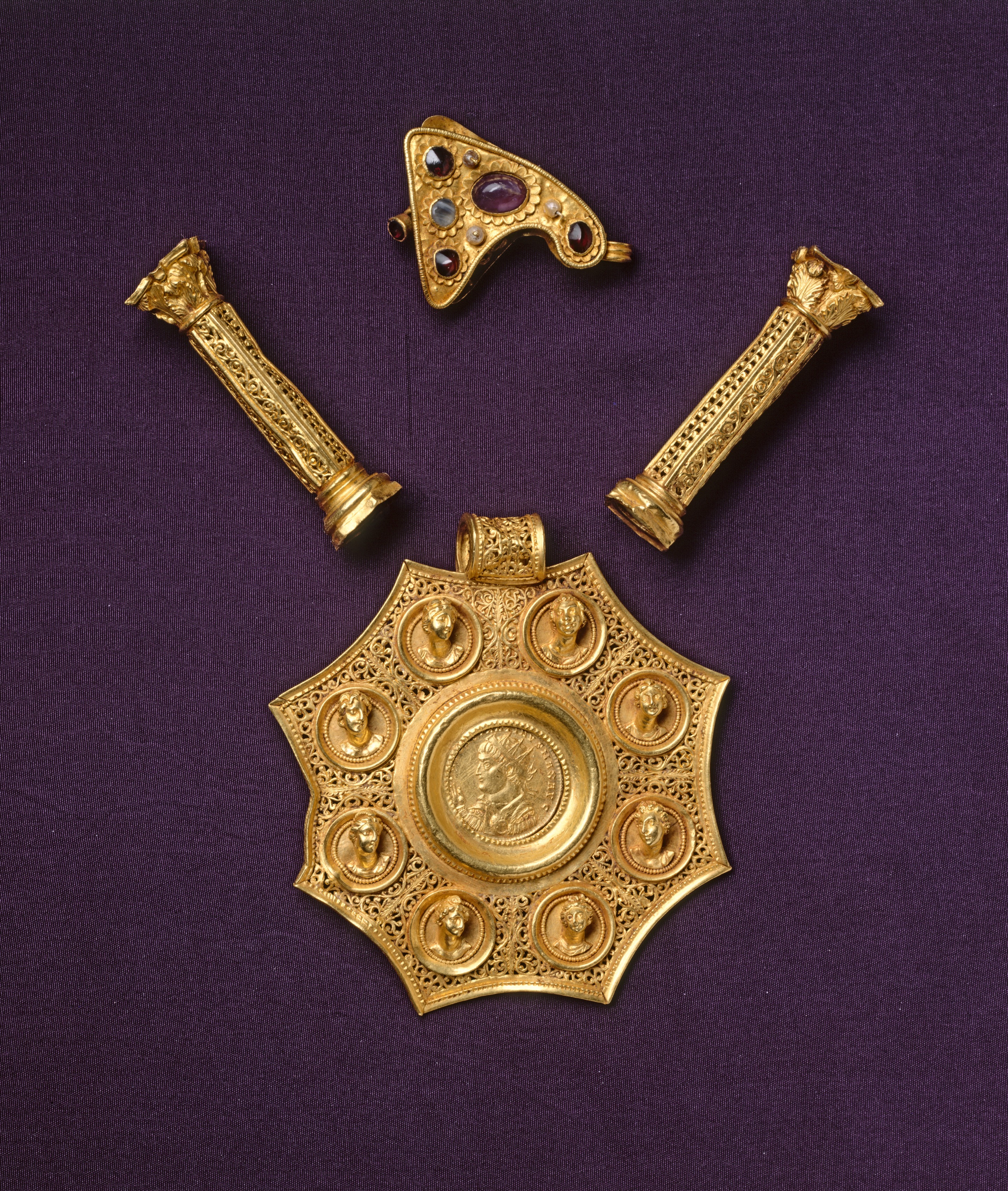
Deconstruction of an Avant-Garde Relic: The Octagonal Pendant with Corinthian Column Spacers
At Zoey Fashion Lab, we do not simply study artifacts; we dissect their temporal DNA. The object in question—a gold octagonal pendant from the Byzantine period, originating in the Eastern Mediterranean—presents a unique challenge to our deconstructionist methodology. This is not a piece of jewelry; it is a portable architectural manifesto. The pendant’s reference to a mirror with split-leaf motifs, combined with the cold narrative of a sarcophagus, creates a dialectic that is profoundly avant-garde. We are tasked with analyzing how this Late Roman relic can be re-contextualized within a modern, experimental fashion framework.
I. The Octagonal Frame: A Geometry of Liminality
The pendant’s octagonal shape is its first radical statement. In the Byzantine era, the octagon was a symbol of resurrection and transition—a bridge between the earthly square and the celestial circle. For Zoey Fashion Lab, this geometry is a structure of deconstruction itself. The eight sides reject the comfort of the circle and the rigidity of the square. They create a liminal space, a pause between viewing angles. In an avant-garde garment, this shape demands asymmetry. Imagine a neckline or a shoulder pad that is not curved but faceted, forcing the eye to travel in sharp, interrupted lines. The pendant’s form suggests a deconstructed collar—a piece that does not frame the face but fragments it, creating multiple perspectives from a single glance.
The gold construction further complicates this. Gold is heavy, permanent, and sacred. Yet, the octagon breaks its monolithic quality. The pendant becomes a geometric prison for light, each facet capturing and distorting the ambient environment. For our lab, this translates into a material philosophy: using rigid, high-shine metals (gold, brass, or polished steel) in angular, segmented forms that refuse to drape. The pendant is not worn; it is worn against the body, a piece of architecture that stands in tension with the organic form.
II. Corinthian Column Spacers: The Body as a Ruined Temple
The inclusion of Corinthian column spacers is the most potent avant-garde element. The Corinthian order, with its acanthus leaves and volutes, is the most ornate of classical architecture. Here, it is miniaturized and repurposed as a mechanical connector. This is not decoration; it is structural subversion. The columns do not support a pediment; they separate the clasp from the pendant body. They create a void, a negative space that is as important as the gold itself. This is the essence of deconstruction: the space between elements carries the meaning.
In a contemporary context, these spacers become exoskeletal joints. They suggest a garment that is not sewn but assembled, held together by visible, architectural connectors. Think of a harness or a cage that references classical ruins—a shoulder piece that uses miniature column capitals as hinges. The acanthus leaf, a symbol of eternal life in Byzantine art, is here rendered as a frozen, metallic sprout. It is life arrested in gold, a botanical specimen preserved in a state of perpetual bloom. This creates a tension between growth and petrification, a key theme in avant-garde fashion where organic forms are often cast in industrial materials.
III. The Clasp Set: The Mechanism of Narrative
The clasp is not merely functional; it is the fulcrum of the pendant’s narrative. In the Archive Resonance reference, we are told of a mirror with split-leaf motifs on one side and a sarcophagus narrative on the other. The clasp, therefore, is the hinge between these two realities. It is the point of rotation. One moment, the wearer presents the polished, reflective surface of the mirror—a surface of vanity, of the present, of the self. The next, the pendant flips to reveal the carved stone of the sarcophagus—a surface of memory, of the past, of death.
For Zoey Fashion Lab, this clasp becomes a mechanism of transformation. It is a wearable device that allows the garment to change its identity. This is the ultimate avant-garde statement: fashion as a performative, mutable object. Imagine a jacket that can be reversed to show two completely different textures, or a skirt that can be unzipped and reconfigured. The clasp is the technological heart of this concept. It is not hidden; it is celebrated. The mechanism becomes the ornament. The act of flipping, of revealing, is the performance.
IV. The Mirror and the Sarcophagus: A Dialectic of Surfaces
The core of this pendant’s power lies in the juxtaposition of the mirror and the sarcophagus. The mirror is a surface of the present—it reflects the viewer, the light, the moment. It is pure, unadorned immediacy. The sarcophagus, conversely, is a surface of the past—it is carved, narrated, and burdened with history. It is texture and time. The pendant forces these two surfaces into a single object, connected by the Corinthian spacers. This is a philosophical collision.
In an avant-garde context, this translates into a fabric dialectic. One side of a garment could be a polished, reflective surface—liquid metal, patent leather, or a high-gloss synthetic. The other side could be a heavily textured, matte surface—embossed leather, distressed wool, or a sculptural jacquard. The wearer becomes the curator of which surface is shown. The garment is no longer a fixed identity; it is a dialogue between the ephemeral and the eternal. The split-leaf motif from the mirror reference suggests a natural form that is also fractured, a leaf that is both whole and divided. This is the language of deconstruction: nothing is complete; everything is in a state of being taken apart and reassembled.
V. Material and Technique: Gold as a Deconstructive Agent
The choice of gold is deliberate. Gold is the most malleable and ductile of metals, yet it is also the most permanent. It does not tarnish, rust, or decay. In Byzantine art, gold was used to represent the divine light, the uncreated energy of God. For Zoey Fashion Lab, gold is a material of distortion. It reflects the world but is not of it. The pendant’s gold surface is a lie of perfection. It is too bright, too smooth, too eternal. This creates a profound unease. The wearer is adorned with a material that denies the passage of time, yet the object itself is a relic of a dead empire.
The technical execution—the granulation, the filigree, the setting of the spacers—must be flawless to the point of absurdity. In an avant-garde garment, this translates to a fetishization of craft. The seams must be perfect, the zippers must be surgical, the construction must be obsessively detailed. This is not about comfort or practicality; it is about the tyranny of the object. The garment wears the person. The pendant, with its intricate columns and precise geometry, demands that the body conform to its logic.
VI. Conclusion: The Pendant as a Wearable Ruin
The Octagonal Pendant with Corinthian Column Spacers is not a historical artifact; it is a blueprint for a new kind of adornment. It teaches us that the most powerful fashion is not that which decorates the body, but that which architectures the body. It forces the wearer into a relationship with history, with geometry, and with the act of seeing. The mirror and the sarcophagus are not opposites; they are the same object viewed from different angles. The pendant is a machine for generating meaning, a device that turns the body into a site of archaeological excavation.
For Zoey Fashion Lab, this piece is a directive. We must create garments that are reversible, fragmentary, and structurally explicit. We must use materials that deny decay and celebrate craft. We must design clasps that are not closures but portals. The Byzantine pendant, in its cold gold and precise geometry, is not a relic of the past. It is a prophecy of the future of fashion—a future where every garment is a wearable ruin, a fragment of a lost civilization that we carry on our bodies. The avant-garde is not about the new; it is about the re-contextualization of the ancient. And in this pendant, we have found our perfect artifact.