Technical Deconstruction: The Buyid Silk Fragment
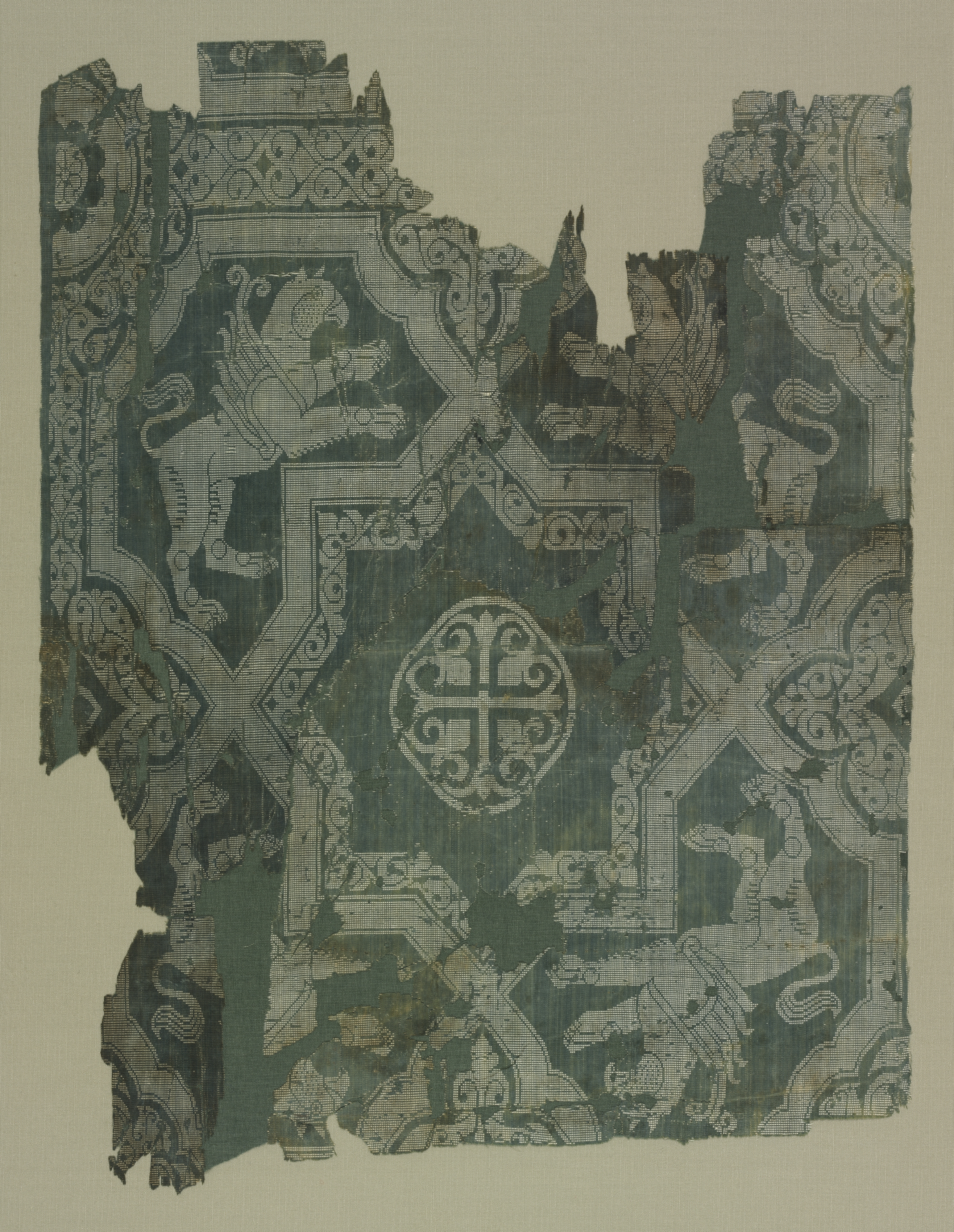
The provided textile fragment is a masterclass in early medieval Islamic luxury textile production. Originating from the Buyid period (934-1062 CE) in the region of modern-day Iraq or Iran, it represents a pinnacle of technical sophistication that directly informs our avant-garde ethos at Zoey Fashion Lab. The foundation is a plain weave variation in silk, a canvas chosen for its strength, sheen, and capacity to carry vibrant dye. The critical innovation, however, lies in the supplementary weft technique. This is not a tapestry weave or an embroidery applied after the fact. Instead, additional silk threads—likely of a different color or even material type (metallic-wrapped thread is a strong possibility given the period and motif)—are woven into the ground fabric during the loom process. These supplementary threads "float" across the back of the textile, brought to the surface only where the pattern demands, creating a dense, raised design against the simpler ground. This method allows for complex, curvilinear patterning with a pronounced textural dichotomy, a fundamental principle we exploit in our own constructions.
Narrative Decoding: Griffins and Cosmic Order
The iconography is not merely decorative; it is a dense visual language. The star pattern forms the cosmological framework. In Buyid art, often influenced by pre-Islamic Persian (Sasanian) traditions, the star or rosette symbolized celestial order, the heavens, and eternal cycles. It provides a geometric, repeating structure—a universe in grid form. Into this ordered firmament are placed the griffins. As composite mythical creatures (lion's body, eagle's head and wings), griffins were ancient symbols of power, guardianship, and the unification of terrestrial and aerial dominion. In the Buyid context, they served as potent emblems of royal authority and protection, often adorning the garments and regalia of the elite. The fragment likely depicts them in a heraldic, confronted, or addorsed stance, contained within the stellar roundels. This creates a powerful narrative of mythical power operating within a cosmic framework—chaos (the potent beast) contained by and interacting with order (the starry sky).
Avant-Garde Translation: The Zoey Fashion Lab Methodology
The directive "Reference: New DNA Strand" is our core interpretive lens. We do not replicate; we extract the genetic code—the core principles—and splice them with contemporary technology and philosophy to create a new organism. The Buyid fragment provides a formidable DNA sequence: Structural Dichotomy, Mythic Symbolism, and Woven Narrative.
Deconstruction & Material Innovation
First, we deconstruct the technique. The "plain weave with supplementary weft" translates into a philosophy of layered dimensionality. At Zoey Lab, we would interpret this not through historical loom replication, but through fusion. Imagine a base layer of laser-cut, biodegradable polymer mesh (our "plain weave") serving as a modern, ethical ground. The "supplementary weft" becomes a series of 3D-printed bioplastic filaments, or straps of upcycled leather, mechanically or hand-stitched onto the ground in floating, griffin-inspired patterns. This creates a dramatic relief, casting shadows and interacting with light in a way that honors the textural intent of the original but with radically altered materials and environmental consciousness. The "star pattern" might be expressed through precise perforations in the base layer or through electro-luminescent wiring integrated into the seams, creating a literal, wearable cosmos.
Motif Re-contextualization
The griffin motif is liberated from its heraldic containment. We fragment it, dissect it, and disperse its genetic components. The eagle's wing might manifest as an asymmetrical, articulated sleeve structure using feather-like scales of recycled aluminum or molded felt. The lion's torso could inspire a corseted or draped form that emphasizes power and posture. We are not printing a griffin on a dress; we are building the garment's architecture from the griffin's anatomical and symbolic principles. The star field ceases to be a mere background and becomes a mapping system for the body. Pressure sensors or flexible LED arrays could be placed at the points of a star chart, creating an interactive garment that responds to touch or environment, making the celestial personal and dynamic.
The "New DNA Strand": A Synthesis for the Contemporary Wardrobe
The final avant-garde creation born from this analysis is a statement on modern power and identity. It is a garment, perhaps a structured coat or a sculptural top-and-trouser set, that embodies guardianship and cosmic connection for the 21st century. The wearer becomes the griffin—a guardian of personal truth, ecological responsibility, or cultural legacy. The integrated "stellar" technology speaks to our place in a digital and astrophysical universe.
The silhouette is severe yet fluid, combining sharp, architectural lines (the order of the stars) with organic, textured eruptions (the spirit of the griffin). The color palette moves beyond historic dyes into ethereal, iridescent finishes and matte, earthen tones, reflecting the duality of earth and sky. This is not costume; it is conceptual armor. It carries the weight of a millennia-old tradition of weaving meaning into cloth but expresses it through the lexicon of sustainable innovation, digital integration, and deconstructed form. For Zoey Fashion Lab, this Buyid fragment is not a relic but a living blueprint. It proves that the most forward-thinking fashion is often a profound conversation with the past, where threads of ancient DNA are rewoven into the startling and beautiful fabric of the new.