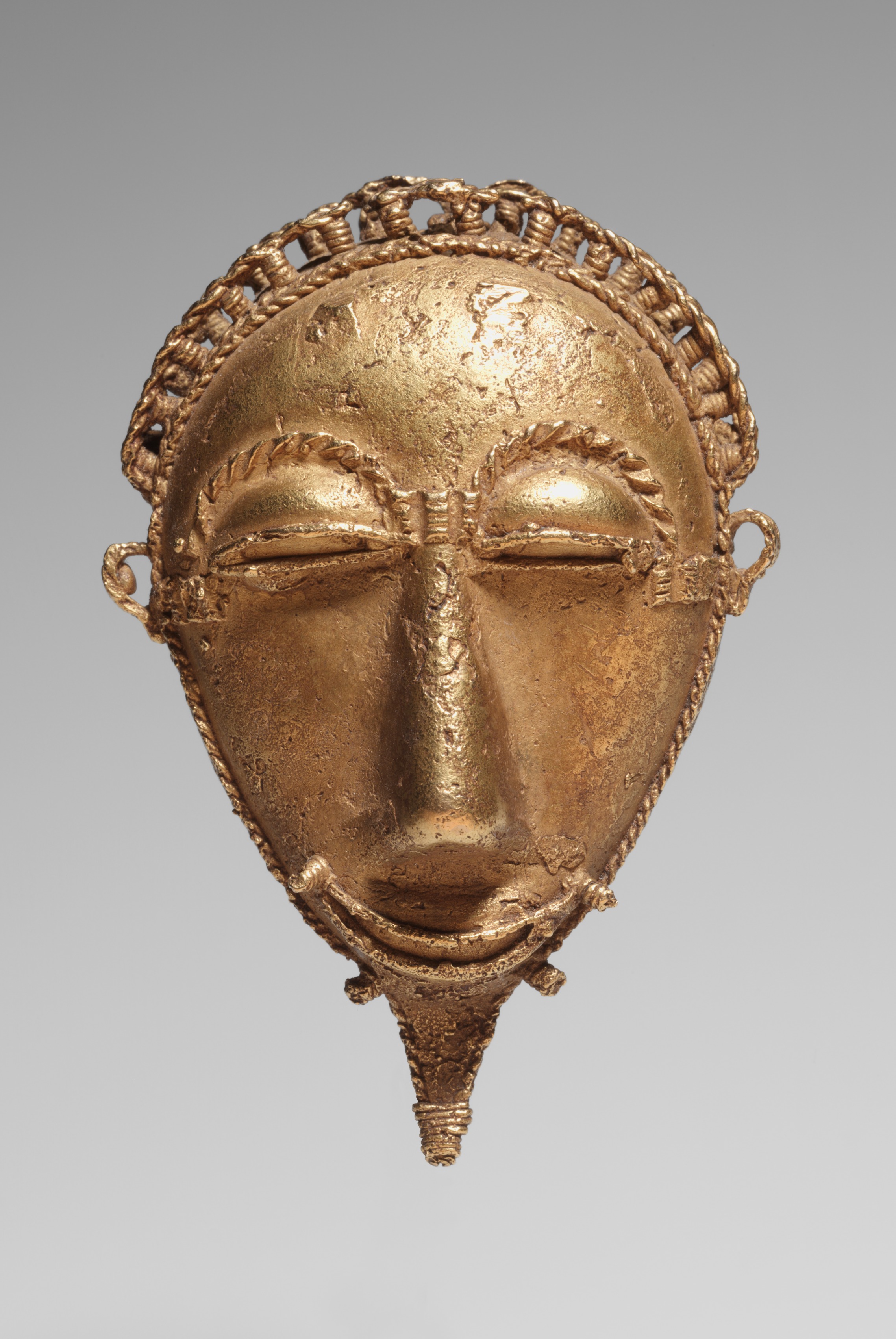
Deconstructing the Face Pendant: An Avant-Garde Analysis of Baule Gold and the Mirror with Split-Leaf Narrative
At Zoey Fashion Lab, the act of deconstruction transcends mere material analysis; it is an excavation of cultural memory, a dialogue between the object’s origin and its potential for radical recontextualization. The subject of this analysis—a West African, possibly Baule-style gold pendant depicting a face—presents a profound challenge to the avant-garde designer. This piece, sourced from Côte d'Ivoire, is not simply an ornament. It is a condensed archive of spiritual authority, social hierarchy, and metallurgical mastery. To deconstruct it for the avant-garde is to strip it of its ethnographic gaze and re-clothe it in a language of abstract power, temporal distortion, and subversive luxury. The pendant’s resonance is further intensified when read through the lens of the provided reference: “一面是光洁银镜上以黄金镶嵌的纷繁棕叶纹,另一面是冰冷石棺板上以浮雕诉说的生命叙事——《Mirror with Split-Lea...” This duality—of reflective surface versus narrative depth, of polished preciousness versus cold, carved eternity—provides the conceptual scaffolding for our deconstruction.
The Technical and Symbolic Matrix of Baule Gold
The technical execution of this pendant is inseparable from its spiritual function. In Baule culture, gold was not merely a currency of wealth but a medium for communicating with the spirit world. The face, often rendered with a serene, downcast gaze and an elongated, refined silhouette, is a classic motif representing a spirit spouse (blolo bian or blolo bla) or a respected ancestor. The goldsmith’s technique—likely lost-wax casting—allows for a surface that is both fluid and sharply defined. The metal’s warm, dense luster is a direct contrast to the “cold” stone of the reference. In our avant-garde re-reading, this gold is not a symbol of static wealth but of fluid, molten memory. The face’s calm expression, a hallmark of Baule aesthetics, becomes a mask of imperturbable power. The deconstructionist eye sees not a portrait, but a prototype of the post-human—a face that has been abstracted into a signifier of pure presence, stripped of individual emotion. The technical precision of the casting, with its intricate detailing of coiffure and scarification marks, becomes a code to be broken and re-sequenced into a new, avant-garde syntax.
The Mirror and the Stone: The Pendant as a Dialectical Object
The reference to the Mirror with Split-Leaf introduces a crucial dialectic. One side is a “polished silver mirror” adorned with “gold split-leaf patterns,” representing surface, reflection, and the ephemeral. The other side is a “cold stone coffin” where “life narratives” are told in relief, representing depth, mortality, and permanence. The Baule face pendant, when viewed through this lens, becomes a three-dimensional embodiment of this duality. The pendant’s front—the face itself—functions as the “mirror.” Its polished gold surface reflects not the viewer’s literal image, but the idealized, spiritual self that the Baule believe resides in the spirit world. It is a surface that refuses to give back a simple, narcissistic reflection. Instead, it projects an archetype. The back of the pendant, often less finished or carrying a loop for suspension, becomes the “stone coffin.” It is the hidden, structural support—the substrate of history upon which the narrative of the face is built. In avant-garde terms, the designer must work with this tension: the pendant is both a seductive, reflective surface (the gold face) and a weighty, narrative anchor (its cultural origin and function). The deconstructionist move is to invert this relationship, making the “coffin” visible and the “mirror” opaque.
Avant-Garde Deconstruction: Fragmentation, Scale, and Material Subversion
For Zoey Fashion Lab, the path forward is not to replicate the pendant but to atomize its logic. The first step is fragmentation. The serene, unified face must be broken. Consider a garment where the pendant’s face is not a single focal point but is dispersed across the body. One eye is cast in high-karat gold and set on a shoulder pauldron; the other eye is rendered in oxidized silver and hangs from a chain at the hip. The mouth is reduced to a single, abstracted line that runs along a collar. This fragmentation destroys the original spiritual unity but creates a new, cyborg-like cartography of the body. The face is no longer a portrait but a field of sensory inputs.
Second, consider scale manipulation. The pendant is typically worn at the throat or chest. In an avant-garde context, the face is blown up to monumental proportions—a 30-centimeter gold bust that sits as a rigid, architectural collar, forcing the wearer’s posture into a state of regal stillness. Alternatively, it is miniaturized to the point of near-invisibility, a tiny gold face embedded in a matrix of laser-cut leather, a secret to be discovered only upon close inspection. This play of scale mirrors the reference’s duality: the monumental “stone coffin” of history versus the intimate “mirror” of personal reflection.
Third, material subversion is essential. The Baule goldsmith’s mastery lies in the warmth and purity of the metal. The avant-garde designer must contaminate this purity. The gold face can be cast but then partially etched with acid, creating a pitted, lunar surface that recalls the “cold” stone of the reference. The smooth, polished “mirror” side is deliberately scarred. Alternatively, the gold can be paired with industrial materials: a high-gloss, black carbon fiber backing that mimics the “stone coffin” while being ultralight and futuristic. The “split-leaf” pattern from the reference can be reinterpreted not in gold but in blackened steel, creating a negative-space filigree around the gold face. The result is a piece that feels both ancient and alien, a relic from a future where Baule spirituality has merged with digital architecture.
Narrative and Temporality: The Pendant as a Time-Bending Device
The reference’s “life narrative” told in relief on the stone coffin suggests that the pendant is not a static object but a storytelling device. In Baule culture, the gold face narrates the presence of the spirit world. For the avant-garde, this narrative must be complicated. The pendant can be designed to reveal its story only through movement. Imagine a garment where the gold face is suspended on a delicate, almost invisible chain that runs through a series of magnetic locks. As the wearer moves, the face shifts, occasionally aligning with a hidden, engraved panel on the garment’s interior. This panel bears the “split-leaf” pattern, but in a fractured, non-linear arrangement—a visual code that must be deciphered. The pendant becomes a key to a locked narrative, a narrative that is never fully revealed but always hinted at. This aligns with the avant-garde’s rejection of easy legibility. The wearer is not an ornament but a custodian of a fragmented history.
Furthermore, the temporality of the pendant is disrupted. The Baule face is timeless, existing in a perpetual spiritual present. The avant-garde designer can introduce a sense of decay or becoming. The gold face could be cast with a thin, removable layer of patina that simulates aging, a “skin” that the wearer can choose to peel away to reveal the bright gold beneath. This act of ritualized de-sacralization and re-sacralization mirrors the reference’s tension between the ephemeral mirror and the eternal coffin. The pendant is no longer a finished object but a process—a negotiation between the ancient gold of Côte d'Ivoire and the cold, digital future of fashion.
Conclusion: The Face as a Threshold
In conclusion, the Baule-style gold face pendant, when subjected to an avant-garde deconstruction at Zoey Fashion Lab, ceases to be a cultural artifact and becomes a threshold object. It stands at the boundary between the reflective surface of the Mirror with Split-Leaf and the narrative depth of the stone coffin. The technical mastery of Baule goldsmithing is not erased but re-coded into a language of fragmentation, scale distortion, and material contamination. The serene face is broken into a constellation of cyborgian parts; its gold is scarred and paired with industrial carbon; its narrative is hidden within magnetic locks and shifting alignments. The final garment is not a tribute to tradition but a dialogue with it—a conversation that acknowledges the pendant’s origin as a spirit spouse while reimagining it as a tool for exploring the fractured, hyper-mediated self of the 21st century. This is the essence of Zoey Fashion Lab’s mission: to take the archive, resonate with its deepest frequencies, and then shatter it into a new, more complex harmony.