Deconstructing the Gorget: A Case Study in Avant-Garde Recontextualization
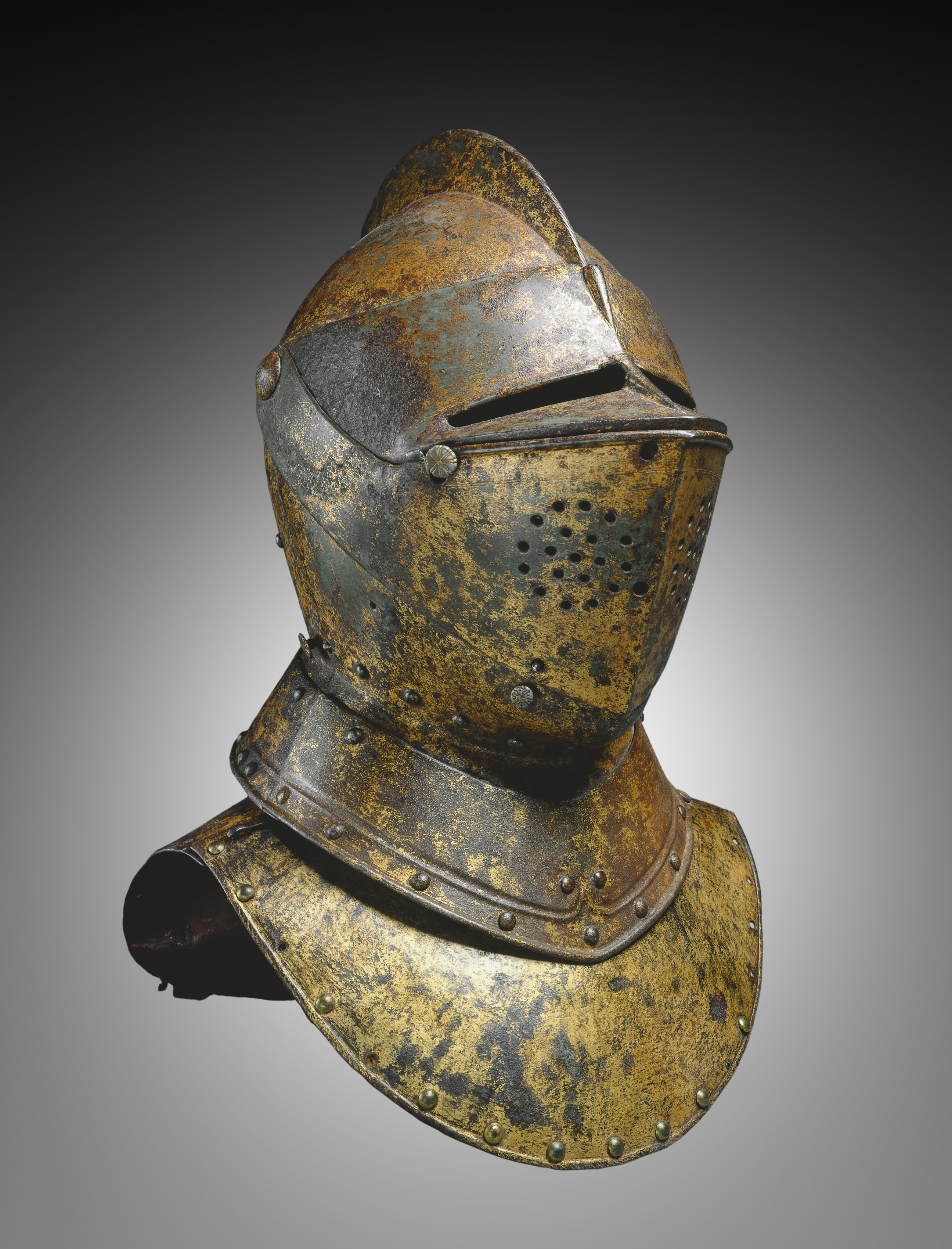
As the Chief Fabric Deconstructionist for Zoey Fashion Lab, I am tasked with dissecting historical artifacts not merely as relics, but as living, breathing source materials for avant-garde design. The subject of this analysis—a gilded steel gorget, likely from a funerary achievement, originating in the Netherlands circa late 16th to early 17th century—presents a singular opportunity. This object, invaded by rust yet retaining its gilded splendor, with its red velvet lining and plume holder, is more than a piece of armor. It is a new DNA strand for our creative lexicon, a fragment of history that demands to be deconstructed, reimagined, and ultimately, reborn.
Materiality and Decay: The Aesthetic of the Imperfect
The gorget’s primary material—gilded steel—immediately establishes a dialogue between opulence and mortality. In its original context, the gilding was a symbol of status, wealth, and martial prowess. The gold leaf or mercury gilding would have caught the torchlight in a great hall, signifying the wearer’s place in a rigid social hierarchy. However, the invasion of rust is the critical element for our avant-garde analysis. This corrosion is not a flaw; it is a narrative. It speaks to the passage of time, the decay of empires, and the fragility of human ambition. For Zoey Fashion Lab, we do not seek to restore this gorget to its pristine state. Instead, we embrace the patina of entropy. The rust creates a textural topography—a landscape of orange, brown, and black that contrasts violently with the remaining gold. This is the aesthetic of the imperfect, a cornerstone of avant-garde fashion that rejects sterile perfection in favor of raw, emotional truth. We will use this as a directive: future garments will incorporate deliberate oxidation, chemical washes, and laser-etched corrosion patterns to mimic this historical decay, turning a flaw into a focal point.
Structural Deconstruction: The Gorget as Architectural Volume
The gorget’s form—a curved, protective collar that shields the throat and upper chest—is fundamentally architectural. It is a rigid, sculptural element designed to deflect a blade. In the context of a funerary achievement, it is a symbolic armor, worn not for battle but for eternal display. Deconstructing this form for the avant-garde involves breaking its silhouette. We will not replicate the gorget; we will abstract it. Consider the following transformations:
- Fragmentation: The gorget’s rigid curve can be segmented into articulated panels, allowing for movement while retaining its protective silhouette. These panels, perhaps made from laser-cut stainless steel or carbon fiber, would be linked with oxidized chainmail, echoing the original’s military lineage.
- Inversion: The internal red velvet lining, originally soft and hidden, becomes the external statement. Imagine a garment where the velvet is the primary surface, but it is burned, singed, or distressed to mimic the rust’s invasion. The steel backing becomes a ghostly underlayer, visible only through strategic cutouts.
- Scale and Repetition: The gorget’s form can be miniaturized into a collar or exaggerated into a full chest piece. Multiple gorget-like forms, each in a different state of decay, could be layered to create a deconstructed carapace, a wearable ruin that challenges the viewer’s perception of armor as protection versus armor as burden.
The Red Velvet Lining: Tactile and Chromatic Dissonance
The presence of red velvet is a masterstroke of historical design. Velvet, a luxury fabric in the 16th century, symbolizes comfort, royalty, and the interior life. Against the cold, hard steel, it creates a profound tactile and chromatic dissonance. The red, likely a deep crimson or vermilion, is a color of blood, passion, and power. For Zoey Fashion Lab, this lining is a directive for material juxtaposition. We will pair high-tech, rigid materials (like 3D-printed polymers, recycled metals, or bio-resins) with sumptuous, organic textiles (such as crushed velvet, silk charmeuse, or hand-dyed wool). The contrast between the industrial and the sensual, the hard and the soft, is a hallmark of our avant-garde aesthetic. Furthermore, the velvet’s fraying and staining over centuries adds another layer of narrative. We will deliberately distress our fabrics—through chemical burns, sanding, or over-dyeing—to evoke this historical wear, creating a garment that feels both ancient and futuristic.
The Plume Holder: Symbolism and Transience
The plume holder, typically a small metal tube or socket, was designed to display a feather—a symbol of chivalry, rank, and the fleeting nature of life. In a funerary context, the plume would have been a final, dramatic gesture. For our analysis, the plume holder represents the potential for adornment and the transience of beauty. We will reinterpret this element not as a literal feather socket, but as a structural node for attachment. Imagine a garment where similar holders are placed along the shoulders, spine, or cuffs, allowing for the insertion of deconstructed elements—such as laser-cut leather strips, fiber optic filaments, or preserved dried flowers. These attachments, like the original plume, are temporary, meant to be swapped, removed, or allowed to decay. This introduces a performative and interactive dimension to the garment, aligning with avant-garde fashion’s interest in impermanence and ritual.
Avant-Garde Recontextualization: The Gorget as a New DNA Strand
The gorget is a new DNA strand for Zoey Fashion Lab because it encodes a complete aesthetic system: the tension between protection and vulnerability, the beauty of decay, the dialogue between hard and soft materials, and the symbolic weight of history. Our avant-garde interpretation will not be a costume. It will be a deconstructed, reconstructed, and recontextualized garment that speaks to contemporary anxieties about identity, mortality, and the environment. For instance, a modern gorget-inspired piece might be made from recycled steel and bio-fabricated velvet, with rust patterns achieved through bacterial fermentation. The plume holder might become a port for a small, wearable sensor that monitors air quality or heart rate, turning a historical symbol of status into a tool for self-awareness.
In conclusion, this gorget from the late 16th to early 17th century Netherlands is not a static artifact. It is a blueprint for disruption. By deconstructing its materials, form, and symbolism, Zoey Fashion Lab can generate a collection that is both deeply rooted in history and radically forward-looking. The rust, the velvet, the gilding, and the plume holder are not remnants of the past; they are active agents in the creation of a new, avant-garde language for fashion. We will wear this history, not as a tribute, but as a transformation.