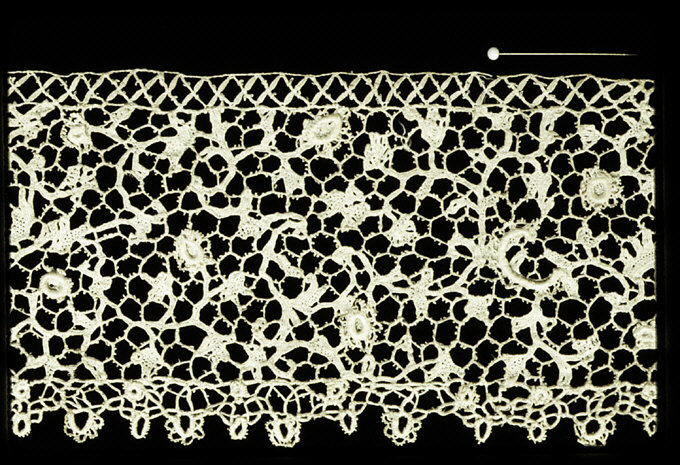
Deconstructing the Frontier: Needle Lace as a Structural Paradox for SS26
The concept of the Border has long been a geopolitical and psychological construct, a line of demarcation that both separates and defines. In the context of Zoey Fashion Laboratory’s SS26 avant-garde study, we dismantle this binary, reimagining the Border not as a barrier but as a dynamic, permeable threshold. The Global Frontier is no longer a physical geography; it is a state of becoming—a liminal space where the body meets the future. This analysis proposes a radical departure: the use of needle lace as the primary material to articulate this thesis. Traditionally associated with delicate, ornamental femininity, needle lace is here weaponized, deconstructed, and re-engineered into a structural language of architectural tension and ethereal strength. For SS26, we present a collection where the border is lace, and the lace is the frontier.
The Material Dialectic: Needle Lace as Structural Armature
To understand the innovation, one must first recognize the inherent contradictions of needle lace. It is a textile of absence—a network of voids held together by thread. Historically, it is a craft of patience, precision, and fragility. In our avant-garde context, we invert these properties. The lace is not applied as a trim or a surface decoration; it becomes the primary structural element. Through a process of hybridized fabrication, we fuse traditional hand-stitched needle lace with thermoformed resin and micro-carbon filaments. The result is a material that retains the visual complexity of openwork while achieving the rigidity of a cantilevered structure. The Border here is not a seam but a zone of tension—where thread becomes tendon, and void becomes volume.
This material innovation enables a new silhouette language. The Global Frontier is expressed through asymmetric, aerodynamic forms that appear to be in a state of perpetual motion. Jackets are constructed as single, continuous lace panels that wrap the torso in a spiral, terminating in a sharp, scalloped edge that mimics a topographical contour line. The structural innovation lies in the negative-space architecture: the lace’s gaps are not empty; they are framed, reinforced, and used to create optical illusions of weightlessness. A coat, for instance, is a lace lattice that flares from a high, closed collar into a wide, floating hem, supported by invisible internal stays that allow the garment to stand independent of the body. This is not clothing that clings; it is clothing that claims space, defining its own border.
Silhouette and the Liminal Body: The Frontier as a Second Skin
The SS26 futuristic silhouettes are defined by a tension between containment and release. The Border is visualized as a series of interrupted geometries. Consider a gown where the bodice is a rigid, corseted structure of dense needle lace, mimicking a map of disputed territories. The lace is layered and compressed, creating a surface that is both opaque and translucent. From the waist, the lace dissolves into a cascade of unbound threads, each terminating in a small, polished metal bead. The lower half of the garment is a flowing, unconstructed field of frayed edges—a deconstruction of the border itself. The silhouette is therefore a narrative: the upper body is the fortified frontier, the lower body is the open, undiscovered territory.
This dichotomy extends to the structural innovation of the sleeve. We propose the “threshold sleeve,” a component that is half garment, half architecture. It begins as a fitted, lace-covered bicep cuff and expands into a voluminous, pleated sail of micro-perforated silk, anchored only by a single, hand-stitched lace point at the shoulder. The effect is of a wing that is both tethered and free. The Global Frontier is thus embodied in the garment’s ability to exist in two states simultaneously—structured and fluid, defined and amorphous. The body becomes the border, a living membrane that negotiates between the interior self and the external environment.
Deconstructive Aesthetics: The Unfinished as a Statement of Becoming
Our approach to deconstructive aesthetics is not about destruction but about strategic incompleteness. The needle lace is left with deliberate, raw edges. Threads are not trimmed; they are extended, forming a fringe that reads as a data stream or a topographic line. The Border is not a finished seam but a site of potential. We introduce the concept of the “unfastened closure.” Garments are held together by a single, oversized, hand-embroidered lace button or, more radically, by a magnetic clasp embedded within the lace itself. The construction is visible, celebrated, and unresolved. This is a direct challenge to the couture tradition of invisible finishing. Here, the construction is the design.
The color palette for this frontier is monochromatic, anchored in industrial white, graphite grey, and oxidized silver. These are the colors of the global network, of satellite imagery and digital cartography. The needle lace is dyed in gradients, creating a sense of depth and distance. A single skirt might shift from a dense, white lace at the waist to a transparent, grey lace at the hem, as if the fabric is dissolving into the air. This chromatic fading is a direct visual metaphor for the Global Frontier—a boundary that is not a line but a gradient, a zone of transition.
Structural Innovation: The Lace as a Load-Bearing System
The most radical proposal of this study is the load-bearing lace. Through a collaboration with digital textile engineers, we have developed a technique to integrate shape-memory alloys into the needle lace pattern. When activated by body heat, the lace contracts and expands, altering the silhouette in real-time. A dress might have a collar that rises and flares upon movement, or a sleeve that shortens as the arm is raised. The Border is no longer static; it is responsive, a living frontier that adapts to the wearer’s actions. This is not wearable technology in the conventional sense; it is wearable architecture, where the material itself is the mechanism.
Furthermore, the structural innovation is expressed through modular components. The collection is a system of interchangeable lace panels that can be attached and detached via invisible magnetic connectors. A single base garment—a simple, form-fitting lace bodysuit—can be transformed into a dozen different silhouettes by adding a lace pauldron, a hip panel, or a back cape. The Global Frontier is therefore customizable, a personal territory that the wearer defines. This breaks the traditional couture model of a fixed, one-time creation, introducing a fluid, evolving wardrobe for the future.
Conclusion: The Border as a Generative Force
In this SS26 avant-garde study, the Border is no longer a limit but a generative force. By re-engineering needle lace into a structural material, we have created a collection that is both futuristic and deeply rooted in craft. The Global Frontier is not a wall; it is a lacework of connections, a permeable membrane that invites exploration. The futuristic silhouettes are not about escape from the body but about a new relationship with it—one where the garment is an active participant in defining the space between self and world. Zoey Fashion Laboratory’s SS26 is a manifesto for the deconstructed, responsive, and boundaryless couture of the next century. The lace is the border, and the border is the future.