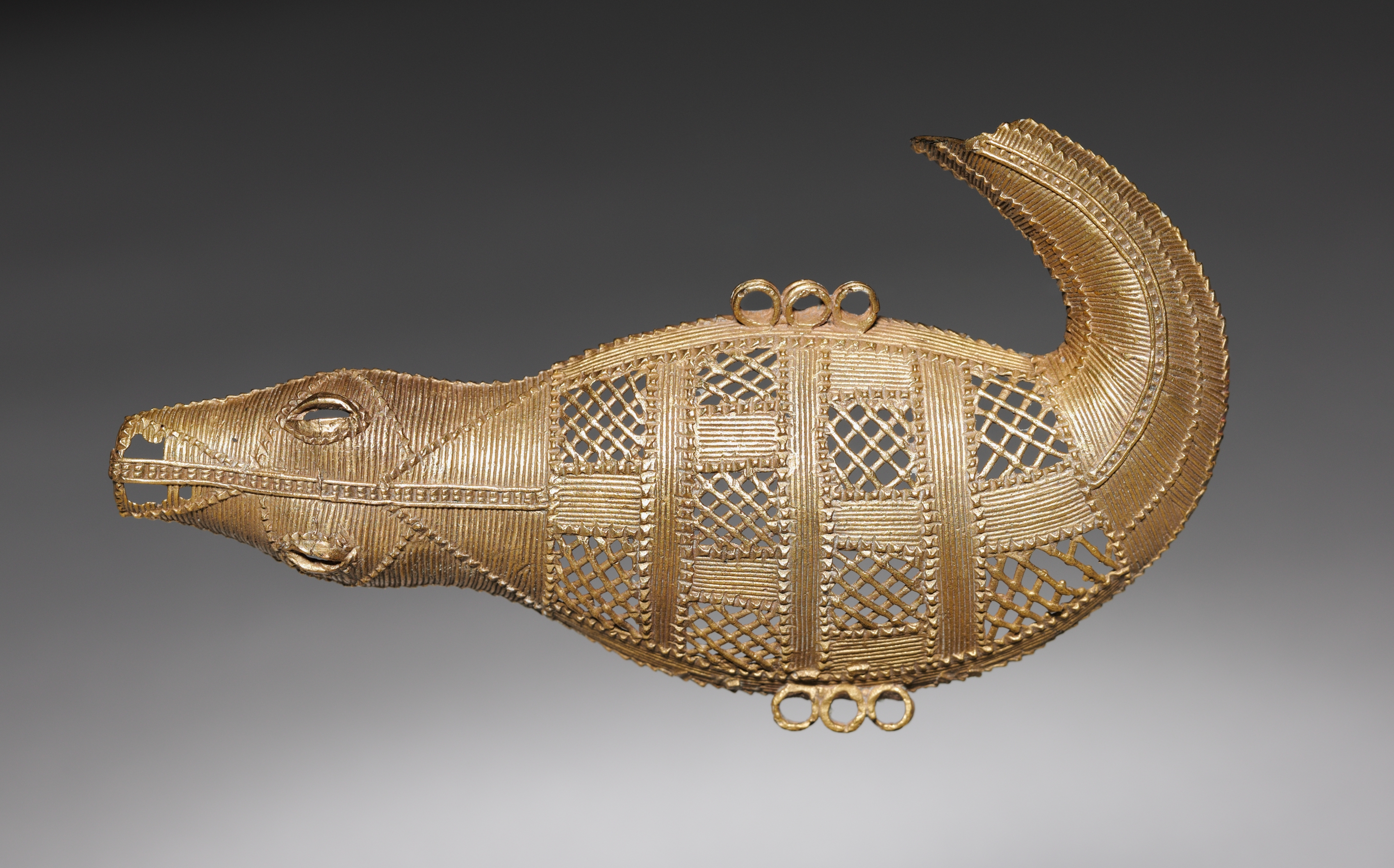
Deconstructing the Avant-Garde: The Baule-Inspired Crocodile Pendant at Zoey Fashion Lab
At Zoey Fashion Lab, we do not merely analyze artifacts; we dissect their material souls. The subject of this report—a gold pendant from West Africa, specifically Côte d'Ivoire, executed in the Baule style—presents a profound challenge to conventional fashion taxonomy. This is not an ornament. It is a statement of power, a talisman of duality, and a masterclass in avant-garde materiality. The pendant’s technical execution in gold, coupled with its cultural resonance, demands a deconstruction that moves beyond the aesthetic into the realms of semiotics, metallurgy, and narrative architecture.
Materiality as Provocation: The Gold Standard of the Avant-Garde
The choice of gold is the first, most assertive gesture of the avant-garde. In the context of Baule goldsmithing, gold is not merely a precious metal; it is a material of spiritual and political weight. Historically, Baule goldweights and ornaments were not decorative but functional—used in trade, ritual, and as markers of status. By isolating the crocodile form in pure gold, the artisan transforms a utilitarian object into a symbol of uncompromising power. The avant-garde fashion lab recognizes this as a deliberate act of material subversion: gold, traditionally associated with opulence and stasis, becomes here a vehicle for primal, kinetic energy.
The technical execution is critical. Baule goldsmiths are renowned for their lost-wax casting technique, a method that allows for intricate, one-of-a-kind forms. This pendant’s surface likely exhibits the hallmark textures of this process: a granular, almost organic finish that contrasts with the polished, machine-made jewelry of the West. For Zoey Fashion Lab, this technical fingerprint is a form of material resistance. It rejects the sterile perfection of industrial production, embracing instead the irregularities that signify human touch and ancestral knowledge. The gold is not a passive surface; it is a record of fire, wax, and the smith’s hand.
Symbolic Architecture: The Crocodile as Avant-Garde Protagonist
In Baule cosmology, the crocodile is a creature of liminality. It inhabits both water and land, the conscious and subconscious realms. This dual existence makes it an ideal subject for avant-garde fashion, which thrives on ambiguity and transgression. The pendant does not depict a docile, decorative reptile. It presents a crocodile in its raw, predatory essence—jaws open, scales textured, eyes watchful. This is not a symbol of luxury; it is a symbol of survival and dominion.
The avant-garde interpretation must go further. The crocodile’s skin, with its repetitive, scaly patterns, mirrors the concept of repetition with variation found in modernist art and fashion. Each scale is a micro-narrative, a unit of meaning that, when aggregated, creates a powerful visual rhythm. The pendant’s form also echoes the Baule concept of “griots” or storytellers—the crocodile becomes a silent narrator of power, lineage, and the delicate balance between human and natural worlds. For the Zoey Fashion Lab archive, this pendant is not an accessory but a wearable manifesto.
Resonance and Rupture: The Mirror and the Stone
The reference provided—“一面是光洁银镜上以黄金镶嵌的纷繁棕叶纹,另一面是冰冷石棺板上以浮雕诉说的生命叙事” (one side a smooth silver mirror inlaid with intricate palm leaf patterns in gold, the other a cold stone sarcophagus with a relief narrating life)—offers a critical lens for deconstruction. This pendant embodies a similar duality. The crocodile pendant, when worn, becomes a mirror reflecting the wearer’s status and the artisan’s skill. But its reverse side, the unseen interior, is the stone sarcophagus—the weight of history, the mortality of the creature, the permanence of the gold.
This duality is the essence of the avant-garde. The pendant operates on two registers: the spectacular (the gleaming gold, the exoticism of the Baule style) and the spectral (the cultural memory, the violence of colonialism, the extraction of African resources). Zoey Fashion Lab must acknowledge that wearing this pendant is an act of appropriation and reverence simultaneously. The avant-garde designer does not shy away from this tension; they amplify it. The pendant becomes a site of critical discourse, questioning who has the right to display such symbols and what narratives are being silenced by the gleam of gold.
Technical Analysis: The Craft as Avant-Garde Statement
From a technical standpoint, the pendant’s construction is a marvel of pre-industrial precision. The lost-wax method requires the artisan to carve the crocodile’s form in wax, encase it in clay, melt away the wax, and pour molten gold into the void. This process is inherently unforgiving—any flaw in the wax becomes a flaw in the gold. The resulting pendant is a unique object, not a reproduction. For the avant-garde, this uniqueness is paramount. It rejects the logic of mass production and fast fashion, embracing instead the slow, sacred labor of the artisan.
The surface treatment is equally significant. The crocodile’s scales are likely rendered through a combination of chasing and repoussé techniques, where the gold is hammered from the reverse side to create relief. This technique creates a play of light and shadow that is impossible to replicate with casting alone. The pendant’s surface is not static; it changes with every angle of light, every movement of the wearer. This kinetic quality aligns with the avant-garde’s fascination with time, motion, and the ephemeral.
Conclusion: The Pendant as a Threshold Object
For Zoey Fashion Lab, the Baule-inspired crocodile pendant is not a historical artifact to be preserved in a vitrine. It is a threshold object—a bridge between the ancestral and the contemporary, the sacred and the profane, the local and the global. Its avant-garde potential lies in its refusal to be categorized. It is jewelry, but it is also armor. It is ornament, but it is also a weapon of cultural memory. It is gold, but it is also fire, earth, and the breath of the artisan.
In the hands of a forward-thinking designer, this pendant can be recontextualized as a provocative accessory that challenges the wearer and the viewer to confront the complexities of cultural exchange, material ethics, and the enduring power of symbols. The crocodile’s open jaws are not a threat; they are an invitation to devour and digest the histories that fashion so often glosses over. This is the true work of deconstruction: to see the mirror and the stone, the gold and the grave, and to wear them both with awareness and intent.