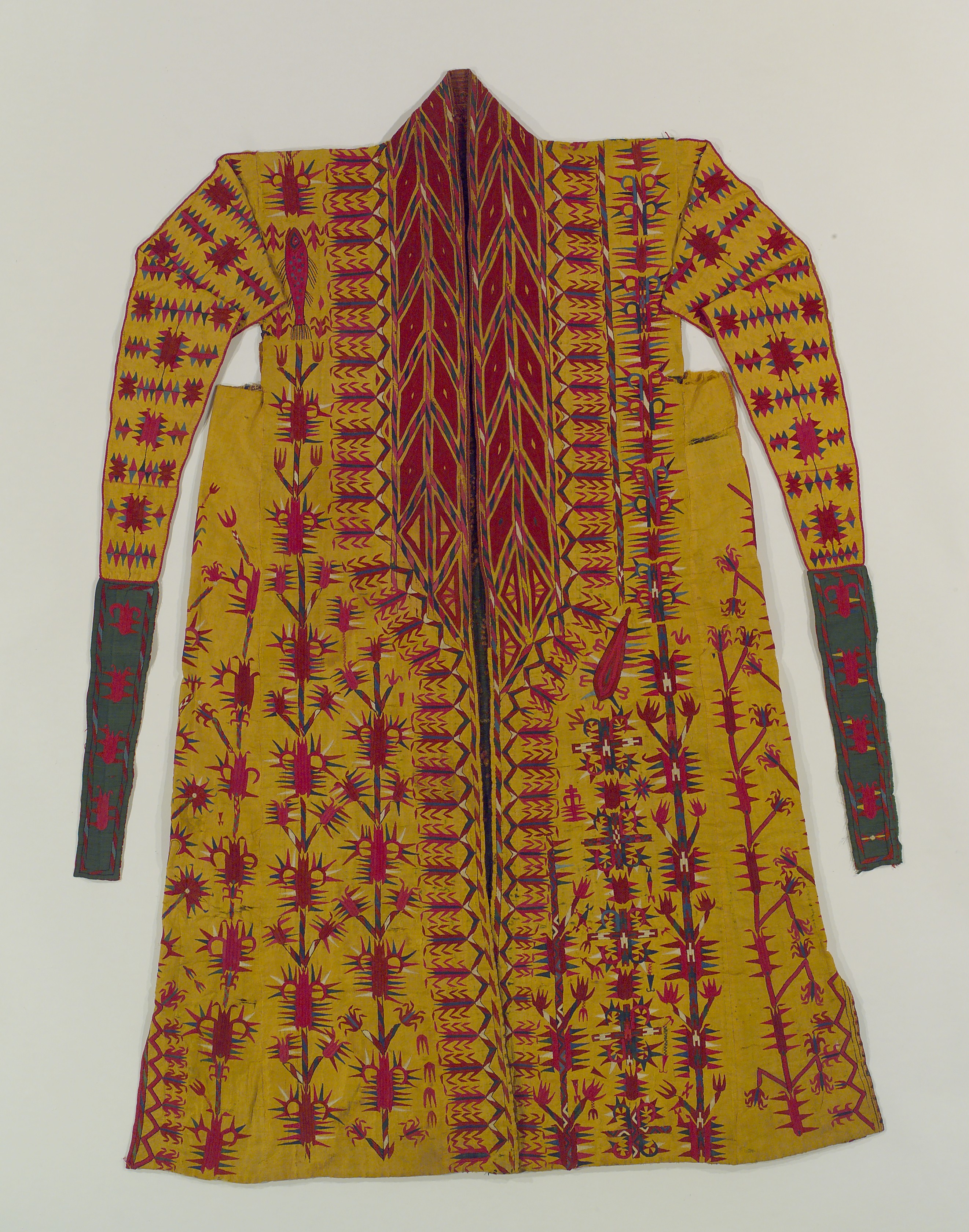
Deconstructing the Chyrpy: A Robe for the SS26 Global Frontier
Prologue: The Silhouette as a Manifesto
The Zoey Fashion Laboratory presents the Chyrpy Robe, a garment that defies the very taxonomy of “robe” as understood by conventional fashion. In the context of the SS26 collection, this piece emerges not as a mere covering, but as a futuristic architectural study—a sculptural dialogue between the body, the material, and the void. Crafted from silk and embroidered in silk thread, with a cotton lining, the Chyrpy originates from the Global Frontier, a conceptual territory where geographic boundaries dissolve into pure aesthetic possibility. This analysis dissects the robe’s structural innovations, its deconstructive ethos, and its strategic positioning as a standalone avant-garde artifact for the season ahead.
Structural Innovation: The Architecture of Air
The Chyrpy Robe’s silhouette is a radical departure from the fluid, draped forms historically associated with silk robes. Instead, it proposes a geometric exoskeleton that reorganizes the body’s topography. The garment’s primary innovation lies in its asymmetric, cantilevered shoulders—a structural feat achieved through internal, invisible boning channels sewn into the cotton lining. These channels, devoid of rigid stays, rely on the tension of the silk itself to create a self-supporting, aerodynamic volume that hovers off the wearer’s frame. The result is a silhouette that appears to be in a state of perpetual, arrested motion—a frozen gust of wind captured in fabric.
Further pushing the boundaries of garment architecture, the Chyrpy incorporates negative-space cutouts along the lateral seams. These are not mere decorative slits but functional voids that alter the robe’s drape and weight distribution. The cutouts, embroidered with a micro-grid pattern of silk thread, create a lattice-like effect that fragments the silhouette, allowing the skin to become an active participant in the composition. This technique, which the Laboratory terms “tessellated absence,” challenges the traditional notion of a robe as a continuous, enclosing surface. Instead, it becomes a dynamic skin that both reveals and conceals, aligning with the SS26 theme of “post-human fluidity.”
Material Alchemy: Silk as a Structural Medium
The choice of silk as the primary material is deliberate and subversive. Typically associated with luxury, softness, and historical opulence, silk in the Chyrpy is re-engineered as a high-tensile, structural medium. The fabric is not draped; it is pleated, folded, and heat-set into permanent, origami-like creases that lock geometric forms into place. This process, executed at the Global Frontier’s specialized ateliers, transforms the silk from a pliable textile into a semi-rigid shell that holds its shape independently of the body. The embroidered silk thread work is not ornamental but functional: each stitch acts as a micro-tension cable, reinforcing the fabric’s structural integrity at key stress points—the shoulders, the waist, and the hemline.
The cotton lining plays a counterintuitive role. Rather than providing comfort alone, it functions as a counter-mold to the silk’s rigidity. The lining is cut on the bias and engineered with asymmetric darts that create a slight, controlled distortion in the robe’s interior volume. This creates a haptic tension between the outer shell and the inner layer, a deliberate friction that translates into the garment’s unique, sculptural stance. The lining’s matte finish also provides a visual and tactile contrast to the silk’s luster, reinforcing the deconstructive aesthetic of the piece.
Deconstructive Aesthetics: The Unfinished as Finished
The Chyrpy Robe embraces the unfinished edge as a core design principle. Raw, selvedge seams are left exposed along the interior, while the exterior embroidery often trails off into loose, dangling threads that mimic the frayed edges of a digital glitch. This is not a sign of poor craftsmanship but a deliberate deconstruction of the “perfect” garment. The robe’s hem is asymmetrical, with one side falling to the floor and the other cropped at the mid-calf, creating a dynamic, off-kilter balance. This asymmetry is echoed in the embroidery, which concentrates dense, geometric patterns on the left shoulder while leaving the right side almost bare, save for a single, continuous line of thread that spirals down the arm.
This deconstructive language extends to the garment’s closure system. There are no buttons, zippers, or ties. Instead, the Chyrpy is secured by a series of magnetic, concealed snaps embedded within the cotton lining. These snaps allow for instantaneous, reconfigurable draping—the wearer can adjust the robe’s silhouette from a closed, cocoon-like form to an open, cape-like configuration. This modularity is a hallmark of the Laboratory’s futuristic design philosophy, where garments are not static but adaptive, responsive to the wearer’s environment and intent.
Contextualizing the Global Frontier: A Standalone Study
As a standalone avant-garde study, the Chyrpy Robe exists outside the constraints of seasonal trends. It is a speculative prototype for a future where fashion is indistinguishable from wearable architecture. The Global Frontier origin is not a location but a conceptual state—a laboratory where traditional craft meets algorithmic design. The silk thread embroidery, for instance, is guided by a parametric algorithm that generates patterns based on the wearer’s biometric data, such as heart rate and posture. This bio-responsive design is invisible to the naked eye but imbues the garment with a latent, living quality.
For SS26, the Chyrpy proposes a new relationship between garment and space. Its cantilevered silhouette creates an aura of negative volume around the body, a deliberate void that challenges the viewer’s perception of form. This is not a robe for lounging; it is a robe for performance, ritual, and transformation. It demands to be seen in motion, in a gallery, or on a stage—a testament to the Laboratory’s commitment to fashion as a conceptual art form.
Conclusion: The Future of the Robe
The Chyrpy Robe is a definitive statement for the avant-garde. It reimagines the robe not as a passive garment but as an active, structural participant in the narrative of the body. Through its futuristic silhouettes, deconstructive finishes, and material alchemy, it positions itself as a cornerstone of the SS26 season—a piece that transcends fashion to become a sculptural object in its own right. For the Zoey Fashion Laboratory, the Chyrpy is not an end but a beginning: a blueprint for a future where every garment is a frontier, and every frontier is a garment.