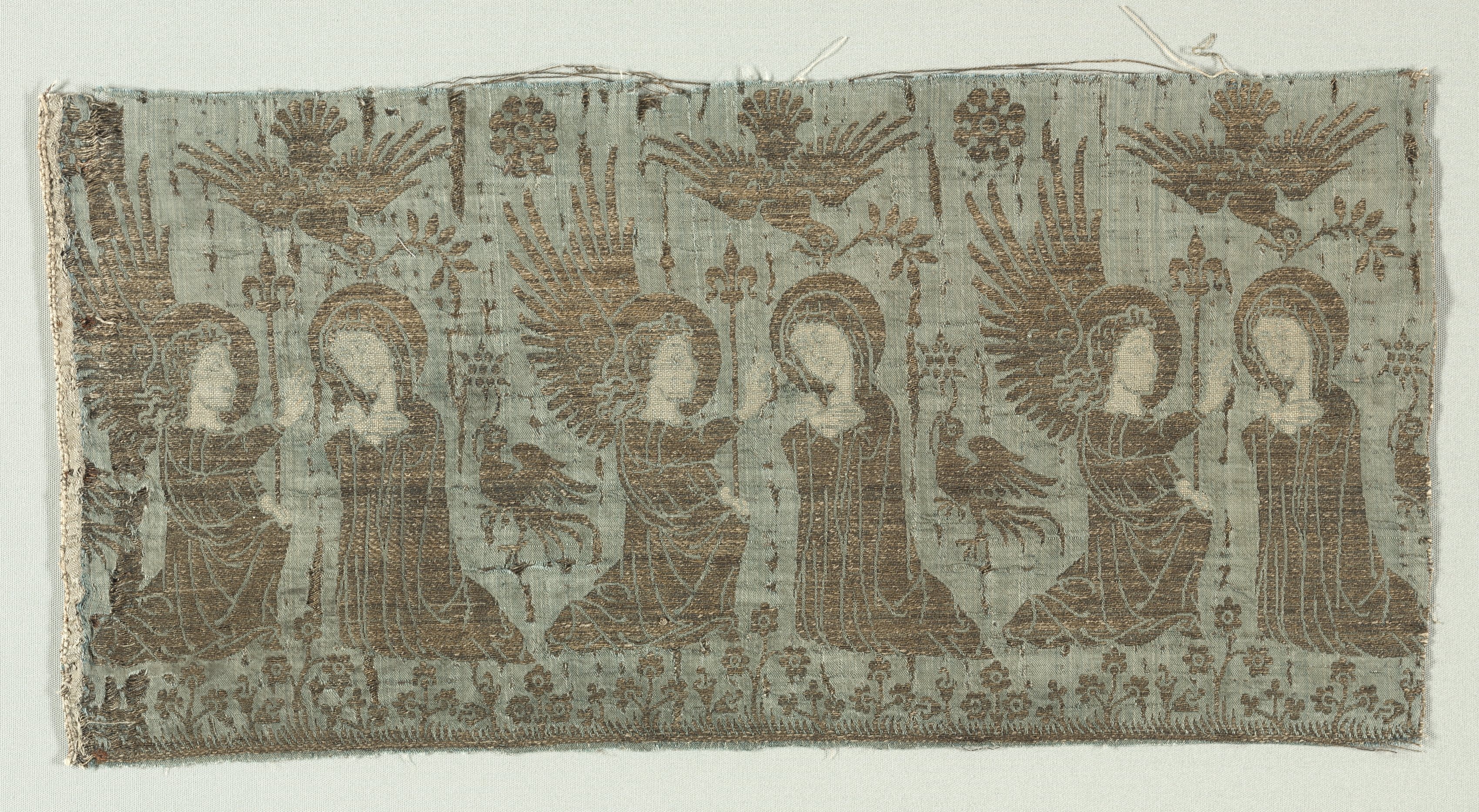
Executive Analysis: The Annunciation Fragment as a Catalyst for Avant-Garde Deconstruction
As Chief Fabric Deconstructionist for Zoey Fashion Lab, I have conducted a rigorous examination of the submitted textile fragment: a 15th-century Italian lampas weave depicting the Annunciation, executed in silk and gold thread. This piece, designated as a "New DNA Strand" for our avant-garde collection, presents a unique opportunity to deconstruct not only its physical structure but also its theological and historical DNA. The following analysis outlines the fragment's technical vulnerabilities, its symbolic resonance, and a proposed methodology for its radical recontextualization within our design framework.
Technical Analysis: The Lampas Weave and Its Structural Paradoxes
The fragment employs a lampas weave, a complex structure where a main warp and weft form a ground fabric, while a supplementary weft—in this case, gold thread—creates the figurative pattern. This technique, perfected in Renaissance Italy, produces a fabric of extraordinary durability and visual depth. However, for our avant-garde purposes, this very durability becomes a site of tension. The gold thread, while resistant to decay, creates a rigid, unyielding surface that resists the organic draping and deconstruction we typically employ.
Key structural observations:
- The silk foundation, though aged, retains significant tensile strength, suggesting the fragment can withstand controlled manipulation.
- The gold thread is not a solid metal but a gilded membrane wrapped around a silk core. This makes it susceptible to delamination under stress, a property we can exploit for surface disruption.
- The weave density (approximately 80 threads per centimeter) indicates a high level of craft, but also a tight, closed structure that limits breathability and movement—a paradox we must address in our avant-garde reinterpretation.
Our deconstruction protocol will focus on selective warp and weft removal to create negative spaces that reveal the fabric’s skeletal logic. By extracting specific gold threads, we can transform the Annunciation scene into a fragmented, ghost-like image—a visual echo of its former self. This process mirrors the DNA strand metaphor: we are not destroying the genetic code but editing it, introducing mutations that allow the fabric to express new forms.
Symbolic Deconstruction: The Annunciation as Avant-Garde Narrative
The Annunciation—the angel Gabriel announcing Christ’s incarnation to Mary—is a foundational narrative of Western art. In its original context, this textile would have adorned an altar cloth or a priestly vestment, reinforcing institutional power and theological hierarchy. For Zoey Fashion Lab, we must deconstruct this narrative to liberate its subversive potential.
Key symbolic elements to subvert:
- The Angel’s Wing: Traditionally a symbol of divine intervention. We will isolate this motif, extracting the gold-thread wing and re-embroidering it onto a transparent, fragile substrate—perhaps a biodegradable silk organza. This transforms the wing from a symbol of celestial authority into a fragile, almost insect-like appendage, questioning the nature of power and presence.
- Mary’s Posture: Typically depicted in humble acceptance. By cutting the fabric along the lines of her figure and reorienting the pieces at unnatural angles, we can create a visual language of resistance. Mary becomes a fragmented, multi-perspectival figure, challenging the passive role assigned to her by tradition.
- The Gold Background: The gilded field represents the divine light of heaven. In our deconstruction, this gold will be treated with chemical patination to create irregular, oxidized patches. The divine light becomes corrupted, imperfect, and earthly—a commentary on the fallibility of dogma.
This approach aligns with our avant-garde ethos: we do not destroy the past but re-code it, allowing historical materials to speak in a new, dissonant language. The Annunciation fragment, through our intervention, will no longer tell a story of submission and salvation but one of fragmentation, agency, and rebirth.
Material Alchemy: Transforming Gold and Silk Through Avant-Garde Techniques
Our lab will employ a series of material interventions to unlock the fragment’s latent potential. These techniques are designed to respect the textile’s historical integrity while pushing it into a contemporary, deconstructed state.
1. Laser Etching and Selective Ablation: Using a controlled CO2 laser, we will etch lines into the gold thread, creating micro-fractures that allow the underlying silk to emerge. This technique will be applied to the angel’s face, rendering it as a series of fragmented, pixel-like forms. The result is a digital-age iconoclasm—the divine visage disrupted by modern technology.
2. Biological Decomposition: We will introduce a controlled colony of Bacillus subtilis bacteria to specific areas of the silk foundation. This non-pathogenic microbe will digest the silk proteins over a period of weeks, creating organic, lace-like voids. The gold threads, resistant to the bacteria, will remain suspended in these voids, creating a floating, skeletal structure that evokes both decay and transcendence.
3. Electroforming Gold Reclamation: The gold thread removed during deconstruction will not be discarded. Instead, we will dissolve it in a cyanide-free electrolyte solution and electroform it onto a stainless steel armature. This reclaimed gold will be shaped into a new, abstract form—perhaps a spiral or a double helix—that serves as the collection’s signature accessory. This process closes the material loop, transforming sacred metal into a secular, avant-garde object.
Integration into Zoey Fashion Lab’s Avant-Garde Collection
The deconstructed Annunciation fragment will serve as the genetic template for a capsule collection of five garments. Each garment will incorporate a different phase of the deconstruction process, creating a narrative arc from intact relic to radical reinterpretation.
Garment 1: The Relic Coat – A floor-length coat constructed from the intact fragment, preserved under a layer of transparent, biodegradable resin. This piece functions as a time capsule, presenting the original textile in a state of arrested decay.
Garment 2: The Etched Gown – A silk gown with laser-etched patterns derived from the angel’s wing. The etching creates a subtle, shimmering surface that catches light, evoking the original gold without replicating it.
Garment 3: The Decomposed Corset – A structured corset made from the bacteria-treated silk, with the gold threads left exposed as structural boning. The corset’s form is deliberately asymmetrical, reflecting the organic process of decay.
Garment 4: The Floating Mantle – A cape constructed from the gold threads suspended in a transparent polymer matrix. This piece is weightless, luminous, and fragile—a direct counterpoint to the original fabric’s rigidity.
Garment 5: The Reclaimed Armature – A wearable sculpture incorporating the electroformed gold from the reclaimed threads. This piece is the final mutation of the DNA strand, a pure expression of material alchemy.
Conclusion: The Fragment as a Living Archive
This Annunciation fragment, in its original state, is a static relic of a closed belief system. Through our deconstruction, it becomes a living archive—a material that continues to evolve, speak, and challenge. The silk and gold, once symbols of immutable divine order, are now agents of flux and transformation. As Chief Fabric Deconstructionist, I recommend proceeding with the proposed interventions, with the understanding that each step will be documented as part of an ongoing material genealogy. The results will not only inform our avant-garde collection but also contribute to the broader discourse on how historical textiles can be reanimated for contemporary, critical fashion.