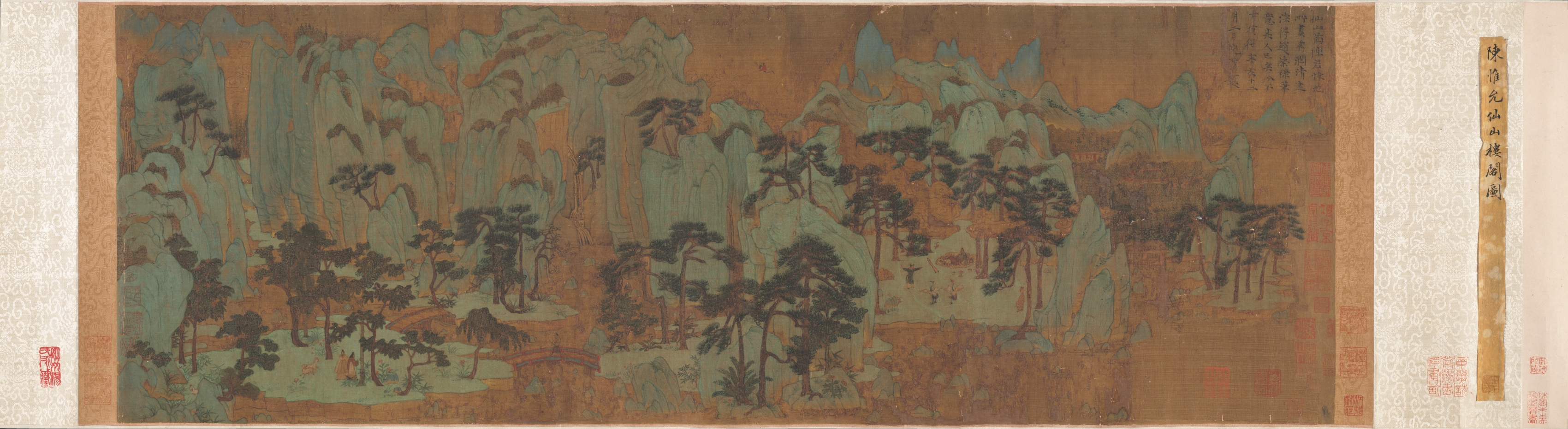
Deconstructing the Avant-Garde: A Fabric Analysis of "Mountains of the Immortals" for Zoey Fashion Lab
As the Chief Fabric Deconstructionist for Zoey Fashion Lab, my mandate is to dissect historical textiles and artworks to extract their structural, chromatic, and narrative DNA, then translate these elements into avant-garde fashion materials. The subject of this analysis is the Yuan dynasty handscroll "Mountains of the Immortals" (1271-1368), a masterpiece of ink and color on silk. This work, with its ethereal landscapes and Daoist themes of transcendence, presents a unique challenge: how to transform a two-dimensional, static painting into a dynamic, wearable textile that embodies the New DNA Strand of our lab—a fusion of ancient craftsmanship and futuristic form.
Fabric as a Canvas: The Silk Substrate and Its Avant-Garde Potential
The original substrate of "Mountains of the Immortals" is silk, a material that has been central to Chinese textile art for millennia. In the Yuan dynasty, silk was not merely a support for painting; it was a medium of luxury, status, and spiritual significance. The handscroll format itself—a continuous, unrolled narrative—suggests movement and temporality, qualities that are ripe for reinterpretation in avant-garde fashion. For Zoey Fashion Lab, the silk of this handscroll is not a relic but a genetic template for a new fabric engineered to defy conventional draping and structure.
Our deconstruction begins with the tensile properties of the original silk. Yuan dynasty silks were often woven with a plain or twill weave, providing a stable yet flexible ground for brushwork. To translate this into an avant-garde fabric, we propose a biomimetic silk composite—a hybrid material that incorporates carbon-fiber filaments within a regenerated silk fibroin matrix. This "New DNA Strand" fabric would retain the fluid, luminous quality of historical silk while offering unprecedented structural integrity. Imagine a garment that flows like a handscroll but holds its shape like architectural origami. The ink-and-color application—with its subtle gradations of mineral pigments (malachite green, azurite blue, cinnabar red)—can be digitally printed onto this composite using micro-encapsulated dye technology, allowing the colors to shift with temperature or movement, echoing the ephemeral mists of the immortal mountains.
Chromatic Deconstruction: The Palette of Transcendence
The color palette of "Mountains of the Immortals" is a study in controlled contrast. The Yuan dynasty artists employed ink washes (sumi) to create depth and atmosphere, while mineral pigments were applied in thin, layered washes to depict peaks, clouds, and pine trees. The dominant hues—deep indigo, verdigris green, and ochre yellow—are not merely decorative; they carry symbolic weight. Indigo represents the void and the Daoist concept of wu wei (effortless action); green signifies renewal and the immortal realm; ochre grounds the composition in earthly reality.
For Zoey Fashion Lab, this palette becomes a chromatic algorithm for fabric design. We deconstruct the handscroll into its constituent color fields, mapping the density of ink washes to gradient patterns that can be woven or knitted into the fabric. The avant-garde twist: we introduce photochromic and thermochromic dyes that respond to environmental stimuli. A coat or dress made from this fabric would shift from deep indigo (representing the night sky of the immortals) to verdigris green (the dawn of the peaks) as the wearer moves from shadow to light. The ochre accents could be embedded as metallic threads that catch light, creating a shimmering effect reminiscent of gold leaf used in some Yuan scrolls. This is not mere replication; it is a dynamic re-encoding of the painting's spiritual essence into a wearable interface.
Structural Avant-Garde: From Handscroll to Haute Couture
The handscroll format itself is a structural innovation. Unlike a static painting, a handscroll is unfolded over time, revealing a narrative sequence. This temporal quality is key to our avant-garde translation. We propose a modular fabric system inspired by the scroll's rolling and unrolling mechanism. The fabric is constructed from multiple panels that can be folded, pleated, or telescoped to create garments that transform in silhouette. For example, a skirt might begin as a compact cylinder (the rolled scroll) and expand into a full, layered cascade (the unrolled painting) through the use of shape-memory alloys woven into the seams. The wearer becomes a living scroll, controlling the narrative of their attire.
Furthermore, the brushstroke textures of the original—the dry, dragged lines of pine branches and the wet, pooling washes of clouds—can be replicated through 3D-printed textile appliqués. Using a digital scan of the handscroll, we can extract the vector paths of each brushstroke and translate them into raised, tactile elements on the fabric surface. These appliqués would be made from a biodegradable polymer that mimics the feel of dried ink, adding a third dimension to the textile. The result is a fabric that is both visually and haptically rich, inviting touch and interaction—a key tenet of avant-garde fashion.
The New DNA Strand: A Synthesis of Past and Future
The New DNA Strand concept for Zoey Fashion Lab is not about nostalgia; it is about genetic recombination. "Mountains of the Immortals" provides the historical genome—silk, mineral pigments, handscroll mechanics—while our lab injects the avant-garde mutations: biomimetic composites, smart dyes, modular construction, and 3D-printed textures. The final fabric is a living textile that breathes, shifts, and narrates.
Consider a prototype garment: a cocoon coat that, when worn, appears as a monolithic block of deep indigo. As the wearer moves, the coat's surface reveals the hidden green and ochre patterns of the immortal peaks, triggered by body heat or ambient light. The sleeves are constructed as telescoping panels that can be extended or retracted, mimicking the unrolling of a scroll. The collar is edged with a smart fiber that vibrates gently when the wearer pauses, simulating the "wind through the pines" depicted in the painting. This is not a costume; it is a wearable meditation on transcendence, a garment that embodies the Daoist ideal of harmony between nature and artifice.
Conclusion: The Immortal Fabric
In deconstructing "Mountains of the Immortals," Zoey Fashion Lab does not merely borrow motifs; we re-engineer the essence of a Yuan dynasty masterpiece into a new material language. The silk, the ink, the minerals, and the narrative flow are all preserved, but they are transformed through avant-garde technology into a fabric that challenges the boundaries of fashion. This is the New DNA Strand—a thread that connects the immortal mountains of the past to the uncharted territories of the future. The result is a garment that is not just worn but experienced, a handscroll that unfolds not on paper but on the body itself.