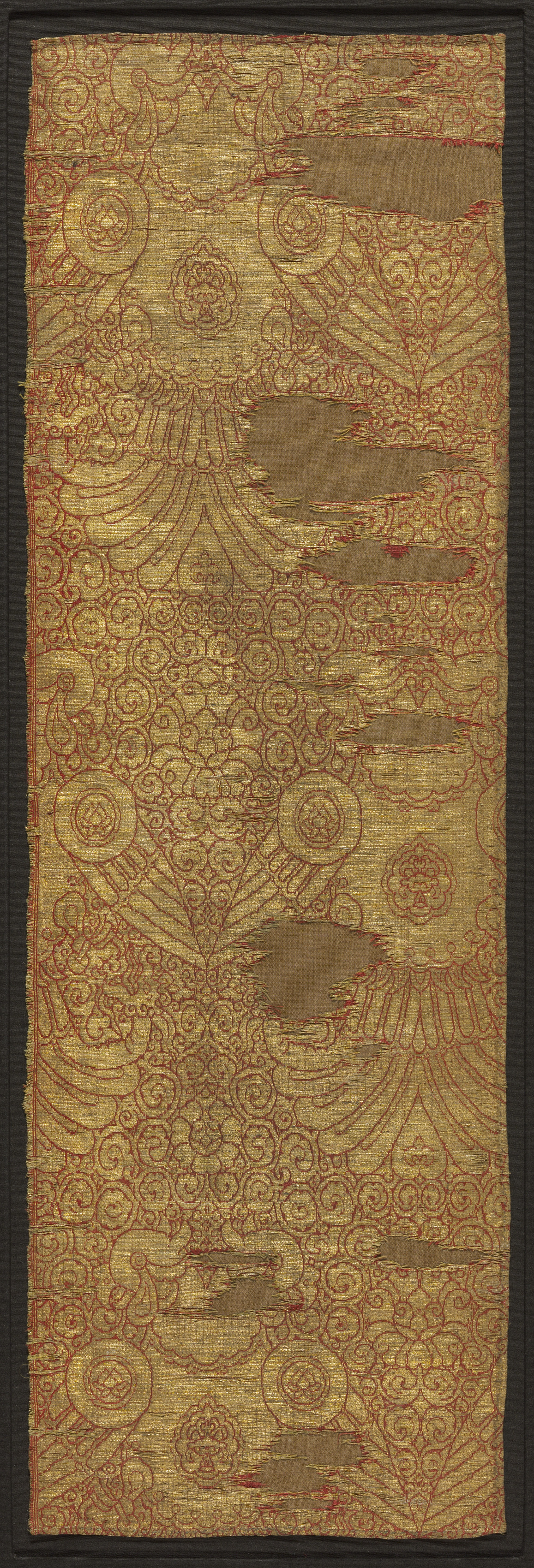
Deconstructing the Avian Gilded Strand: A Technical and Stylistic Analysis of the "Cloth of Gold: Displayed Falcons"
As Chief Fabric Deconstructionist at Zoey Fashion Lab, I am pleased to present a comprehensive analysis of a singular textile specimen: the "Cloth of Gold: Displayed Falcons." This piece, originating from Central Asia and constructed using silk and gold thread in a lampas weave, represents a critical intersection of historical craftsmanship and avant-garde design philosophy. The reference to a "New DNA Strand" is not merely poetic; it signals a fundamental re-evaluation of how we perceive, deconstruct, and ultimately re-contextualize this fabric within the framework of contemporary fashion. This analysis will dissect the technical, material, and stylistic implications of this cloth, positioning it as a foundational element for Zoey Fashion Lab’s next disruptive collection.
I. Technical Provenance: The Lampas Weave and the Gilded Thread
The technical foundation of this cloth is the lampas weave, a complex structure that historically defined the luxury textiles of the Silk Road. Unlike simpler weaves, lampas employs a main warp and weft (typically silk) to create a ground fabric, while a secondary, often discontinuous, weft (here, gold thread) is bound to the surface to form the pattern. This technique allows for the creation of intricate, multi-layered designs without compromising the drape or structural integrity of the base silk. The "Cloth of Gold" utilizes this to its full advantage: the silk ground provides a subtle, matte luster, while the gold thread—likely a gilded membrane wrapped around a silk or linen core—introduces a brilliant, reflective surface that catches light with every movement.
The use of gold thread is not merely decorative; it is a material statement of power and permanence. In Central Asian weaving traditions, gold was reserved for courtly and ceremonial garments, symbolizing divine authority and cosmic order. However, in the context of Zoey Fashion Lab’s avant-garde lens, this gold is not a relic of empire but a new DNA strand—a code that can be rewritten. The thread’s inherent rigidity and weight, which would traditionally dictate a static, ceremonial garment, are now seen as design constraints to be subverted. We will explore how this material can be manipulated, fractured, and recombined to create structures that are both fluid and architectural.
II. Iconographic Deconstruction: The Displayed Falcon Motif
The central motif of the displayed falcon—a heraldic pose where the bird is shown frontally with wings spread—is a powerful symbol of vigilance, speed, and dominion. In Central Asian iconography, the falcon was associated with the hunt, the sky, and the sovereign’s gaze. Yet, for our deconstruction, we must interrogate this image not as a static emblem but as a dynamic genetic sequence. The "displayed" posture, with its symmetrical wings and sharp talons, offers a template for structural experimentation.
We can deconstruct the falcon’s form into its constituent parts: the wings become asymmetric draping panels that can be detached, reoriented, or layered to create a sense of motion. The talons, typically rendered as sharp, angular forms, can be translated into geometric cutouts or laser-etched perforations that reveal the skin beneath. The falcon’s eye—often a single, unblinking point—can be reinterpreted as a focal point for optical illusion, perhaps using mirrored or holographic elements that distort the viewer’s perception. This is not about preserving the falcon; it is about mutating it into a new species of garment.
III. Material Alchemy: The New DNA Strand
The reference to a "New DNA Strand" is the conceptual core of this analysis. In biological terms, DNA is a code that can be edited, spliced, and recombined. Similarly, the "Cloth of Gold" is not a finished product but a living archive of material possibilities. We must approach the silk and gold thread as base pairs, capable of forming new sequences when exposed to modern technologies.
For example, the gold thread can be chemically or mechanically distressed to create a patina that suggests age and decay, then selectively repaired with conductive fibers or light-emitting diodes (LEDs). This creates a fabric that is both ancient and futuristic—a hybrid that speaks to the passage of time while pointing toward a cybernetic future. The silk ground can be bio-engineered to incorporate micro-encapsulated pigments that change color with body heat or UV exposure, effectively allowing the garment to "breathe" and adapt to its environment. This is the new DNA: a code that is no longer fixed but responsive, interactive, and alive.
IV. Avant-Garde Stylistic Implications: From Ceremony to Subversion
Historically, a cloth of gold with displayed falcons would have been used for a ceremonial robe—a garment of rigid formality, worn to project unchallengeable authority. The avant-garde mandate, however, demands we subvert this. The style we propose is one of calculated deconstruction and reassembly.
The first step is to fragment the weave. Rather than using the cloth as a single, continuous piece, we will cut it into asymmetric panels that are then rejoined with visible seams using contrasting threads—perhaps a neon silk or a matte black synthetic. This creates a patchwork effect that acknowledges the cloth’s history while asserting a new, fractured identity. The gold thread, once a symbol of wholeness, becomes a line of deliberate rupture.
Next, we introduce negative space. The falcon motifs can be cut out and replaced with transparent mesh or sheer organza, allowing the wearer’s skin or an underlying garment to become part of the design. This is a direct challenge to the original cloth’s opaqueness and weight. The garment becomes a layered landscape, where the gold is both present and absent, seen and unseen.
Finally, we consider silhouette. The traditional robe is replaced with a modular system: a bolero jacket with detachable sleeves, a skirt that can be worn high-waisted or as a train, a hood that can be collapsed into a collar. Each piece is a gene in the new DNA strand, capable of being expressed or suppressed depending on the wearer’s intent. The falcon, once displayed, is now in flight—a form that is never static.
V. Conclusion: The Fabric as a Living Code
The "Cloth of Gold: Displayed Falcons" is not a historical artifact to be preserved; it is a genetic blueprint for a new species of fashion. By deconstructing its technical weave, interrogating its iconography, and reimagining its material properties through the lens of a New DNA Strand, Zoey Fashion Lab can produce garments that are at once reverent and rebellious, luxurious and subversive. This fabric is a code to be rewritten, a tradition to be mutated. The avant-garde style we propose is one of controlled chaos, where gold and silk, falcon and flight, history and future, coexist in a state of perpetual becoming. The result is not just clothing—it is a living, breathing statement of material evolution.