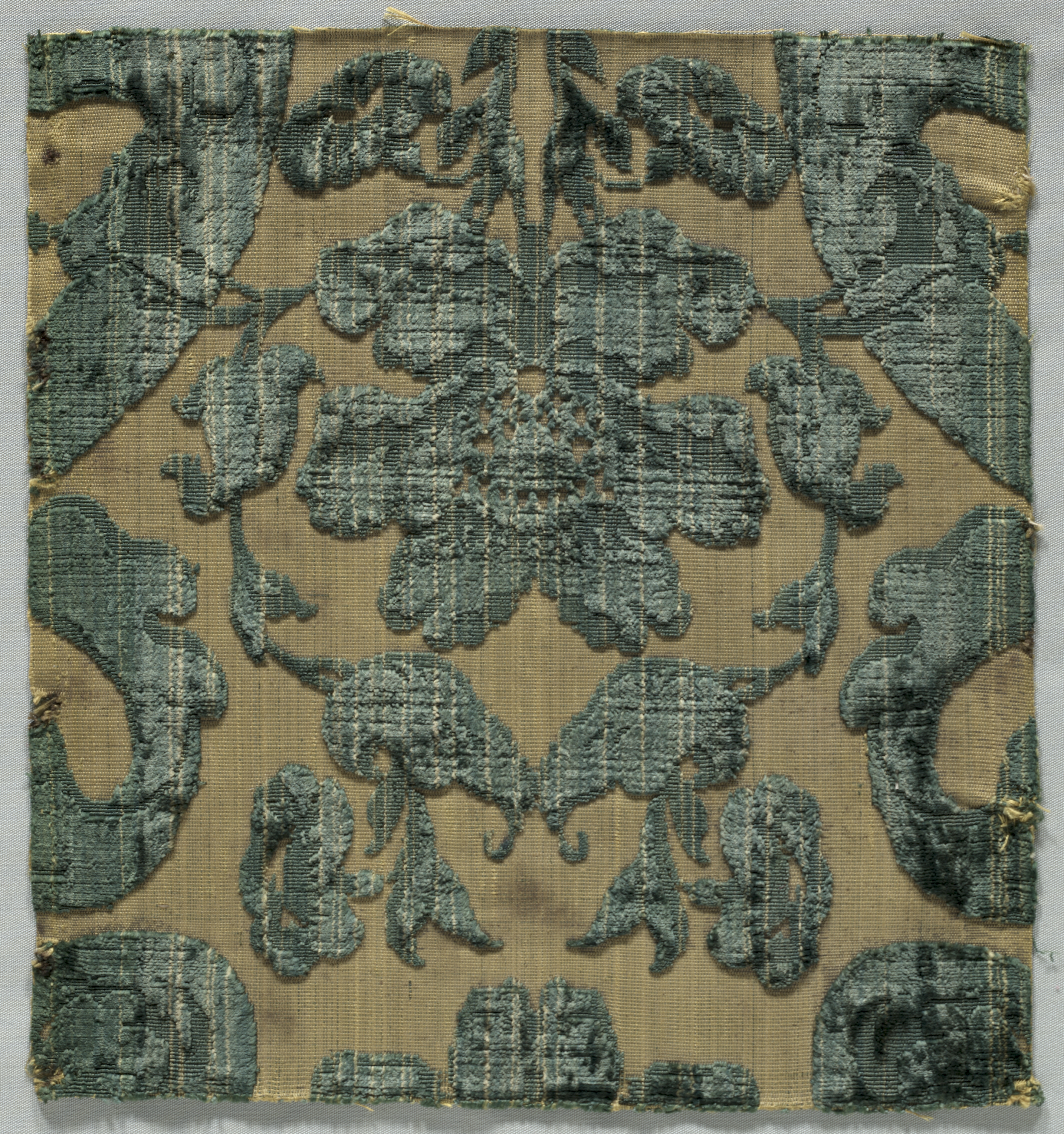
Technical Analysis: Velvet Fragment, Italy, Early 17th Century
The submitted velvet fragment represents a pinnacle of European textile craftsmanship from the Baroque period. Originating from the Italian workshops of Genoa or Venice—the era's undisputed centers of luxury textile production—this piece is technically a voided velvet, likely with a silk pile on a silk ground. The "voided" technique creates a pattern by leaving areas of the ground weave bare, allowing for dramatic contrasts between the luminous, light-catching pile and the flat, matte foundation. Under magnification, we would expect to see a complex weave structure, possibly incorporating a supplementary warp to create the pile, with a high thread count indicative of meticulous hand-loom work. The depth and density of the pile would have been controlled with precision, a testament to the weaver's skill. The original coloration, now faded, likely involved rich, costly dyes such as kermes for scarlet or woad for deep blues, signifying its status as a luxury good for ecclesiastical, aristocratic, or patrician use.
Deconstructionist Lens: The "New DNA Strand" Reference
The directive to reference a "New DNA Strand" is a powerful conceptual framework for our deconstruction. We are to treat this historical artifact not as a static relic, but as a living genetic code. Its material composition—silk proteins, dye molecules, degraded metallic threads (if present)—constitutes its biological DNA. However, its cultural and structural DNA is what we must sequence and splice. This DNA contains the encoded information of 17th-century aesthetics: opulence, drama, tactile seduction, and a hierarchical expression of wealth and power through material excess. Our avant-garde mission is to isolate these genes—the texture gene, the light-interaction gene, the pattern-contrast gene—and recombine them with a contemporary genomic sequence.
This new sequence is defined by 21st-century values: sustainability, fluid identity, technological interface, and deconstructed form. The goal is not replication, but transgenic expression. We are creating a hybrid where the historical genetic material provokes new functionalities and meanings within a radically different contemporary host body.
Avant-Garde Recombinant Proposals
Moving from analysis to application, here are three pathways for recombinant design, treating the velvet fragment as our core genetic donor material.
Proposal 1: The Bio-Digital Hybrid
This approach focuses on the texture and light-interaction genes. We sequence the tactile information of the velvet—its compression resistance, its bidirectional light catch (the infamous "nap")—and translate this data into a digital substrate. Using 3D modeling and programmable LED or e-textile technology, we create a garment surface that reacts to touch and movement with changes in luminosity and color.
Imagine a sleek, minimalist neoprene bodice embedded with thousands of micro-LEDs. The "pile" is not silk but a field of light. A swipe of the hand "parts" the light, creating a dynamic, voided pattern that evolves in real-time. The historical contrast between matte and shine becomes an interactive, ephemeral display. The physical fragment is not used materially but as the source code for behavior, creating a living fabric that honors the original's dynamism through 21st-century bioluminescence.
Proposal 2: The Temporal Collage & Amplified Decay
This method engages directly with the fragment's material DNA and its state of decay. Instead of viewing the fraying edges, faded hues, and potential small holes as damage, we amplify these traits as the primary aesthetic. Using innovative zero-waste cutting techniques, we integrate the actual historical fragment as a topographical centerpiece on a garment constructed from upcycled technical fabrics (recycled parachute silk, decomposed industrial felt).
The fragment is stabilized and applied like a geological sample. Surrounding it, we use laser-cutting and heat-sealing to create intentional "decay pathways" that echo the fragment's erosion. The color palette derives directly from the faded velvet, translating its patina into digital prints on modern fabrics. The resulting piece is a wearable archive, a dialogue between two temporal states: the slow, dignified decay of organic luxury and the precise, engineered degradation of synthetic materials. It speaks to the beauty of impermanence and responsible sourcing.
Proposal 3: Structural Decomposition & Volumetric Translation
Here, we deconstruct the structural and pattern genes of the voided velvet. We abandon the flat, woven plane entirely and translate its formal principles into three-dimensional space. The contrast of pile versus ground, the play of positive and negative space, is reimagined through sculptural fashion techniques.
We create a garment using modular, padded units (inspired by the plushness of the pile) connected by a "void" of sheer, rigid tulle or laser-cut acrylic. The silhouette becomes an abstract, architectural landscape. The pattern of the original fragment is not printed but built through this volumetric assembly. Materials could include innovative foams, recycled stuffing, and biodegradable plastics. The wearer inhabits the pattern, moving through a structure that reinterprets Baroque grandeur as avant-garde spatial design. It is a garment that prioritizes form and concept over conventional wearability, embodying the fragment's DNA as experiential architecture.
Conclusion: From Relic to Recombinant Catalyst
For Zoey Fashion Lab, this 17th-century Italian velvet fragment is far more than a historical sample. It is a donor genome for avant-garde creation. By applying our deconstructionist methodology through the lens of the "New DNA Strand," we move beyond pastiche or literal reference. We engage in a process of genetic isolation and recombinant expression, splicing genes of texture, contrast, opulence, and craft with modern genes of interactivity, sustainability, and structural innovation.
The ultimate collection born from this analysis will not contain velvet in the traditional sense. Instead, it will manifest the essence of velvet—its behavioral, textural, and symbolic codes—in startlingly new forms. It transforms the fragment from a closed artifact of the past into an open-source catalyst for the future, ensuring its luxurious DNA continues to evolve, mutate, and inspire in the laboratory of contemporary fashion.