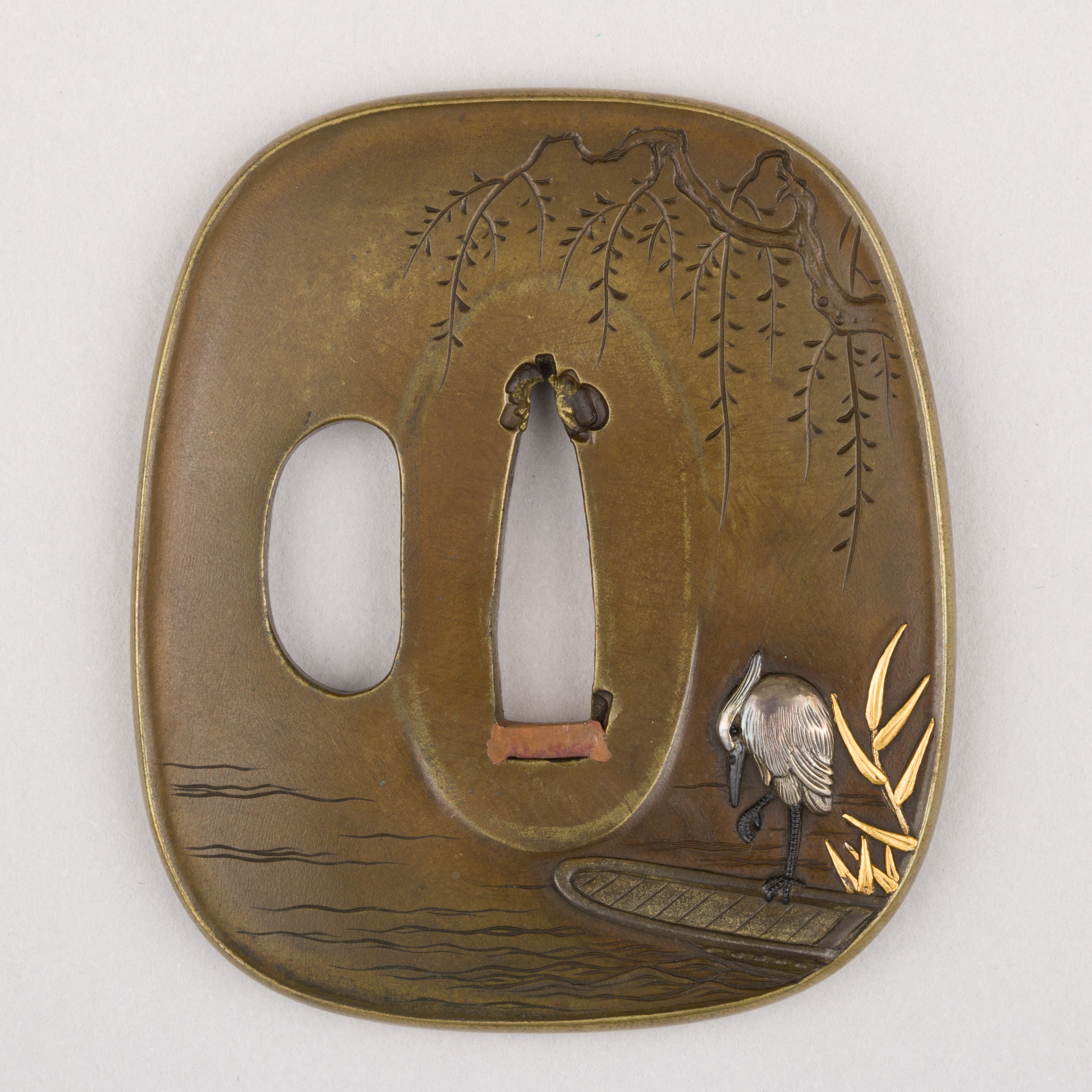
The Tsuba Deconstructed: An Avant-Garde Blueprint for SS26
At Zoey Fashion Laboratory, we do not merely observe artifacts; we dissect their latent potential. The Japanese sword guard, or tsuba, is a masterclass in functional restraint—a circular or lobed plate that simultaneously protects the hand, balances the blade, and announces the artisan’s philosophy. For SS26, we propose a radical reinterpretation: the tsuba as a wearable architecture of tension, asymmetry, and metallurgical alchemy. This is not a costume piece; it is a structural manifesto for a future where the body becomes both the weapon and the canvas.
Metallurgical Alchemy: From Shakudō to Bio-Luminescent Alloys
The tsuba’s material palette—brass, gold, silver, shakudō (a copper-gold alloy), and copper—is a laboratory of patina and light. Traditional shakudō, when treated with a specific solution, yields a deep, almost black-blue surface that catches gold inlays like stars against a night sky. For SS26, we extrapolate this into a new material language: thermochromic shakudō that shifts from indigo to violet under body heat, and micro-etched copper that refracts light into fractal patterns. Imagine a sculptural jacket where the shoulder armor—a direct descendant of the tsuba’s rim—is forged from a brass-gold composite that oxidizes unevenly, creating a living map of wear and environmental exposure.
This is not nostalgia; it is a recoding. The gold inlays, traditionally depicting dragons or chrysanthemums, are replaced by laser-sintered silver lattices that form a protective exoskeleton over the garment’s seams. The copper base becomes a conductive substrate for embedded LEDs, pulsing with the wearer’s heartbeat. The tsuba’s patina—once a sign of age and battle—is now a dynamic interface, a dialogue between the metal and the digital.
Silhouette as Armature: The Body as a Sword
The tsuba’s core function—to guard—is reimagined as a spatial relationship between the garment and the wearer. Traditional tsuba are flat, yet their negative space (the nakago-ana, or blade hole) suggests a void of power. For SS26, we invert this: the garment’s silhouette becomes a three-dimensional guard that encircles the torso, not the hand. Consider a deconstructed leather corset with a circular, laser-cut brass frame that floats 4 cm from the body, supported by carbon-fiber struts. The frame’s inner edge is lined with silver micro-spikes—a literal translation of the tsuba’s protective rim—that catch light without touching the skin.
This silhouette is deliberately asymmetrical. One shoulder is exaggerated into a sweeping, wing-like plate (inspired by the tsuba’s mimi, or rim), while the opposite side is bare, exposing a single arm clad in a copper-mesh gauntlet. The waist is cinched not by a belt but by a horizontal brass bar that mimics the tsuba’s seppa-dai (the central platform where the blade rests). The bar is articulated with gold hinges, allowing the wearer to adjust the garment’s tension—a nod to the tsuba’s role as a balancing point between the sword’s blade and hilt.
Structural Innovation: The Tsuba as a Load-Bearing System
In traditional Japanese swordsmithing, the tsuba is a compression member that absorbs shock and distributes force. For SS26, we apply this principle to garment construction through tensioned wire frameworks and cantilevered panels. A floor-length gown, for instance, features a tubular brass spine that runs from the nape to the hem, with lateral struts branching out like the ribs of a fan. The fabric—a lightweight, recycled shibori silk—is suspended between these struts, creating a negative space that echoes the tsuba’s cutouts. The result is a silhouette that moves like a pendulum, with the brass spine acting as the fulcrum.
Another prototype: a modular vest composed of interlocking copper discs, each etched with a unique geometric pattern derived from the tsuba’s ji (ground surface). The discs are connected by gold-plated rivets that allow 360-degree rotation, enabling the vest to collapse into a flat, circular form for storage—a direct translation of the tsuba’s portability. When worn, the discs overlap like scales, creating a chainmail-like armor that is both flexible and protective. The weight is distributed across the shoulders via a silver wire harness, a modern take on the tsuba’s fuchi (collar).
Futuristic Silhouettes: The Body as a Blade
The SS26 collection does not merely reference the tsuba; it embodies its geometry. The circular form is repeated in halo necklaces that frame the face, orbital shoulder pads that rotate with the arm, and annular skirts that are stiffened with brass wire to maintain a perfect O-shape. The asymmetry of the tsuba’s cutouts—often shaped like leaves or clouds—is translated into laser-cut leather panels that reveal glimpses of the skin beneath, creating a play of concealment and exposure.
For the finale piece, we propose a full-body exoskeleton constructed from a single sheet of shakudō-coated titanium. The exoskeleton is perforated with a pattern of hexagonal voids that reduce weight while maintaining structural integrity. The front is open, exposing a gold-mesh bodysuit that mimics the tsuba’s inlay work. When the wearer moves, the exoskeleton’s edges—sharpened to a razor’s edge—catch the light, creating a silhouette that is both predatory and protective. This is the tsuba as a second skin, a guard for the future.
Conclusion: The Tsuba as a Philosophical Object
The tsuba is not a relic; it is a diagram of power. It teaches us that protection is not passive but active, that beauty emerges from function, and that asymmetry can be a form of balance. For SS26, Zoey Fashion Laboratory reimagines this artifact as a blueprint for a new kind of fashion—one that is architectural, metallurgical, and kinetic. The body becomes the blade, the garment becomes the guard, and the line between adornment and defense dissolves. This is avant-garde couture as a practice of radical materialization, where every seam, every alloy, and every void is a statement of intent. The future is forged, not sewn.