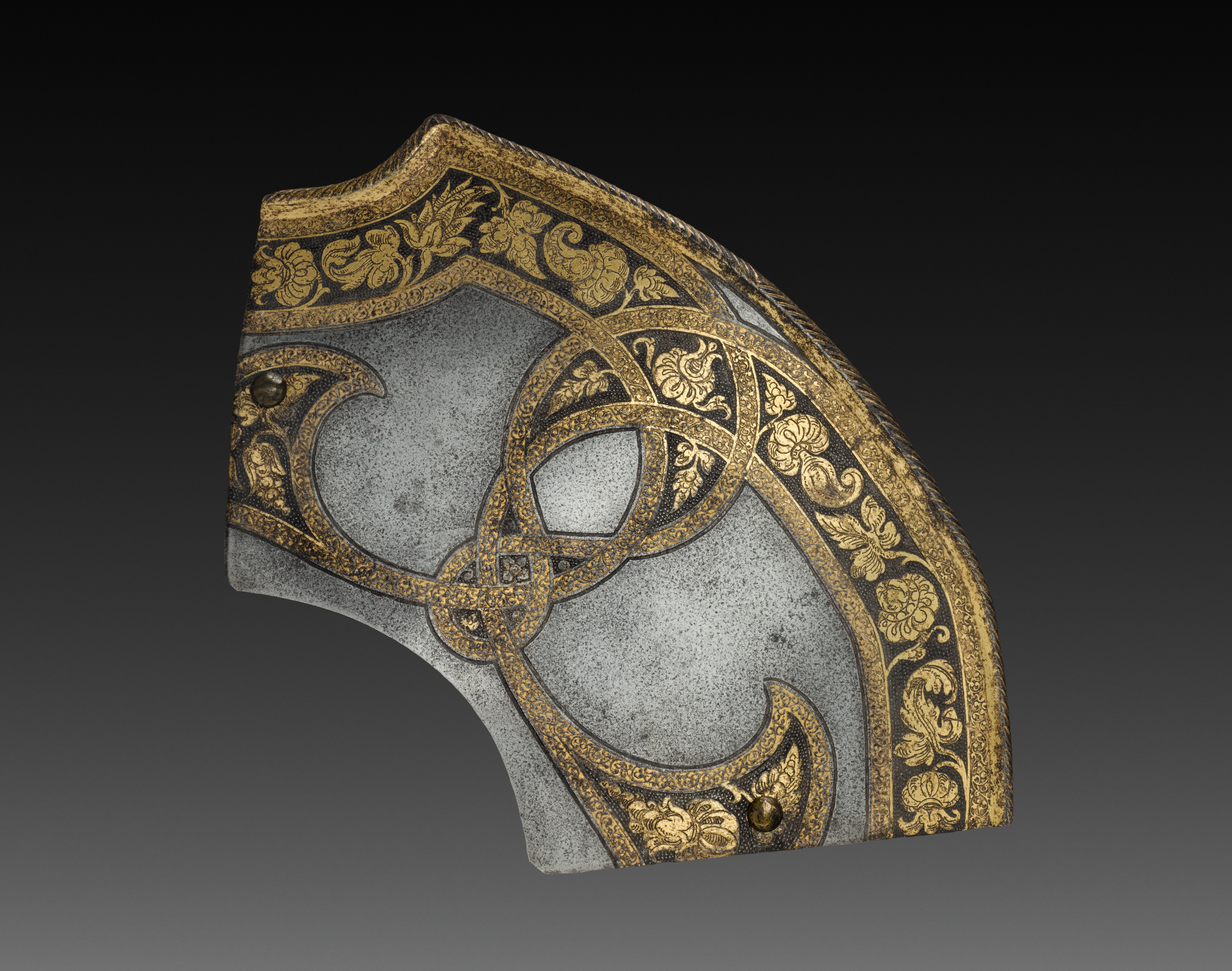
Deconstructing the Pommel Plate: An Avant-Garde Analysis of the "Flechtband" Garniture
At Zoey Fashion Lab, we approach historical artifacts not as relics but as raw DNA—blueprints for radical reinterpretation. The Pommel Plate of a Saddle from the "Flechtband" Garniture of Rudolf II and Archduke Ernst, crafted in Augsburg, Germany, is a masterclass in controlled chaos. Its technical execution—blued, etched, and gilded steel—speaks to a precision that borders on the obsessive. Yet, beneath the surface of imperial armor lies a subversive energy that resonates deeply with avant-garde fashion principles. This analysis dismantles the plate’s material vocabulary to extract a new design language—one that challenges symmetry, embraces entropy, and redefines ornamentation as a form of rebellion.
Material Alchemy: The Blued, Etched, and Gilded Steel as a Tension Fabric
The plate’s surface is a battlefield of processes. The bluing—a chemical oxidation that transforms steel into a deep, almost nocturnal blue—creates a backdrop of infinite depth. This is not a passive color; it is a void that absorbs and reflects light unevenly, much like a black hole in textile form. In an avant-garde context, this translates to a fabric that shifts between matte and iridescent, achieved through micro-pleating or laser-etched metallic threads. The etching, meanwhile, introduces linear violence: delicate lines carve into the metal, forming the "Flechtband" (braided band) patterns that mimic organic growth. These are not decorative; they are scars of intention, a deliberate disruption of the plate’s smoothness. For fashion, this suggests a garment where seams are exposed, not hidden—where stitching becomes a visual narrative of construction and deconstruction.
The gilding—applied in selective highlights—adds a layer of opulent decay. Gold, traditionally a symbol of eternal power, is here used sparingly, almost as an afterthought. It catches the eye but does not dominate, creating a rhythm of interruption. This is a direct challenge to the maximalist tendencies of historical armor. In the lab, we translate this into a "gilded fray": thin, gold-plated threads that are deliberately frayed or left unfinished, woven into a base of oxidized copper or steel mesh. The result is a textile that feels both ancient and futuristic, a material that whispers of courtly luxury while screaming of industrial decay.
Structural Subversion: From Armor Plate to Soft Architecture
The pommel plate is a convex shield designed to protect the rider’s hand. Its form is inherently protective, rigid, and gendered—a masculine exoskeleton. Yet, the "Flechtband" pattern betrays a vulnerability: the braided motifs are fluid, almost textile-like in their repetition. They mimic the interlocking of threads, suggesting that even the hardest steel can be woven. This paradox is the core of our avant-garde reading. The plate is not a barrier but a membrane—a transitional space between the rider’s body and the horse, between control and surrender.
In fashion, this translates to a new silhouette: the "armor-as-drape." Imagine a jacket where the shoulders are reinforced with blued steel panels, but the panels are cut into strips and interlaced with sheer silk organza. The rigidity of the steel is subverted by the fluidity of the fabric, creating a structure that moves like liquid metal. The pommel plate’s curvature informs a bustier that cups the body not as a cage but as a second skin, with etched patterns that follow the wearer’s breath. The gilded accents become focal points for asymmetry—a single gold stripe tracing the spine, not the center line. This is not protection; it is provocation.
Pattern as Code: The "Flechtband" as a New DNA Strand
The "Flechtband" pattern is the artifact’s most avant-garde element. It is not a heraldic emblem or a naturalistic motif; it is a geometric abstraction that predates modernism by centuries. The braided lines loop and intersect with no clear beginning or end, creating a visual infinity. In the context of Rudolf II’s court—a hotbed of alchemy, occultism, and scientific curiosity—this pattern was likely a coded reference to the interconnectedness of all things. For Zoey Fashion Lab, it becomes a new DNA strand: a repeatable, scalable motif that can be deconstructed and recombined.
We propose a "Flechtband" algorithm for digital textile printing. The pattern is broken into its core components—loops, crosses, and gaps—and reassembled using generative design software. The result is a fabric that evolves with each iteration, never repeating exactly. This is fashion as living code, where the garment’s surface is a dynamic map of its own creation. The blued background becomes a digital void, with the etched lines rendered in phosphorescent ink that glows in low light. The gilding is replaced by micro-LEDs embedded in the fabric, creating a constellation of light that mirrors the pattern’s infinite loops. The pommel plate’s original function—to protect—is inverted: now, the pattern protects nothing but its own complexity.
Avant-Garde Application: The Deconstructed Saddle as Wearable Sculpture
To actualize this analysis, Zoey Fashion Lab proposes a capsule collection titled "Flechtband: The Unraveling." The centerpiece is a deconstructed saddle dress. The bodice is constructed from blued steel mesh, laser-cut to mimic the pommel plate’s curvature but left open at the sides to expose the wearer’s skin. The "Flechtband" pattern is etched into leather panels that drape from the shoulders like reins, terminating in gilded brass tips. The skirt is a cascade of braided silk cords, each strand dyed in gradient hues of blue and gold, referencing the bluing and gilding processes. The overall effect is one of controlled unraveling—a garment that suggests both imperial authority and its imminent collapse.
Accessories include a "pommel cuff": a rigid bracelet of blued steel that wraps around the forearm, with etched grooves that allow it to flex. The gilding is applied only to the inner edge, so the wearer sees gold when they look down, while others see only steel. This is a private luxury, a secret language of power. Footwear takes the form of "etched boots": leather ankle boots with steel toe caps etched with the "Flechtband" pattern, the bluing oxidized to a matte finish. The heels are hollow, containing small compartments for hidden messages or talismans—a nod to Rudolf II’s fascination with the occult.
Conclusion: The Armor of the Future
The Pommel Plate of the "Flechtband" Garniture is not a static object; it is a provocation. Its blued steel, etched patterns, and gilded accents are not merely decorative—they are a vocabulary of tension, decay, and rebirth. For Zoey Fashion Lab, this artifact serves as a blueprint for an avant-garde that rejects nostalgia in favor of radical reinterpretation. The "Flechtband" pattern, in particular, offers a new DNA strand for fashion: a code that can be endlessly rewritten, a geometry that defies closure. By deconstructing the pommel plate, we do not honor the past; we weaponize it, forging garments that are both armor and art, protection and provocation. This is not fashion as adornment; it is fashion as alchemy—a transformation of steel into silk, of history into the future.