The Logic of the Lacunae: Insertion as Structural Genesis
In the lexicon of avant-garde couture, the term "insertion" often connotes a secondary act, a grafting of one element onto a pre-existing form. Yet for Zoey Fashion Laboratory’s SS26 collection, insertion is reimagined as the primary generative principle. It is not an addition but a genesis—a deliberate void that defines the surrounding volume. This analysis dissects how bobbin lace, a material historically associated with domestic craft and ornamental delicacy, is weaponized against its own heritage to produce futuristic silhouettes that challenge the very architecture of the garment.
Deconstructing the Global Frontier: Lace as Digital Topography
The origin of this collection is deliberately ambiguous, a "Global Frontier" that exists not as a geographic location but as a conceptual space between tradition and technology. Bobbin lace, with its intricate network of twisted and crossed threads, becomes the perfect medium for this liminality. Each loop and braid is a node in a manual network, a precursor to digital mesh. The insertion technique here is not a patch but a strategic excision of the ground fabric, replaced by lace panels that act as translucent membranes.
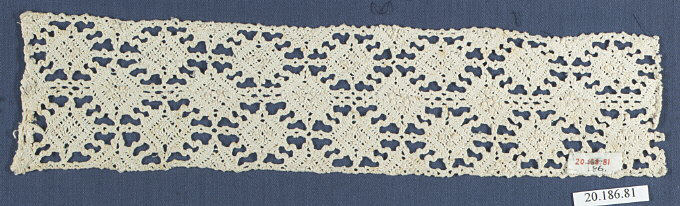
These are not the delicate floral motifs of Bruges or Chantilly. Instead, the lace is engineered with asymmetrical, tessellated patterns that mimic satellite imagery or cellular automata. The voids within the lace are not decorative; they are structural lacunae that expose the body in fragmented, non-linear ways. The silhouette is no longer a continuous envelope but a series of floating planes connected by these lace bridges. A jacket’s shoulder may dissolve into a web of thread, leaving the arm suspended in negative space, while the waist is cinched by a lace corset that reads as a carbon-fiber lattice.
The Architecture of Absence: Silhouettes of Controlled Instability
The futuristic silhouette for SS26 is defined by what is absent as much as by what is present. Insertion, in this context, allows for a modular construction that can be reconfigured in real-time. Consider a floor-length coat whose back panel is entirely replaced by a single, massive piece of bobbin lace. As the wearer moves, the lace billows and contracts, creating ephemeral volumes that shift between opaque and transparent, solid and ethereal. This is not a garment; it is a wearable architectural intervention.
The structural innovation lies in the tension-based engineering of the lace itself. Traditional bobbin lace is worked on a pillow with pins, creating a flat, static textile. Zoey Fashion Laboratory subverts this by integrating smart fibers and shape-memory alloys into the lace construction. When heat or electrical current is applied, specific sections of the lace contract or expand, altering the garment’s silhouette in real-time. A sleeve can be programmed to furl or unfurl, a neckline to rise or plunge. The insertion becomes a reactive membrane, a second skin that responds to the environment or the wearer’s biometrics.
Material Alchemy: Bobbin Lace as Structural Armature
The choice of bobbin lace is a deliberate provocation against the sleek, seamless aesthetic of fast fashion. The material’s inherent fragility is its greatest strength. Each thread is a line of force, and the insertion technique allows for gradients of density that mimic the load-bearing capacity of a geodesic dome. The lace is not applied as a surface decoration but as a primary structural armature that replaces traditional seams, darts, and linings.
For example, a bodice might be constructed entirely from lace panels inserted into a rigid, 3D-printed frame. The lace provides flexibility and breathability, while the frame maintains the silhouette’s extreme, futuristic geometry—think of a sharp, angular shoulder line that softens into a cascade of lace at the collarbone. This hybridization of hard and soft is the hallmark of SS26. The insertion points are not hidden; they are celebrated as visible joints, akin to the rivets on a steel beam or the stitches on a surgeon’s incision.
Kinetic Sculpture: The Garment as Living System
The final frontier is movement. Insertion allows for kinetic articulation that static fabrics cannot achieve. A skirt might feature multiple layers of lace inserted at varying tensions, creating a cascade of shifting opacity as the wearer walks. The lace acts as a moiré pattern, generating optical illusions of depth and motion. This is not merely a visual effect but a functional system that modulates temperature, airflow, and even sound. The rustle of the threads becomes a sonic signature, a whisper of the digital age.
Consider a dress whose entire back is a single, continuous insertion of bobbin lace, anchored at the shoulders and hips. As the wearer moves, the lace stretches and snaps back, creating a dynamic tension map that changes the garment’s silhouette second by second. This is couture as performance art, where the garment is never the same twice. The insertion becomes a record of motion, a frozen moment of a fluid system.
Conclusion: The Inserted Future
Zoey Fashion Laboratory’s SS26 collection redefines insertion as a paradigm of creation. Bobbin lace, once a symbol of patient domesticity, is reborn as a material of radical possibility. The Global Frontier is not a place to be conquered but a condition to be inhabited—a space of constant negotiation between the hand and the machine, the thread and the circuit, the void and the form. The futuristic silhouette is not about streamlining or minimalism; it is about controlled chaos, structural fragility, and the beauty of the gap. In this world, the insertion is not a seam; it is the entire point.