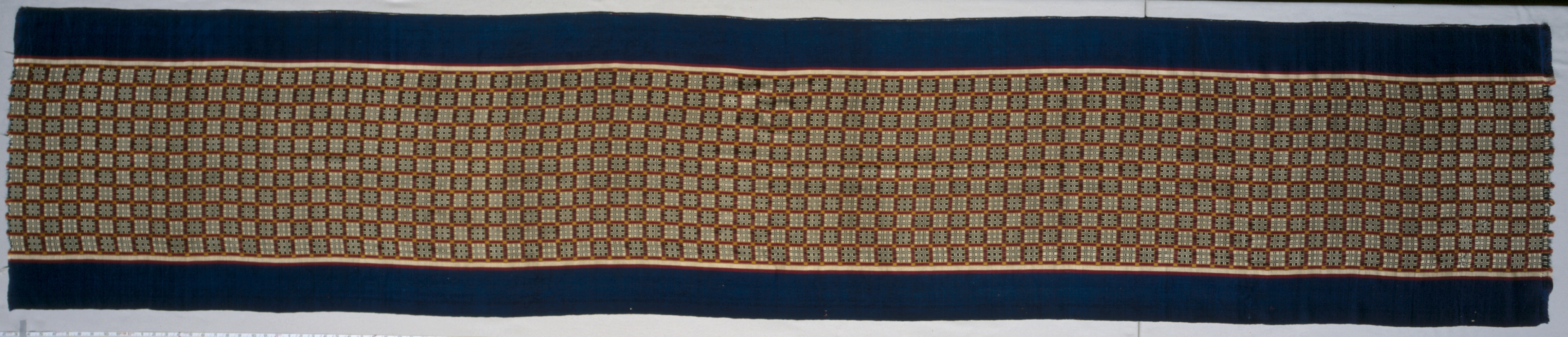
Deconstructing the Msimsim: An Avant-Garde Analysis of a Moroccan Wall Hanging
At Zoey Fashion Lab, our mandate is not merely to observe textiles but to deconstruct their genetic code. The subject of this analysis—a traditional Moroccan wall hanging known as a msimsim from Tétouan—presents a fascinating paradox. On the surface, it is a relic of North African craft: hand-dyed silk, woven by skilled hands in a lineage stretching back centuries. Yet, when viewed through our lens of Avant-Garde Deconstructionism, this object reveals itself as a New DNA Strand—a living blueprint for radical fashion. It is not an artifact to be preserved in amber, but a provocation to be unraveled, re-threaded, and re-imagined.
I. The Material Genome: Silk as a Radical Substrate
1.1. The Paradox of Silk
Silk is the original high-performance fiber. Its natural protein structure—sericin and fibroin—gives it a tensile strength comparable to steel on a weight-for-weight basis. In the msimsim, this silk is not a passive backdrop; it is an active participant. The weavers of Tétouan have historically used wild silk (Bombyx mori or indigenous variants), which possesses an irregular, slubbed texture that resists industrial uniformity. For the Avant-Garde, this irregularity is not a flaw but a signature of the hand. It introduces a stochastic, unpredictable element into the weave—a genetic mutation that disrupts the sterile perfection of mass production.
1.2. Dye as Alchemy
The dyes used in the msimsim are not mere colorants; they are chemical narratives. Traditional Moroccan dyers employed natural mordants (alum, iron, tannin) and plant-based pigments (madder for red, indigo for blue, saffron for yellow). In the Avant-Garde context, we treat these dyes as reactive agents. They are not fixed. They can be re-mordanted, over-dyed, or stripped to reveal hidden layers. The msimsim’s original palette—often a deep crimson or indigo—becomes a starting point for a chemical conversation. We can introduce pH shifts (using vinegar or ammonia) to create localized color changes, or apply resist techniques (like wax or starch) to disrupt the dye’s flow, mimicking the fractured, non-linear logic of a new DNA strand.
II. Structural Deconstruction: The Weave as a Blueprint
2.1. The Loom as a Machine of Possibility
The msimsim is typically woven on a horizontal ground loom, a tool that predates the industrial revolution by millennia. Its structure is based on warp-faced plain weave or twill, creating a dense, durable fabric. For the Avant-Garde, this weave is not a finished product but a scaffold. We propose a de-weaving protocol: selectively removing warp or weft threads to create negative space. This is not destruction; it is re-composition. The remaining threads can be re-tensioned, twisted, or knotted to form three-dimensional reliefs—a topographical map of the original pattern. The msimsim’s geometric motifs (often diamonds, stars, or zigzags) become architectural elements that project off the fabric plane.
2.2. The Fringe as a Radical Edge
Traditional msimsim often feature fringed edges, formed by the unwoven warp ends. In our analysis, this fringe is not a decorative afterthought but a threshold—a zone where the fabric dissolves into raw fiber. We propose exaggerating this threshold by unraveling additional warps to create a frayed, organic border. This fringe can then be braided, beaded, or left to dangle as a deconstructed hem, challenging the conventional notion of a finished edge. The msimsim’s fringe becomes a literal unraveling of the garment’s boundary, echoing the Avant-Garde’s obsession with liminality and transition.
III. The New DNA Strand: A Framework for Avant-Garde Garments
3.1. From Wall to Body
The msimsim is a two-dimensional object designed for vertical display. To transform it into an Avant-Garde garment, we must re-orient its axis. The warp direction (vertical on the wall) can become the horizontal circumference of a dress or the radial structure of a cape. The geometric motifs, when cut and re-pieced, can form asymmetrical panels that drape in unexpected ways. The dense silk becomes a sculptural medium, capable of holding sharp pleats, dramatic gathers, or rigid folds. We envision a deconstructed caftan where the msimsim’s original pattern is sliced into horizontal bands, each band shifted slightly off-register to create a visual stutter—a genetic mutation in the pattern’s code.
3.2. Dye as a Narrative of Time
The msimsim’s natural dyes are photosensitive and pH-sensitive. In our Avant-Garde application, we can exploit this instability. A garment made from the msimsim could be designed to change color over time as it is exposed to light, sweat, or washing. This is not a flaw but a living archive—a record of the wearer’s interaction with the fabric. We propose a gradual dye-release system: the msimsim’s original indigo could be over-dyed with a fugitive pigment that fades to reveal the underlying red, creating a time-lapse of the garment’s history. This aligns with the Avant-Garde’s interest in ephemerality and process.
3.3. The Weaver as a Co-Designer
Finally, we must acknowledge the human element. The Tétouan weaver is not a passive artisan but an active collaborator in this deconstruction. Their hand gestures, tension choices, and dye recipes are encoded in the fabric’s DNA. Our role as Chief Fabric Deconstructionist is to amplify these signals, not erase them. The msimsim’s imperfections—a dropped thread, a uneven dye bath, a misaligned motif— become precious artifacts of the human touch. In the Avant-Garde garment, these imperfections are celebrated, not corrected. They are the signatures of a living process.
IV. Conclusion: The Msimsim as a Catalyst
The Moroccan msimsim from Tétouan is not a static relic. It is a dynamic system—a New DNA Strand waiting to be re-sequenced. By deconstructing its materials (silk, dye), its structure (weave, fringe), and its cultural context (weaver, tradition), we unlock a radical potential for Avant-Garde fashion. It becomes a provocation: a garment that unravels as it is worn, a color that shifts with time, a pattern that mutates across the body. At Zoey Fashion Lab, we do not preserve the past; we deconstruct it to build the future. The msimsim is our raw material, and the Avant-Garde is our laboratory.