Deconstructing the Throne: An Avant-Garde Analysis of the Armchair as Architectural Silhouette for SS26
Introduction: The Armchair as a Proto-Futurist Artifact
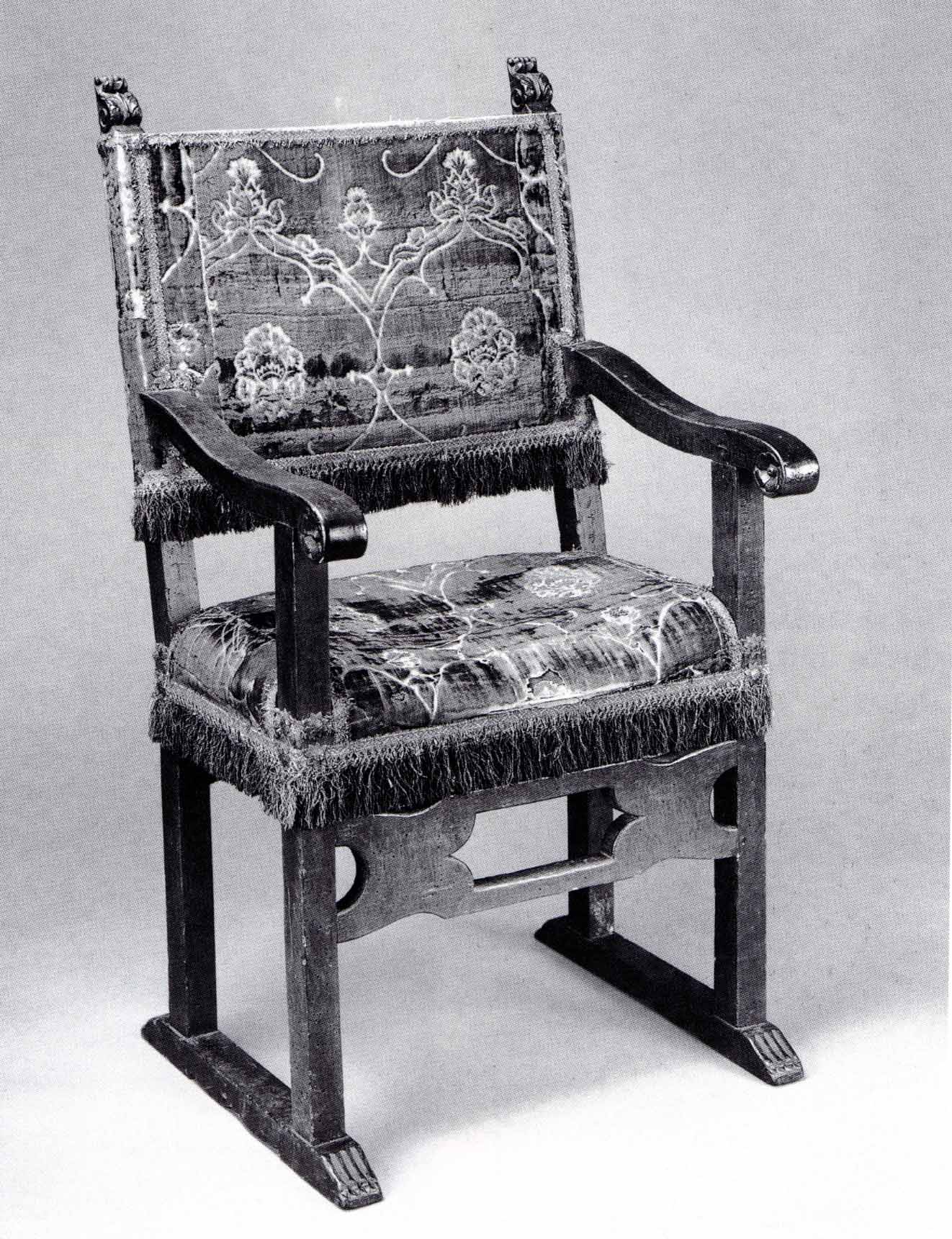
The armchair, a relic of domestic comfort and hierarchical seating, is traditionally understood through the lens of ergonomics and bourgeois repose. However, when we subject an Iberian or Flemish carved walnut frame, upholstered in dark red silk and satin cut velvet with gilt metal fringe, to a rigorous avant-garde analysis, it ceases to be mere furniture. It becomes a structural manifesto—a dialogue between the rigid, linear geometry of the woodwork and the voluptuous, almost liquid, decadence of its textile skin. For the Zoey Fashion Laboratory SS26 collection, this object is not a source of inspiration but a template for deconstructing the human silhouette. The armchair’s inherent tension between support and ornament, between the vertical thrust of its turned legs and the horizontal expanse of its seat, offers a blueprint for reimagining the body as an architectural vessel. We are not looking to replicate its form; we are dissecting its structural logic to engineer garments that challenge the very notion of wearability.
I. The Walnut Frame: Carving the Skeletal Silhouette
The carved and turned walnut of the armchair’s frame is a study in controlled asymmetry and tensile strength. The vertical elements—the legs and back posts—are not merely supports but exoskeletal struts. In an avant-garde context, this translates directly into a silhouette that prioritizes linear elongation and angular articulation. For SS26, we propose a series of dresses and jackets where the human spine is mirrored by an external, articulated walnut-like structure. This is not a corset; it is a kinetic framework. Imagine a gown where the central seam is replaced by a series of carved, polished walnut panels, joined by precision hinges of gilt metal, allowing the wearer to move with a robotic, almost insectoid grace. The turned elements—those bulbous, rounded forms on the armrests—are reimagined as shoulder epaulets or hip protrusions, creating a silhouette that is simultaneously armored and organic. The wood is not a costume piece; it is a structural innovation that forces the body to adopt new postures, turning the wearer into a living sculpture. The negative space between the carved elements becomes equally important, suggesting cutouts in leather or molded synthetics that reveal the skin as a pale, vulnerable contrast.
II. The Velvet and Satin: Draping the Decadent Second Skin
The dark red silk and satin cut velvet of the armchair’s upholstery is a paradox: it is both opulent and oppressive. The velvet’s pile creates a depth of shadow, while the satin’s sheen introduces a luminous tension. In the Zoey Fashion Laboratory, we do not simply drape fabric; we engineer surface. For SS26, this textile is deconstructed into a series of floating panels that mimic the cut velvet’s pattern—where the pile is cut away to reveal a lower, contrasting weave. This technique is translated into a garment where laser-cut layers of velvet and satin are suspended from the walnut framework, creating a voluminous, yet transparent, silhouette. The dark red is not a color; it is a mood of restrained passion, a chromatic anchor that grounds the otherwise aggressive structure. The satin is used for fluid, draping elements that spill from the rigid wooden struts, evoking the armchair’s original comfort but subverting it into a deliberate, almost dangerous, elegance. The velvet’s pile is manipulated through crushing and pleating, creating a map of tactile surfaces that invite touch while asserting distance. The silhouette here is asymmetrical and layered, with one shoulder heavily draped in velvet while the other is exposed, supported only by a thin walnut armature.
III. The Gilt Metal: The Fringe of Futurist Decoration
The gilt metal tape and fringe with gilt-metal thread are the most overtly decorative elements, yet they are also the most structurally radical. In traditional context, the fringe softens the armchair’s edges, adding a note of luxury. In our avant-garde analysis, the fringe becomes a kinetic, metallic exoskeleton. For SS26, we propose a series of chainmail-like garments where the gilt metal tape is woven into a flexible, yet rigid, lattice. This is not a fringe that hangs; it is a fringe that stands, that defines the silhouette’s perimeter. Imagine a skirt where the hem is not a line but a cascade of interlocking gilt metal loops, each one catching the light and clinking with every step. The fringe is also used to accentuate the structural joints—where the walnut meets the velvet, the metal fringe acts as a transitional membrane, blurring the boundary between hard and soft. The gilt-metal thread is embroidered directly into the velvet, creating a network of conductive pathways that suggest a garment that is not just worn but energized. The silhouette becomes a constellation of metallic sparks against the dark red void, a futuristic vision of ornament as function.
IV. Synthesis: The Armchair as Wearable Architecture for SS26
The final synthesis of these elements—walnut, velvet, and gilt metal—yields a collection that is neither nostalgic nor purely futuristic. It is a temporal collision. The armchair’s Iberian or Flemish origin is not a historical reference but a foundation for structural innovation. The SS26 Zoey Fashion Laboratory collection will feature garments that are modular and transformable, where the walnut frame can be disassembled and reconfigured, the velvet drapes can be tightened or loosened, and the gilt metal fringe can be detached and worn as separate jewelry. The silhouette is architectonic: wide at the shoulders, narrow at the waist, and exploding into a cascade of velvet and metal at the hips. The back of the garment is as important as the front, echoing the armchair’s three-dimensional presence. The human body becomes the armchair’s ghost, a phantom that animates the structure. This is not clothing; it is habitable sculpture. The wearer is not a model but a curator of their own structural identity, moving through space as a living armchair—a throne of deconstructed luxury, a monument to the power of silhouette.