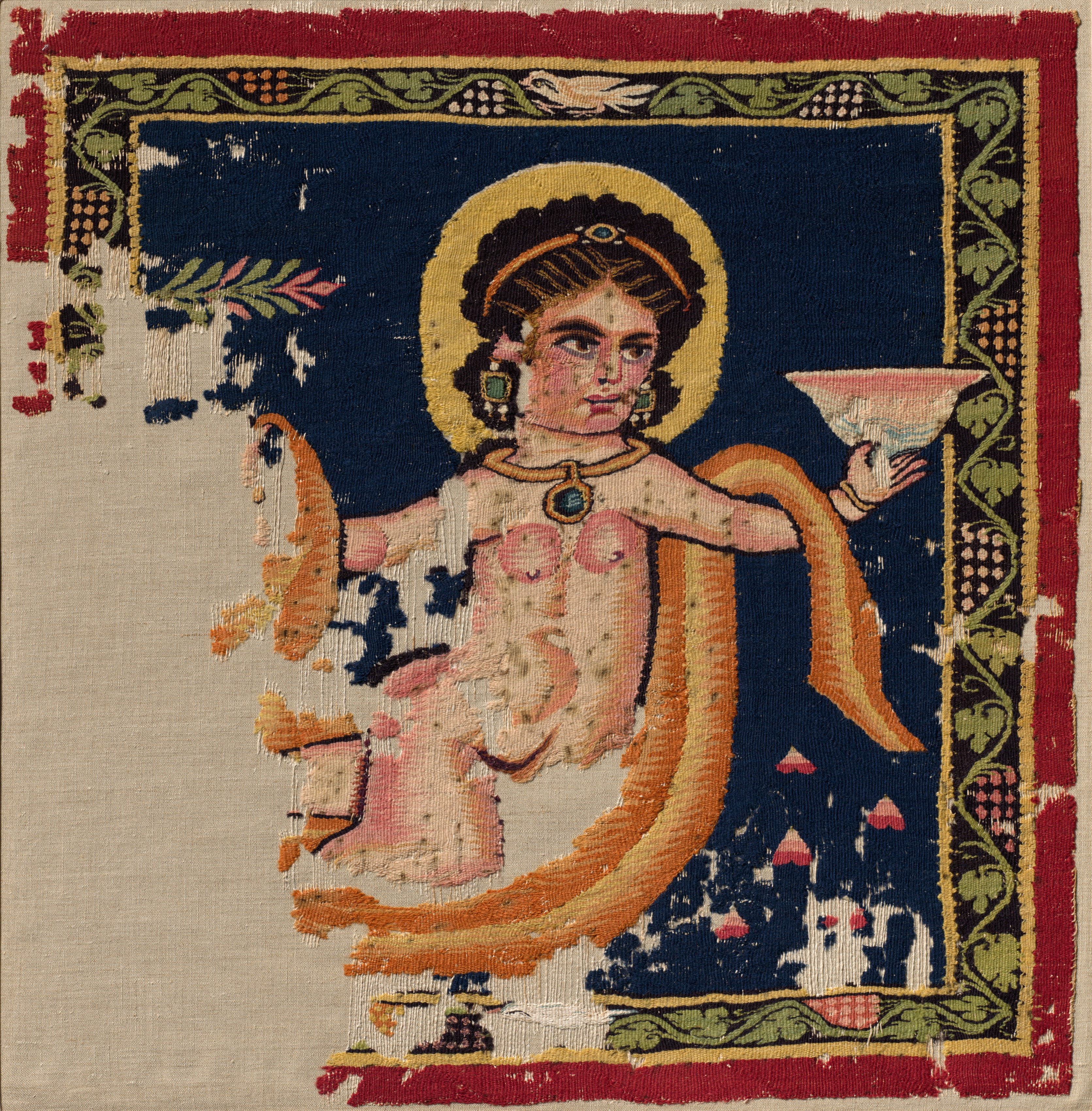
Technical Deconstruction: The Nereid Hanging as a Textile Anomaly
The subject under analysis—a fragment depicting a Nereid (sea-nymph) from a hanging textile—presents a paradox of materiality and cultural resonance. Originating from the Byzantine Empire, specifically Egypt (circa 6th–7th century CE), this piece employs dyed wool and undyed linen in a technique that blends Hellenistic iconography with Coptic weaving traditions. At Zoey Fashion Lab, we approach this artifact not as a relic but as a proto-avant-garde statement: a textile that disrupts linear time by embedding a pagan sea deity within a Christianized imperial context. The technical choice of wool (dyed) against linen (undyed) creates a deliberate tension—the former absorbs color, the latter resists it—mirroring the cultural friction between classical mythology and Byzantine orthodoxy. This is not mere decoration; it is a fabric deconstruction of identity, where the Nereid’s flowing form becomes a metaphor for the fluid boundaries of empire and belief.
Material Semiotics: Wool, Linen, and the Politics of Dye
The dyed wool in this hanging is not a neutral aesthetic choice. Wool, sourced from sheep in the Nile Delta or imported from Anatolia, was a medium of status and symbolism in Byzantine Egypt. The specific dyes—likely madder for reds, woad or indigo for blues, and possibly kermes for crimson—were extracted from organic sources, each carrying economic and ritual weight. The undyed linen, by contrast, is a structural anchor: its natural beige or ivory hue evokes the raw earth of the Egyptian landscape, a reminder of the textile’s local provenance. This juxtaposition is a technical avant-garde gesture avant la lettre. By leaving the linen uncolored, the weaver emphasizes the Nereid’s otherworldliness—she emerges from the ground of the undyed fabric, a spectral figure riding a sea creature (likely a hippocampus or dolphin) across a field of warp and weft. The wool’s chromatic intensity, achieved through repeated dye baths, creates a visual hierarchy that privileges the mythological over the mundane. For Zoey Fashion Lab, this material choice prefigures contemporary deconstructionist practices, where raw, unfinished edges or unbleached fabrics are used to expose the labor and history embedded in clothing.
Weaving as Cultural Collision: The Nereid in Coptic Context
The Nereid motif itself is a site of cultural collision. In classical Greek mythology, Nereids were benevolent sea nymphs, daughters of Nereus, often depicted accompanying Poseidon or rescuing sailors. By the Byzantine period, however, such pagan imagery was increasingly marginalized in official art, replaced by Christian saints and biblical narratives. Yet here, in a hanging from Egypt—a region where Coptic Christianity coexisted with lingering Hellenistic traditions—the Nereid survives as a decorative element, perhaps commissioned by a wealthy patron with secular tastes. The weaving technique, likely a slit tapestry method typical of Coptic textiles, uses discontinuous wefts to create sharp color blocks, resulting in a stylized, almost abstract rendering of the nymph’s flowing hair and drapery. This abstraction is not a failure of realism but a deliberate formal choice: the weaver reduces the Nereid to essential lines and planes, anticipating the geometric distortions of 20th-century avant-garde art. The hanging thus becomes a document of cultural hybridity—a Byzantine artifact that refuses to abandon its pagan roots, much as Zoey Fashion Lab’s deconstructive collections refuse to adhere to a single historical narrative.
Archive Resonance: The 16th–17th Century Lens and the Avant-Garde Echo
The reference provided—Archive Resonance: 在人类文明的长河中,器物与绘画不仅是时代技艺的结晶,更是文化碰撞与美学交融的无声见证。十六至十七世纪....—frames this artifact within a broader discourse of cross-cultural exchange. The 16th and 17th centuries, marked by the Silk Road’s decline and the rise of maritime trade, saw textiles as primary vehicles of aesthetic transfer. The Nereid hanging, though earlier, resonates with this later period’s fascination with exoticism and hybridity. When European collectors encountered Coptic textiles in the 19th and early 20th centuries, they often misread them as purely “Egyptian” or “Islamic,” ignoring the Byzantine and Hellenistic layers. This misreading is itself an avant-garde act: it liberates the textile from its original context, allowing it to be reimagined in new assemblages. For Zoey Fashion Lab, the Nereid hanging is a precursor to the “archive resonance” concept—where objects from disparate times and places are brought into dialogue through deconstruction. The nymph’s undulating form, rendered in dyed wool against undyed linen, anticipates the way contemporary designers like Rei Kawakubo or Martin Margiela use fabric to disrupt narrative coherence, creating garments that are both ancient and futuristic.
Formal Analysis: Deconstructing the Nereid’s Visual Syntax
Let us examine the hanging’s formal elements through an avant-garde lens. The composition is likely fragmentary, with the Nereid centered against a plain or patterned ground. Her body is elongated, with exaggerated curves that suggest movement—a technique that flouts natural proportions in favor of rhythmic flow. The dyed wool creates a palette of deep blues, greens, and reds, evoking the sea’s depths and the nymph’s vitality. The undyed linen, used for the background or specific details (perhaps the sea creature’s body), introduces a tactile contrast: the wool’s soft, absorbent surface versus the linen’s crisp, reflective sheen. This interplay of textures is a deconstructionist strategy, forcing the viewer to confront the materiality of the image rather than its illusionistic content. The weaving technique itself—where each weft thread is manually inserted and beaten down—leaves subtle irregularities: slight gaps between color fields, variations in thread tension, and a visible warp structure. These “imperfections” are not flaws but signatures of the hand, prefiguring the Japanese concept of wabi-sabi and the avant-garde celebration of the unfinished. In Zoey Fashion Lab’s practice, we intentionally expose such structural elements—raw seams, hanging threads, visible darning—to honor the labor of making and to challenge the myth of seamless perfection.
Avant-Garde Implications: The Nereid as Proto-Conceptual Textile
What does this 6th-century hanging teach us about avant-garde fashion? First, it demonstrates that deconstruction is not a modern invention but a recurring impulse in textile history. The Coptic weaver’s choice to juxtapose dyed and undyed fibers, to prioritize abstraction over naturalism, and to embed a pagan motif in a Christian context, all anticipate the conceptual strategies of 20th- and 21st-century designers. Second, the hanging’s materiality—its wool and linen, its dyes and weaves—embodies a resistance to commodification. Unlike mass-produced textiles, this artifact bears the trace of individual hands and local ecologies, a quality that avant-garde fashion seeks to reclaim through artisanal techniques and slow production. Finally, the Nereid herself, as a liminal figure between sea and land, human and divine, pagan and Christian, serves as a metaphor for the deconstructed garment: a form that refuses fixed identity, inviting constant reinterpretation. For Zoey Fashion Lab, this hanging is not a historical artifact to be preserved but a catalyst for new creations—a resonance that vibrates across centuries, urging us to weave our own cultural collisions into fabric.
Conclusion: Weaving Time into Textile
The Nereid from a Byzantine Egyptian hanging is, at its core, a deconstruction of time itself. Its dyed wool and undyed linen speak to a moment of cultural flux, where classical myths persisted in Christian contexts and local traditions merged with imperial aesthetics. For Zoey Fashion Lab, this artifact is a blueprint for avant-garde practice: it teaches us to embrace contradiction, to elevate material over narrative, and to see textiles as living documents of human exchange. As we continue our work as Chief Fabric Deconstructionist, we will draw on this Nereid’s legacy—its fragmented form, its chromatic intensity, its refusal to be pinned down by history. In doing so, we honor the weaver’s silent rebellion, transforming a hanging from the past into a garment for the future.