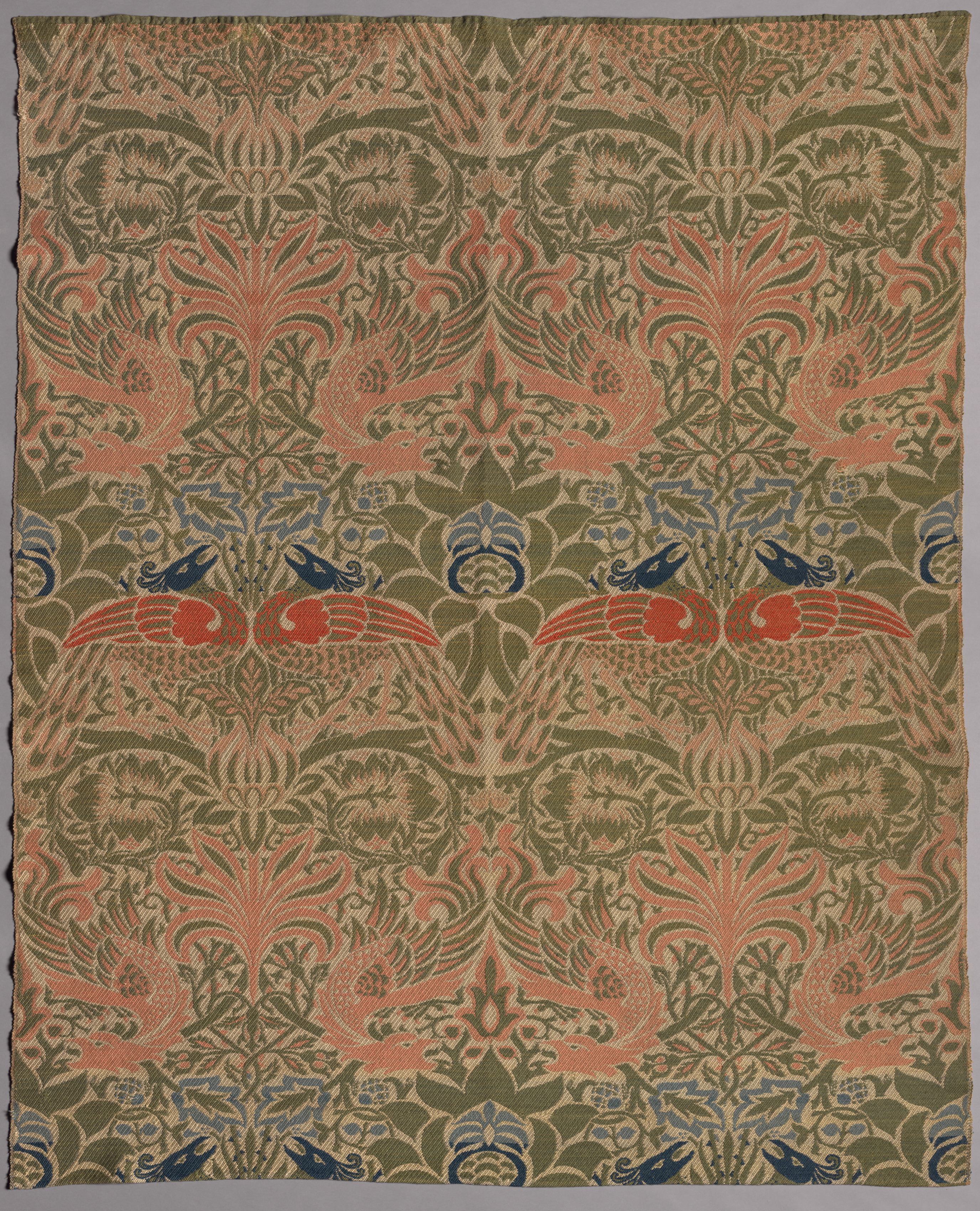
Deconstructing the Avant-Garde: A Fabric Analysis of "Peacock and Dragon"
At Zoey Fashion Lab, we approach historical textiles not as relics, but as radical blueprints for future design. The subject of this analysis—a weft-faced compound twill wool textile titled "Peacock and Dragon", originating from Merton Abbey, Surrey, England—presents a unique opportunity to bridge the opulent past with the disruptive ethos of the avant-garde. This fabric, with its intricate interplay of Eastern and Western motifs, technical precision, and material honesty, serves as a profound case study in deconstruction and reimagination.
Origin and Context: Merton Abbey’s Legacy
The provenance of "Peacock and Dragon" is critical to understanding its avant-garde potential. Merton Abbey, a historic tapestry and textile works in Surrey, was a crucible of the Arts and Crafts Movement under William Morris. This movement was, in its own time, an avant-garde rebellion against the dehumanizing effects of industrialization. Morris championed handcraft, natural dyes, and a return to medieval and non-Western design sources. The choice of wool—a humble, organic fiber—over silk or synthetic blends reflects a deliberate anti-consumerist stance. For a contemporary deconstructionist, this origin story is a manifesto: true innovation often arises from a radical re-engagement with tradition, not its rejection. The "Peacock and Dragon" pattern, with its stylized, sinuous forms, directly references Persian and Chinese textile designs, which Morris admired for their flat, non-illusionistic space. This cross-cultural appropriation, executed with English precision, creates a fertile ground for avant-garde reinterpretation.
Technical Analysis: Weft-Faced Compound Twill
The technical structure of this fabric is a masterclass in controlled complexity. A weft-faced compound twill is a weave where the weft threads dominate the surface, creating a dense, patterned fabric with a distinct diagonal ribbing. Unlike a simple twill, the "compound" aspect indicates multiple warp or weft systems—often a main warp and a binding warp—that allow for intricate, multi-colored designs without the structural weakness of a tapestry weave. In "Peacock and Dragon," the wool wefts are likely dyed in deep indigos, rich ochres, and verdant greens, creating a luminous, almost painterly surface. The twill structure provides durability and a subtle, directional sheen, while the weft-faced nature ensures that the pattern remains crisp and unbroken.
For the avant-garde designer, this technical foundation offers a paradox: the fabric is both rigid and fluid. The compound twill’s structural discipline can be subverted through deconstruction. By selectively cutting or fraying the weft threads, the underlying warp grid can be exposed, creating a distressed, "unfinished" aesthetic. Alternatively, the fabric’s dense surface can be manipulated through heat or pressure—wool is thermoplastic—to create sculptural, three-dimensional folds that distort the peacock and dragon motifs. This technical understanding allows us to treat the textile not as a finished product, but as a raw material for further transformation.
Motif Deconstruction: Peacock and Dragon as Avant-Garde Symbols
The titular motifs—the peacock and the dragon—are laden with symbolic weight. In Morris’s original context, the peacock represented beauty, vanity, and immortality, while the dragon symbolized power, wisdom, and the exotic East. Together, they form a harmonious, decorative tableau. However, in an avant-garde framework, these symbols must be fractured and recontextualized. The peacock’s eye-like tail feathers can be isolated and repeated as a hypnotic, optical pattern, reminiscent of Op Art. The dragon’s serpentine body can be abstracted into a series of jagged, angular lines, referencing Cubist fragmentation. The juxtaposition of these two creatures—one avian, one reptilian—can be pushed to extremes: the peacock’s fragility against the dragon’s ferocity, the organic against the geometric. By deconstructing the narrative harmony, we reveal a tension that is inherently modern and disruptive.
Archive Resonance: The 16th-17th Century Bridge
The reference to "Archive Resonance" and the 16th-17th centuries is not merely historical decoration; it is a conceptual key. This period saw an unprecedented flow of goods and ideas between East and West, driven by trade routes and colonial expansion. Textiles were primary carriers of cultural DNA. The peacock and dragon motifs, while filtered through Morris’s Arts and Crafts lens, originally derived from Chinese and Persian silks that were highly prized in European courts. This historical moment of cultural collision is a template for the avant-garde’s own obsession with hybridity and dislocation. By acknowledging this resonance, we position "Peacock and Dragon" as a node in a network of global exchange, rather than a static English artifact. The deconstructionist’s task is to amplify this hybridity—perhaps by introducing materials or techniques from the original source cultures, such as gold-thread embroidery from China or block-printing from India—to create a textile that speaks to our own era of globalized identity.
Materiality and the Avant-Garde: Wool as a Radical Choice
Wool, as a fiber, is often associated with warmth, tradition, and comfort. In the context of an avant-garde fashion lab, wool is a subversive choice. It is not the slick, synthetic futurism of polyester or the ethereal luxury of silk. Wool is earthy, tactile, and unpredictable. It can be felted, shrunk, stretched, or scorched. The weft-faced compound twill structure, when executed in wool, creates a fabric that is both heavy and malleable. For Zoey Fashion Lab, this materiality suggests a design language of tactile dissonance. Garments could be constructed with exaggerated, asymmetrical seams that exploit the wool’s tendency to fray. The fabric could be treated with resin or wax to create armor-like surfaces, contrasting with its soft interior. The peacock and dragon patterns could be partially obliterated through sanding or laser cutting, leaving ghostly traces. In this way, the wool becomes a canvas for process-based art, where the act of making is visible and celebrated.
Conclusion: A Blueprint for Future Deconstruction
"Peacock and Dragon" from Merton Abbey is far more than a beautiful artifact. It is a document of cultural synthesis, technical mastery, and material integrity. For Zoey Fashion Lab, this fabric provides a rich lexicon for avant-garde exploration. By deconstructing its weft-faced compound twill, we can liberate its structural potential. By fragmenting its motifs, we can create new visual languages. By honoring its historical resonance, we can engage in a dialogue with the past that is critical, not nostalgic. The final garment or textile object will not replicate "Peacock and Dragon"; it will transcend it, using its DNA to forge something alien, beautiful, and radically new. This is the essence of deconstruction: not destruction, but a deeper understanding that enables transformation.