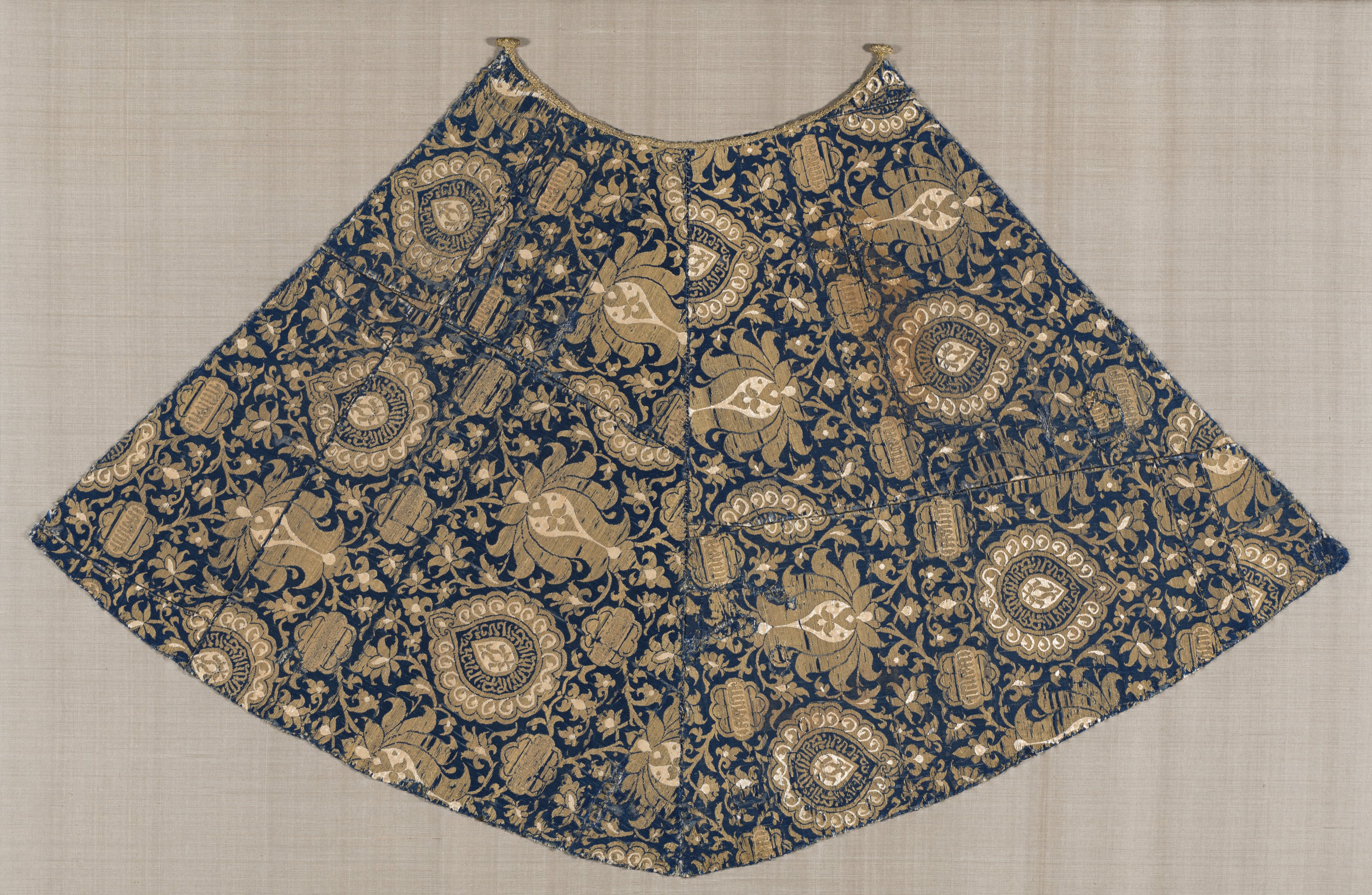
Executive Analysis: The Mantle as a New DNA Strand in Avant-Garde Fashion
At Zoey Fashion Lab, the mantle for a statue of the Virgin with Lotus Blossoms and Medallions represents a pivotal artifact in our ongoing deconstruction of historical textiles. This piece, originating from the cross-cultural nexus of Egypt and Spain, is crafted from silk and gilt-metal thread in a lampas weave. Our analysis positions this mantle not merely as a religious or decorative object, but as a new DNA strand for avant-garde fashion—a genetic blueprint that redefines structural form, material dialogue, and narrative resonance. The lotus blossoms and medallions, once symbols of purity and celestial order, are recoded here as disruptive motifs that challenge the boundaries between the sacred and the secular, the historical and the futuristic.
Technical Deconstruction: The Lampas Weave as Structural Code
The technical foundation of this mantle—the lampas weave—is critical to understanding its avant-garde potential. Lampas, a compound weave structure, typically involves a main warp and a pattern weft that floats across the fabric's surface, creating intricate, multi-layered designs. In this mantle, the silk provides a luminous, fluid ground, while the gilt-metal thread introduces a rigid, reflective counterpoint. This juxtaposition of soft and hard, matte and metallic, is not merely decorative but structural. Our deconstruction reveals that the lampas weave functions as a kind of biological code: the warp acts as a backbone, the weft as a series of expressive nucleotides, and the interplay of threads as a sequence of instructions for form.
For Zoey Fashion Lab, this translates into a new approach to garment construction. The mantle's weave allows for zones of variable density—areas where the silk dominates for drape and movement, and others where the gilt-metal thread creates rigid, almost architectural panels. This is not a fabric that simply covers; it is a self-supporting membrane. In avant-garde fashion, we can replicate this by engineering textiles with embedded metallic threads that act as exoskeletal elements, allowing garments to hold shapes without internal structuring. The lotus blossoms, woven with dense gilt-metal, become structural nodes—points of tension and release that dictate the garment's silhouette. The medallions, conversely, serve as porous interfaces, where the silk is left unbound, permitting the skin to breathe and the body to move. This creates a dynamic, living garment that adapts to the wearer's form, much like a biological organism.
Symbolic Recoding: Lotus Blossoms and Medallions as Avant-Garde Motifs
The lotus blossom, a symbol of rebirth and purity in Egyptian and Buddhist iconography, is typically rendered in a static, idealized form. In this mantle, however, the blossoms are not isolated but integrated into a network of medallions that resemble celestial maps or genetic sequences. Our analysis reinterprets these motifs as code fragments—each lotus a node in a digital matrix, each medallion a data cluster. This is not a decorative pattern but a narrative system that encodes the wearer's identity, history, and future.
In an avant-garde context, the lotus blossom can be reimagined as a biometric symbol. Imagine a garment where the lotus motif is rendered in conductive thread, capable of monitoring the wearer's pulse or temperature. The medallions, traditionally circular and closed, become open circuits—zones where the fabric can be programmed to change color, emit light, or respond to touch. The mantle's original function—to cover and protect—is thus transformed into a dialogic interface. The wearer is no longer a passive observer of sacred imagery but an active participant in a living textile. This aligns with Zoey Fashion Lab's mission to deconstruct and reconstruct historical forms into functional, interactive art.
Cross-Cultural DNA: Egypt and Spain as Genetic Influences
The mantle's origin in Egypt and Spain is not merely geographical but genetic. Egypt contributes a legacy of linen and silk production, a reverence for geometric order, and a deep connection to the Nile's cyclical rhythms. Spain, through its Moorish heritage, introduces the intricate interlacing of Islamic art, the use of gilt-metal thread, and a baroque sensibility for ornamentation. This fusion creates a hybrid textile genome that is uniquely suited to avant-garde fashion's emphasis on hybridity and transgression.
Our deconstruction identifies specific genetic markers: the Egyptian warp is linear, disciplined, and structural—akin to a backbone. The Spanish weft is fluid, ornamental, and expressive—like a nervous system. Together, they create a fabric that is both rigid and pliable, sacred and profane. In avant-garde design, this translates into garments that oscillate between order and chaos. A dress might have a structured, almost architectural bodice (Egyptian influence) that flares into a fluid, cascading skirt (Spanish influence). The gilt-metal thread, a Spanish contribution, becomes a conductive element that connects these two poles, allowing the garment to function as a unified system.
This cross-cultural DNA also informs the mantle's narrative potential. The lotus, an Egyptian symbol, and the medallion, a Spanish motif, are not simply combined but recombined to create new meanings. The lotus, once a symbol of the sun's rebirth, becomes a marker of digital resurrection—a code that can be transmitted and replicated. The medallion, once a sign of royal or religious authority, becomes a data storage unit—a wearable archive of the wearer's history. This recoding allows the mantle to transcend its original context and become a portable narrative device for the avant-garde subject.
Avant-Garde Applications: The Mantle as a New Garment Type
For Zoey Fashion Lab, this mantle is not a relic but a prototype. Its technical and symbolic features suggest a new garment type: the biomorphic mantle. This garment would be constructed from a lampas-like weave that combines silk with conductive, metallic, or bio-engineered threads. The lotus blossoms and medallions would be rendered as interactive nodes—the lotus as a sensor, the medallion as a display. The mantle's function would shift from covering to communicating: it could respond to the wearer's emotional state, environmental conditions, or digital inputs.
In practice, a biomorphic mantle might be worn as a second skin that adapts to the body's needs. The silk zones would provide breathability and comfort, while the metallic nodes would offer protection or connectivity. The lotus blossoms, when activated, could emit light patterns that map the wearer's biometric data. The medallions could serve as touch-sensitive interfaces, allowing the wearer to control connected devices. This garment would be both a fashion statement and a functional tool, embodying the avant-garde principle of form following function into the future.
Moreover, the mantle's sacred origins lend it a ritualistic quality. In avant-garde fashion, ritual is often repurposed to critique or transcend contemporary culture. A biomorphic mantle could be worn in performance art, digital ceremonies, or as a daily uniform for the post-human subject. It would blur the line between the sacred and the secular, the natural and the artificial, the historical and the speculative. This is the essence of Zoey Fashion Lab's approach: to take a historical artifact, deconstruct its DNA, and re-encode it into a garment that speaks to the anxieties and aspirations of the present.
Conclusion: The Mantle as a Living Code
The mantle for a statue of the Virgin with Lotus Blossoms and Medallions is far more than a textile artifact. It is a new DNA strand—a genetic code for avant-garde fashion that combines technical innovation, cross-cultural hybridity, and symbolic recoding. The lampas weave provides a structural blueprint for garments that are both fluid and rigid, organic and architectural. The lotus blossoms and medallions are not mere decorations but functional motifs that can be repurposed as sensors, interfaces, and narrative nodes. The Egyptian and Spanish origins offer a genetic template for hybridity, allowing the garment to oscillate between order and chaos, tradition and innovation.
At Zoey Fashion Lab, we see this mantle as a living code—a set of instructions for creating garments that are not worn but inhabited. The future of avant-garde fashion lies in textiles that think, respond, and evolve. This mantle, with its intricate weave and rich symbolism, is the first strand in that new DNA sequence. It is our task to decode it, replicate it, and mutate it into forms that challenge the very definition of clothing. The result will be a fashion that is not just seen but experienced—a fashion that, like this mantle, transcends its material origins to become a new kind of life.