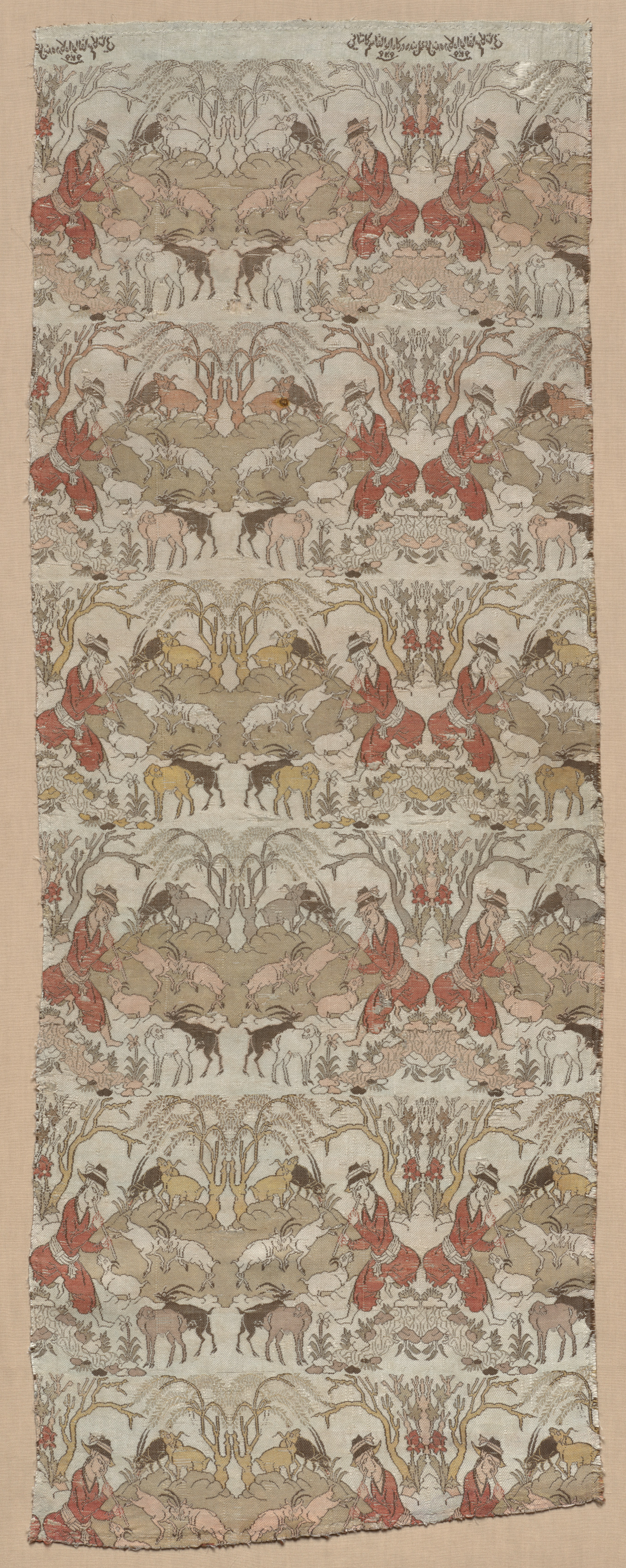
Deconstructing the Threads of Time: A Zoey Fashion Lab Analysis of a 16th-17th Century Isfahan Silk
At Zoey Fashion Lab, we do not merely observe textiles; we deconstruct their DNA. We dissect the weave, the motif, and the historical resonance to extract the raw, avant-garde potential hidden within. Our latest subject is a masterwork of the Safavid era: a silk textile in lampas weave, originating from Isfahan, Iran, circa 16th to 17th century. The scene depicts goatherds in a landscape—a pastoral idyll woven in precious threads. But to our lab, this is not a relic. It is a blueprint for radical innovation.
This analysis will dismantle the textile’s technical, iconographic, and philosophical layers, revealing how its historical “resonance” can be channeled into a disruptive, avant-garde fashion statement. We will explore how the tension between the rigid structure of lampas weave and the fluid narrative of the goatherds creates a dialectic—a conversation between order and chaos—that is the very essence of the avant-garde.
I. Technical Deconstruction: The Lampas Weave as a Structural Paradox
Lampas is a compound weave, a technical marvel of the Safavid loom. It is characterized by a ground weave—typically a plain or twill—and a supplementary patterning weft that floats across the surface to create the design. This is not a simple embroidery; the pattern is integral to the fabric’s very structure. From our deconstructionist perspective, lampas embodies a profound paradox: rigid control versus expressive freedom.
The ground weave provides a strict, mathematical grid—a system of warp and weft that dictates the fabric’s stability. This is the architecture of constraint. The supplementary weft, however, introduces a second, independent system. It can break free from the grid, floating across the surface to create curved lines, intricate details, and subtle shading. This is the gesture of liberation. In this Isfahan silk, the goatherds and their landscape are not woven into the fabric; they are woven upon it, a layer of narrative suspended above the structural foundation.
For the avant-garde designer, this duality is a goldmine. The lampas weave suggests a design philosophy: build a system, then subvert it. We can translate this into fashion through:
- Deconstructed Silhouettes: A garment with a rigid, architectural base (a structured corset or a sharp-shouldered jacket) that is then overlaid with fluid, seemingly chaotic panels of silk. The “ground weave” is the tailored shell; the “supplementary weft” is the draping, the asymmetry, the unexpected volume.
- Material Hybridity: Combining a dense, stable fabric (like a technical twill or a bonded neoprene) with a delicate, floating silk or organza. The structural fabric becomes the “ground,” and the sheer, ethereal layer becomes the “pattern,” allowing the body to be both armored and exposed.
- Print as Weave: Using digital printing to mimic the effect of the supplementary weft. A base fabric can be printed with a grid or a linear pattern (the “ground”), while a secondary, floating layer of sheer fabric is printed with the narrative motif—the goatherds, the trees, the sky. The layers are then fused or stitched only at key points, allowing the narrative to “float” over the structure.
II. Iconographic Deconstruction: The Goatherd as a Symbol of Nomadic Disruption
The pastoral scene—goatherds tending their flock in a landscape—is a classic motif in Persian art, often signifying harmony with nature, divine order, and the cyclical rhythms of life. But to our avant-garde lens, this is a scene of inherent tension. The goatherd is a liminal figure: part of the natural world, yet an agent of control. He guides, but he does not dominate. The goats themselves are creatures of chaos—climbing, leaping, nibbling at the edges of the cultivated world.
The landscape is not a static backdrop; it is a dynamic system of curves, spirals, and organic forms. The trees bend, the hills undulate, the clouds swirl. This is not a rigid, geometric paradise; it is a living, breathing ecosystem. The Archive Resonance text—referencing the 16th to 17th centuries—reminds us that this era was a crucible of cultural collision. The Safavid Empire was a crossroads of trade, religion, and artistic influence. The goatherd, in this context, is not just a shepherd; he is a witness to change, a figure navigating a world in flux.
To translate this into avant-garde fashion, we must embrace the aesthetic of disruption. The goatherd motif can be deconstructed and reconfigured:
- Fragmented Figuration: Instead of a complete, harmonious scene, we present the goatherd as a broken silhouette—a shoulder, a staff, a single horn of a goat. These fragments are appliquéd or embroidered onto a garment in a seemingly random, chaotic arrangement, forcing the viewer to reconstruct the narrative.
- Scale Manipulation: The goatherd is rendered in an absurdly large scale, dominating the garment, or microscopically small, hidden in the folds. This plays with power dynamics and the relationship between the human and the natural world.
- Material Subversion: The pastoral scene is traditionally rendered in luxurious silk. We subvert this by embroidering the motif using industrial materials—metallic threads, rubber, plastic, or even recycled fibers. The goatherd becomes a commentary on the tension between the natural and the synthetic, the historical and the hyper-modern.
III. Philosophical Deconstruction: The Archive Resonance as a Call to Action
The Archive Resonance text speaks of “器物与绘画” (objects and paintings) as “无声见证” (silent witnesses) to “文化碰撞与美学交融” (cultural collision and aesthetic fusion). This is the core philosophical challenge for Zoey Fashion Lab. How do we make these silent witnesses speak? How do we translate their historical resonance into a contemporary, disruptive language?
The answer lies in active deconstruction. We do not simply appropriate the motif; we interrogate it. We ask: What does this goatherd mean in the age of climate crisis and mass migration? What does this landscape signify when nature is being systematically commodified and destroyed? The avant-garde is not about nostalgia; it is about critical engagement. This Isfahan silk is not a relic to be preserved; it is a text to be rewritten.
Our design approach, therefore, is one of radical reinterpretation:
- The Garment as a Palimpsest: We create a garment that has multiple layers of meaning. The base layer is a direct digital print of the original textile—the “silent witness.” Over this, we add layers of deconstruction: cut-outs, slashes, raw edges, and incongruous additions. The garment becomes a site of historical layering, where the past is visible but not intact.
- Performance and Wearability: The avant-garde is not just about the object; it is about the act of wearing. A garment inspired by this textile could be designed to be transformed. It might have detachable panels that allow the wearer to “unweave” the narrative, or hidden fastenings that create new silhouettes. The act of dressing becomes a performance of deconstruction.
- Ethical and Sustainable Deconstruction: The original silk represents immense luxury and labor. In our avant-garde reinterpretation, we honor this by using sustainable and ethically sourced materials. The “disruption” is not wasteful; it is a conscious act of re-creation. We might use deadstock silk, organic cotton, or biodegradable synthetics, ensuring that our deconstruction is not destructive to the planet.
Conclusion: From Archive to Avant-Garde
The 16th-17th century Isfahan silk is not a museum piece. It is a living document of cultural collision, technical mastery, and aesthetic beauty. At Zoey Fashion Lab, we see it as a provocation. The lampas weave challenges us to build systems and then break them. The goatherd challenges us to find beauty in disruption. The Archive Resonance challenges us to make history speak in a new tongue.
Our final design concept is a collection titled “Nomadic Structures.” It features garments that are both architectural and fluid, rigid and chaotic. A jacket with a structured, lampas-inspired base, overlaid with a sheer, floating cape printed with fragmented goatherd motifs. A dress that is a palimpsest of historical prints, cut and reassembled into a new, asymmetrical silhouette. Accessories that are miniature landscapes—brooches shaped like broken trees, belts that mimic the winding paths of the original scene.
This is not a revival of the past. It is a re-imagining. We do not wear history; we wear its deconstruction. We do not honor the goatherd; we transform him into a symbol of our own turbulent, beautiful, and ever-changing world. The silk of Isfahan is no longer a witness; it is a voice. And at Zoey Fashion Lab, we are giving it a new, avant-garde vocabulary.