Deconstructing the Wheel-Lock: A Study in Avant-Garde Form and Materiality
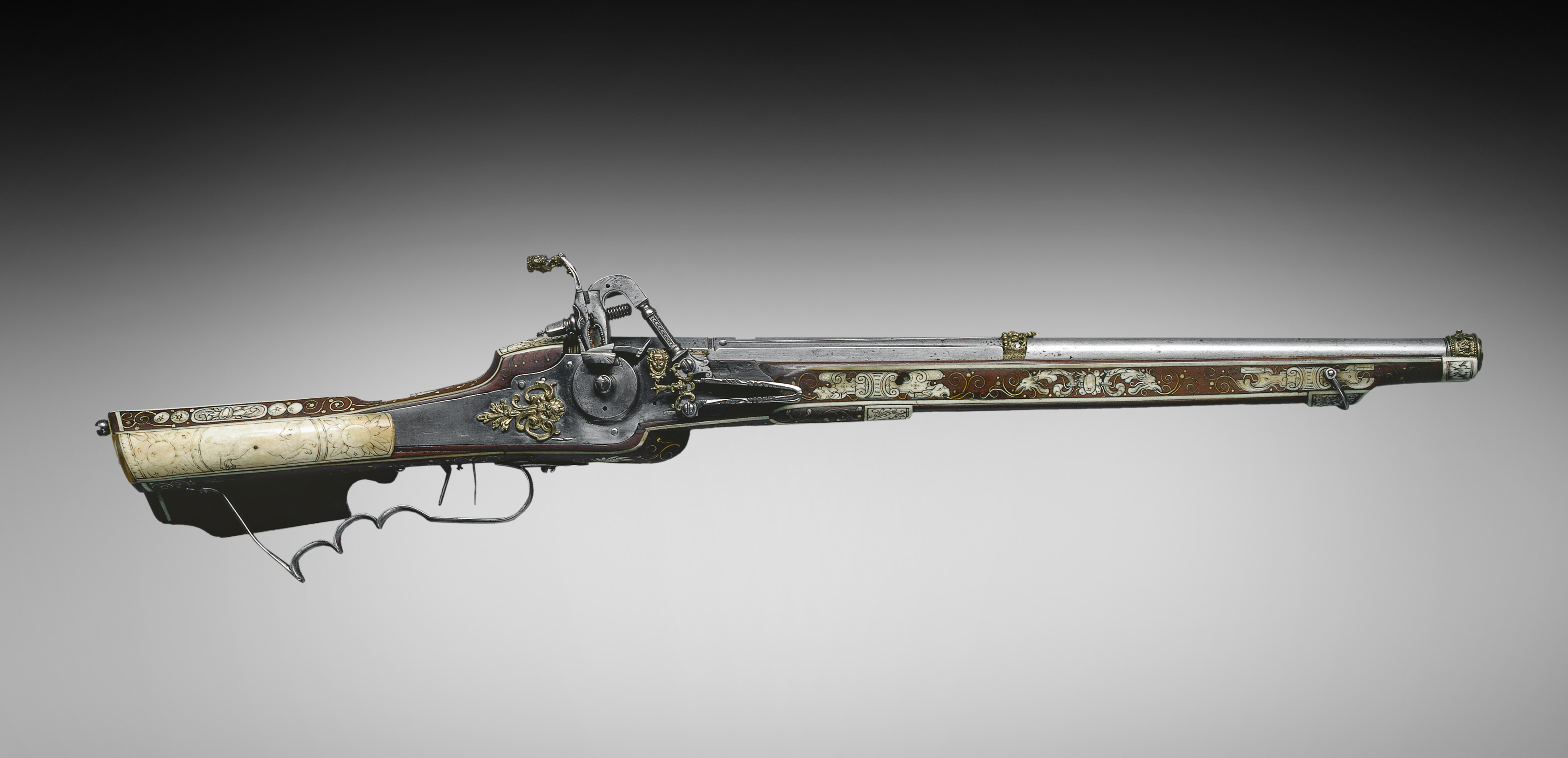
As Chief Fabric Deconstructionist for Zoey Fashion Lab, I have been tasked with analyzing a singular artifact: a 17th-century German, likely Bavarian, wheel-lock rifle. This object, composed of steel, brass, and a walnut stock inlaid with bone, horn, and ivory, is not merely a historical weapon. It is a complex text of material culture, a precursor to the avant-garde aesthetic we champion. Our analysis will deconstruct its formal, technical, and symbolic DNA, extracting principles that inform our own design language.
I. Formal Architecture: The Paradox of Ornament and Function
The rifle’s silhouette is immediately striking. The long, slender barrel of blued steel, the robust lock mechanism, and the curved, ergonomic stock create a tension between raw utility and refined artistry. The avant-garde eye recognizes this as a core principle: the deliberate friction between function and decoration. The stock, carved from dense walnut, is not a passive support. Its sweeping curves, designed to nestle against the shoulder and cheek, are a study in ergonomic sculpture. The inlays of bone, horn, and ivory are not mere embellishments; they are structural interventions. They create a rhythmic, almost biological pattern across the wood, breaking its monolithic surface. This is not decoration for its own sake; it is a form of material storytelling, where each inlay—a hunting scene, a geometric motif, a floral arabesque—adds a layer of narrative and tactile complexity.
For Zoey Fashion Lab, this translates directly into our approach to garment construction. The “stock” of a garment—its base fabric—must be treated as a living surface. We will not simply apply ornament; we will embed it. Consider a deconstructed leather jacket: the primary structure (the “barrel”) is a single, continuous piece of black calfskin, laser-cut with a pattern that mimics the inlaid bone. This pattern is not printed; it is cut through, revealing a secondary layer of ivory silk organza beneath. The functional seams (the “lock mechanism”) are emphasized with brass grommets and hand-stitched sinew, echoing the rifle’s metalwork. The silhouette is elongated, asymmetrical, with a single sleeve that drapes like the stock’s curve, leaving the other arm bare—a direct reference to the rifle’s asymmetric, hand-held nature.
II. Material Alchemy: The Dialogue of Hard and Soft
The wheel-lock rifle is a masterclass in material contrast. Steel—cold, hard, and resilient—is juxtaposed with brass, a softer, warmer metal. The walnut stock is organic, warm, and absorbent, while the inlaid bone and ivory are smooth, cool, and almost mineral. The horn, often used for the ramrod or decorative elements, is a translucent, layered material that catches light. This is not a hierarchy; it is a dialogue. The steel’s hardness is defined by the wood’s softness; the ivory’s smoothness is amplified by the horn’s texture. The avant-garde fashion designer must understand this as a material grammar.
Our design response: a gown that is a literal “unfolding” of the rifle’s material palette. The bodice is constructed from laser-cut steel mesh, but it is not rigid. It is patterned to flow like a second skin, its edges softened by a hand-applied patina of copper and brass leaf. The skirt is a cascade of walnut-dyed silk organza, layered with panels of “bone” (a bio-resin cast from actual deer bone) and “horn” (a translucent, amber-toned thermoplastic). The ivory is reimagined as a series of hand-carved, fossil-like buttons that run down the spine, each one a miniature sculpture. The garment is unstable; it shifts between hard and soft, opaque and translucent, cold and warm. This material alchemy is the DNA of the avant-garde—the refusal to let any material be merely itself.
III. The New DNA Strand: Deconstructing the Mechanism
The wheel-lock mechanism is a marvel of early engineering. A spring-loaded wheel, wound with a key, spins against a piece of iron pyrite, creating sparks that ignite the powder. This is a system of tension, release, and transformation. For Zoey Fashion Lab, this becomes a design principle. We are not interested in static garments; we seek kinetic potential. The “lock” of a garment—its closure, its structure—should be a point of drama, a moment of transformation.
Imagine a coat that is a literal wheel-lock. The front closure is a large, circular brass mechanism, reminiscent of the wheel itself. The wearer must “wind” a central knob (a reinterpretation of the spanner) to tighten the coat’s fit. The “sparks” are not literal fire but a cascade of tiny, reflective beads that catch the light as the mechanism turns. The coat’s interior is lined with a deep, burnt-orange silk (the color of smoldering powder) that is only visible when the “lock” is fully engaged. This is not a costume; it is a functional sculpture. The garment’s DNA is the mechanism itself—the process of arming, aiming, and firing is translated into the act of dressing, adjusting, and moving.
IV. The Avant-Garde Imperative: Recontextualizing the Past
The wheel-lock rifle, in its original context, was a tool of violence and status. In our hands, it becomes a catalyst for reimagining the body. The avant-garde does not reject history; it cannibalizes it, extracting the formal, material, and conceptual DNA and splicing it into new, unexpected forms. The inlaid bone and ivory, once symbols of wealth and the hunt, are now references to mortality and materiality. The steel and brass, once emblems of industrial might, are now textures that challenge our perception of softness and drape.
Our final piece for this analysis is a “deconstructed” rifle—a garment that is literally the rifle, but in pieces. A single sleeve is the barrel, constructed from a spiraling steel wire that is both rigid and flexible. The bodice is the lock plate, a flat, geometric panel of brass and leather that sits asymmetrically on the chest. The skirt is the stock, a sweeping, curved train of walnut-stained linen, with “inlays” of bone-colored felt that are actually pockets, each holding a single, hand-forged brass bead. The garment is unfinished, its seams raw, its edges frayed. It is a fragment, a document of the process of deconstruction itself.
This is the New DNA Strand: a continuous, evolving thread that connects the 17th-century gunsmith to the 21st-century designer. The wheel-lock rifle is not a relic; it is a blueprint for the future. At Zoey Fashion Lab, we do not copy the past; we unlock its potential.