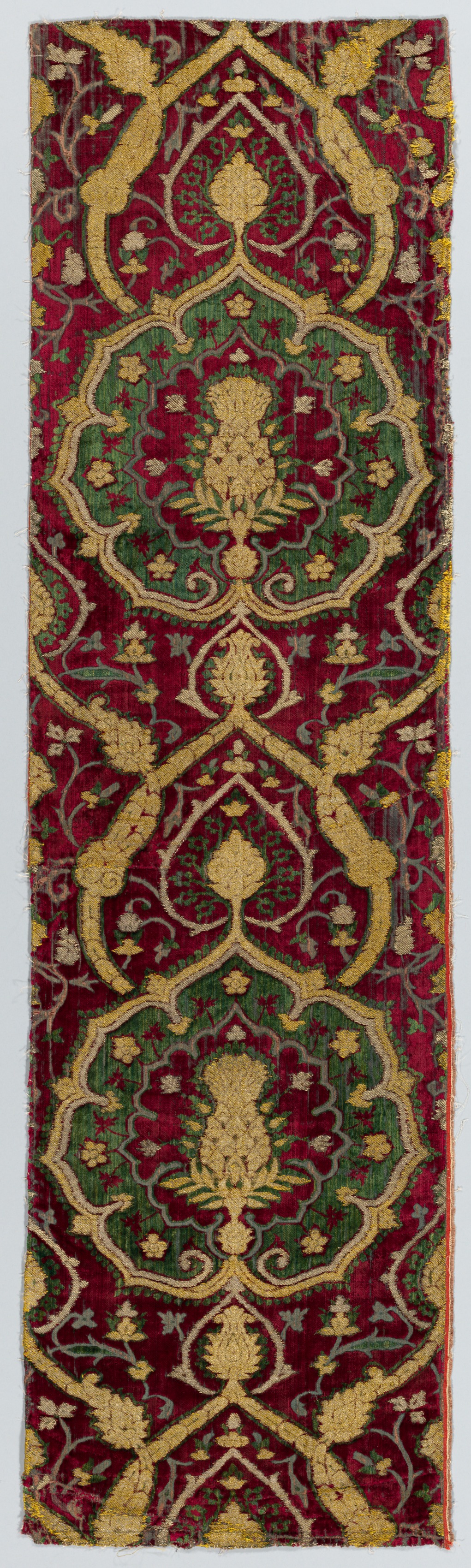
Brocaded Velvet: A 16th-Century Anatolian Artifact Reimagined for the Avant-Garde
At Zoey Fashion Lab, we approach historical textiles not as relics to be preserved, but as living, breathing sources of genetic code—DNA strands that can be spliced, mutated, and re-expressed into entirely new forms. The subject of this analysis is a fragment of brocaded velvet from early 16th-century Turkey, a masterpiece of Ottoman court craftsmanship. Its technical composition—silk velvet brocaded with gold and silver threads—presents a formidable challenge for deconstruction. Yet, it is precisely this layered opulence that offers the richest potential for avant-garde reinterpretation. We will dissect its materiality, its structural logic, and its symbolic weight to propose a new design lexicon that honors its origins while violently propelling it into the future.
Material Deconstruction: The Silk and Metal Matrix
The foundation of this textile is silk velvet, a fabric of extraordinary tactile and visual depth. The velvet’s pile, created by looping and cutting fine silk filaments, produces a surface that absorbs and reflects light with unparalleled softness. In the 16th-century Ottoman context, this plushness signified not only luxury but also a deliberate slowing of the gaze—a material invitation to touch and contemplation. For Zoey Fashion Lab, this tactile density is our first point of intervention. We do not preserve the pile; we fracture it. By selectively burning, shearing, or chemically dissolving portions of the velvet ground, we can create a topography of absence and presence. The resulting surface becomes a map of decay, where the original plushness is punctuated by raw, exposed silk warp threads. This is not damage; it is a deliberate act of textural violence that reveals the fabric’s internal scaffolding.
The brocading element—gold and silver threads—introduces a second, metallic layer of complexity. These are not simple metal wires but composite threads: a silk core wrapped in thin strips of gilded silver or pure silver. In the original, these threads were used to create intricate floral and geometric patterns, often with a raised, almost sculptural quality. Our deconstructionist approach treats these metallic elements as conductive pathways. Rather than weaving them into predetermined patterns, we will extract, re-spin, and re-introduce them as randomized, circuit-like traces across the velvet field. The gold and silver become not decoration but information—a chaotic network of shimmering lines that disrupt the original order. We will also oxidize portions of the silver to create patinas of black and green, introducing a chemical temporality that speaks to aging and transformation.
Structural Logic: From Symmetry to Chaos
The original Ottoman brocaded velvet was governed by a strict geometric and floral symmetry. Repeating motifs—often stylized leaves, carnations, or cloud bands—were arranged in mirrored patterns, reflecting a cosmological order where nature was idealized and controlled. The brocading itself followed a precise point paper system, where every metallic thread was placed with mathematical certainty. For the avant-garde, this order is a cage. Our deconstruction targets this grid of perfection.
We will employ a technique we call “pattern bleeding.” Instead of maintaining the original motif boundaries, we will digitally scan the fabric’s pattern and then algorithmically distort it through a series of procedural noise functions. The result is a design where the original carnation blossoms appear to melt, elongate, and collide with one another. The gold brocading will be re-woven to follow these distorted paths, creating a fractured symmetry—a visual echo of the original that is simultaneously broken and reconfigured. This approach respects the historical motif’s DNA while introducing a mutational logic that is inherently contemporary.
Furthermore, the structural relationship between the velvet pile and the brocaded areas will be inverted. In the original, the velvet serves as a ground, and the metal threads as figure. We will reverse this hierarchy by cutting away the velvet pile in the areas where the brocading is densest, leaving only the exposed silk warp and the metallic threads. The resulting fabric becomes a negative image of its former self—a ghostly, skeletal version where the metal appears to float above a void. This inversion challenges the viewer’s perception of foreground and background, creating a disorienting, multi-dimensional surface.
Symbolic Recontextualization: Power, Luxury, and Decay
Historically, Ottoman brocaded velvet was a symbol of imperial power, worn by sultans and courtiers to project wealth, authority, and divine favor. The gold and silver threads were not merely decorative; they were material assertions of sovereignty. For Zoey Fashion Lab, this symbolic weight is a critical component of the deconstruction. We do not wish to erase this history but to critique and subvert it. Our avant-garde interpretation will use the same materials to express fragility, entropy, and the impermanence of power.
The “New DNA Strand” reference in our brief is key. We envision a garment that is not a finished object but a living system. The brocaded velvet will be treated as a substrate for bio-digital intervention. Using conductive gold and silver threads, we will integrate micro-LEDs and sensors into the fabric. The oxidized silver patches become not flaws but energy-harvesting surfaces, capable of capturing ambient light or body heat. The garment’s pattern will shift in response to the wearer’s movement or heart rate, creating a dynamic, reactive surface. The original Ottoman motifs, now distorted and bleeding, will appear to pulse and breathe—a techno-organic resurrection of a 500-year-old textile.
This recontextualization also embraces the concept of “ruin value.” We will deliberately introduce tears, frayed edges, and missing patches of velvet, revealing the underlying construction. These are not signs of neglect but deliberate archaeological interventions, inviting the wearer and viewer to consider the fabric’s history of use and decay. The gold and silver, once symbols of eternal power, become markers of time’s passage—tarnished, worn, yet still luminous. This is a garment that celebrates imperfection as a form of beauty, challenging the fashion industry’s obsession with pristine, untouched surfaces.
Conclusion: A Fabric as a Cultural and Material Hypothesis
The brocaded velvet of early 16th-century Turkey is not a finished statement but a starting point for a new material narrative. At Zoey Fashion Lab, we see it as a complex system of textures, symbols, and technologies that can be decoded, mutated, and re-expressed. By fracturing its pile, inverting its figure-ground relationship, distorting its patterns, and integrating digital and biological elements, we transform it from a historical artifact into an avant-garde provocation. The resulting fabric is neither a replica nor a rejection of the past but a hybrid entity—one that carries the memory of Ottoman splendor while speaking the language of algorithmic chaos and bio-digital fusion. This is the new DNA strand: a textile that is simultaneously ancient and futuristic, luxurious and decaying, ordered and chaotic. It is a garment for the wearer who understands that true innovation lies not in forgetting history but in dismantling it to rebuild something radically new.