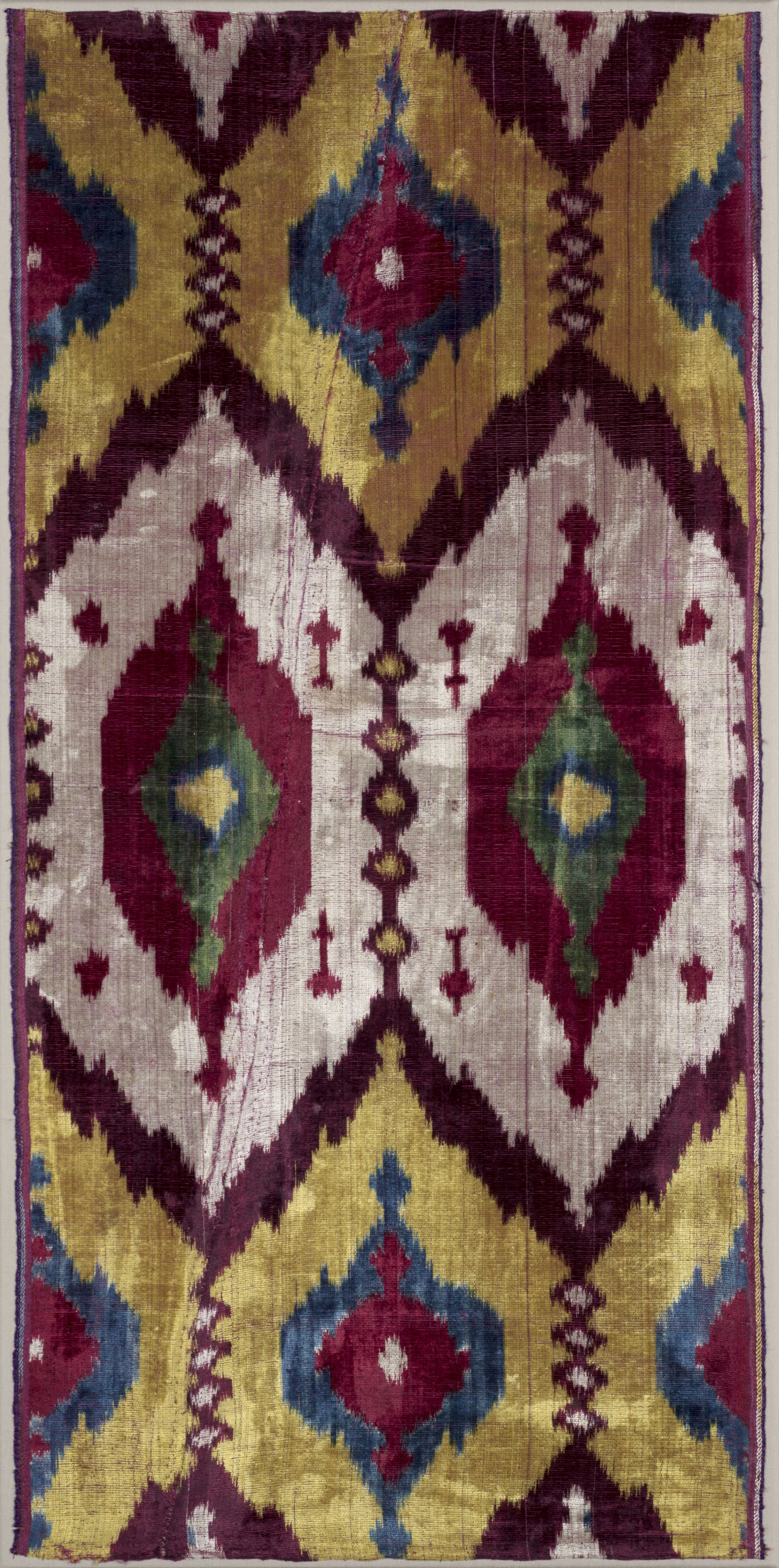
Deconstructing the Silk Velvet Ikat: A Technical and Avant-Garde Analysis
As the Chief Fabric Deconstructionist for Zoey Fashion Lab, it is my distinct responsibility to dissect and re-imagine the foundational materials of our craft. Today, we turn our analytical lens to a specimen of extraordinary complexity and cultural resonance: a length of silk velvet ikat from Bukhara, Uzbekistan. This is not merely a textile; it is a coded message from history, a technical marvel, and a potent source of avant-garde innovation. Our deconstruction will proceed through three primary phases: technical analysis, cultural deconstruction, and speculative reconstruction for the Zoey Fashion Lab aesthetic.
Phase I: Technical Analysis – The Anatomy of a Hybrid
The specimen in question presents a unique convergence of two distinct textile technologies: the ikat resist-dyeing process and the velvet weaving structure. The silk warp ikat base is the first point of investigation. Ikat, from the Indonesian mengikat meaning “to tie,” involves binding and dyeing the warp threads before weaving to create a predetermined pattern. In Bukhara, this is a deeply mathematical art. The precision required to align the dyed warp threads with the weft to produce a clear, blurred-edge design is immense. The “blur” is not a flaw but a signature—a visual vibration that suggests movement and depth. This is a deliberate aesthetic choice, a soft-focus lens on a rigid pattern.
The addition of the velvet weave introduces a third dimension. Velvet is a pile weave, where an additional set of warp threads (the pile warp) is raised above the ground weave and then cut to create a dense, plush surface. In this Uzbekistan silk velvet ikat, the pile is likely made from silk, lending an unparalleled luster and softness. The technical challenge is staggering: the resist-dyeing must be applied to the pile warp as well, or the ikat pattern must be carefully integrated with the pile structure. The result is a fabric that is both visually complex and tactilely rich. The “New DNA Strand” reference in our brief is apt. The fabric’s structure resembles a double helix: the ground weave and the pile weave intertwine, while the ikat pattern spirals through the warp, creating a dynamic, living surface. The density of the pile, the fineness of the silk, and the precision of the ikat alignment are the three critical variables in this technical equation.
Phase II: Cultural Deconstruction – Bukhara as a Crossroads of Craft
To understand this fabric, we must deconstruct its cultural DNA. Bukhara, an ancient city on the Silk Road, was a crucible of textile innovation. The ikat tradition here is not merely decorative; it is a language of status, identity, and cosmology. The patterns—often featuring stylized pomegranates, almonds, and geometric medallions—are symbolic. The pomegranate represents fertility and abundance; the almond (bodom) symbolizes life and resilience; the medallions (gul) can denote the sun or the universe. The colors, historically derived from natural dyes, carry their own meanings: deep reds for power, indigo for spirituality, and gold for divinity.
However, the velvet pile adds a layer of luxury that was historically reserved for the elite. In Uzbekistan, silk velvet ikat (bahmal ikat) was a fabric of the court, used for robes of honor and ceremonial garments. The tactile experience of the velvet—its softness against the skin, its ability to catch light and shadow—was a physical manifestation of power. The avant-garde lens of Zoey Fashion Lab forces us to question these cultural hierarchies. We are not simply preserving a tradition; we are interrogating it. What does it mean to take a fabric born of royal patronage and re-contextualize it in a contemporary, often anti-establishment, fashion framework? The answer lies in the tension between the fabric’s historical weight and its potential for radical reinterpretation.
Phase III: Avant-Garde Reconstruction – The Zoey Fashion Lab DNA
Our laboratory is not a museum. We do not restore; we deconstruct and reconstruct. The “New DNA Strand” reference is our directive. We will treat this silk velvet ikat not as a finished product but as a genetic sequence to be edited, spliced, and re-expressed. Here are three speculative avenues for avant-garde application:
1. Deconstructed Silhouette and Negative Space: The traditional use of ikat velvet is for full, voluminous garments. Our approach will be to fragment the fabric. We will cut the velvet into long, ribbon-like strips, leaving the raw edges exposed. These strips will be suspended from a structural, almost architectural undergarment made of black leather or recycled polymer. The ikat pattern will appear as floating, fragmented DNA strands against a void. The velvet pile will be partially sheared in some areas, creating a gradient of texture from plush to flat, mimicking the process of genetic transcription. The garment will be a living deconstruction, where the fabric’s history is visible in its wounds.
2. Kinetic Textures and Light Play: The velvet’s pile is inherently responsive to light and touch. We will exploit this by creating a garment with multiple layers. The outer layer will be a sheer, almost invisible organza, laser-cut with geometric voids. Beneath it, the ikat velvet will be mounted on a flexible, spring-like substructure. As the wearer moves, the velvet will shift and pulse, creating a moiré effect of the ikat pattern. The “blur” of the ikat will be amplified by motion, transforming the static design into a dynamic, living surface. This is not just clothing; it is a kinetic sculpture that references the biological movement of DNA replication.
3. Symbiotic Hybridity – The Digital and the Handcrafted: The Bukhara ikat is a testament to human handcraft. We will contrast this with digital precision. We will scan the ikat pattern at microscopic resolution and then use a digital jacquard loom to weave a secondary fabric that is a “mutated” version of the original. This new fabric will have the same structural logic but with distorted proportions, inverted colors, and algorithmic glitches. The original velvet ikat will be used as a lining or as accent panels, while the digital mutation will form the primary surface. The garment will be a dialogue between the handmade and the machine-made, the ancient and the futuristic, the organic and the synthetic. The “New DNA Strand” is thus realized as a hybrid genome, combining the best of both worlds.
Conclusion: The Fabric as a Living Archive
This length of silk velvet ikat from Bukhara is far more than a piece of cloth. It is a technical achievement, a cultural artifact, and a repository of meaning. For Zoey Fashion Lab, it is a starting point for a radical re-imagining. By deconstructing its weave, its history, and its symbolism, we can extract its core DNA and re-express it in forms that challenge, provoke, and inspire. The avant-garde is not about rejecting the past; it is about engaging with it critically, creatively, and fearlessly. This fabric will not be preserved; it will be transformed. And in that transformation, the spirit of Bukhara will find a new voice in the 21st century.