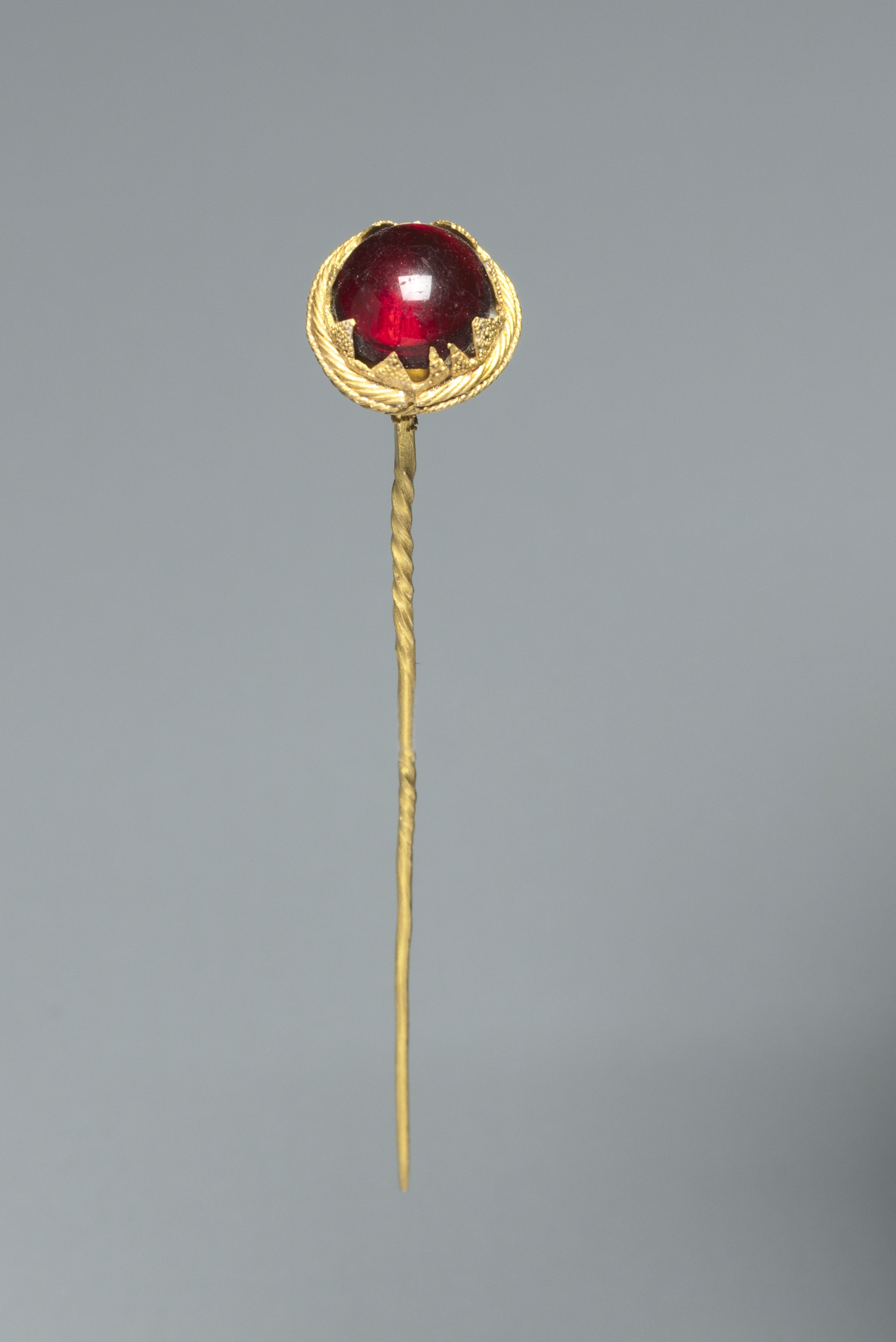
Deconstructing the Etruscan Straight Pin: An Avant-Garde Analysis for Zoey Fashion Lab
At Zoey Fashion Lab, our core methodology—Fabric Deconstructionism—seeks to unravel the narrative threads embedded within material artifacts. We do not merely observe objects; we dissect their structural, cultural, and temporal DNA. The subject of this analysis is an Etruscan straight pin, a seemingly humble implement of adornment, yet one that resonates with profound avant-garde potential. Crafted from gold and glass, this object is not a static relic but a dynamic archive. Its technical execution, combined with its Etruscan origins, offers a blueprint for a garment that exists in a state of perpetual tension—between the polished surface of a silver mirror and the carved narrative of a stone sarcophagus. This analysis is guided by the archival reference: “Mirror with Split-Leaf”, a work that embodies the duality of reflection and inscription.
Technical Analysis: The Gold and Glass Nexus
The straight pin’s construction is a study in controlled precision. The gold component, likely worked through granulation or filigree, speaks to a mastery of metallurgy that defies its era. Gold, in this context, is not merely a material of wealth; it is a conductor of light and a signifier of permanence. The glass element, possibly a bead or inlay, introduces a contrasting fragility. Glass is both transparent and opaque, reflecting and absorbing. Together, these materials create a dialectic: the gold’s warmth against the glass’s coolness, the metal’s malleability against the glass’s brittleness.
For the avant-garde designer, this pin suggests a garment where seams are not hidden but celebrated. Imagine a fabric that mimics the pin’s structure: a base of metallic thread (gold) woven with iridescent glass filaments. The pin’s point—sharp, functional—becomes a design motif: sharpened hems, angular darts, and asymmetric closures. The pin’s head, a focal point of ornament, translates into a series of detachable, modular accents—golden clasps, glass cabochons—that can be repositioned across the garment’s surface. This is not decoration; it is a system of architectural articulation.
Etruscan Origins: The Archive of the Body
The Etruscans, precursors to the Romans, possessed a unique relationship with adornment. Their pins were not mere fasteners; they were narrative anchors for the body. In Etruscan funerary art, pins often secured garments for the deceased, serving as conduits between the living and the afterlife. This functional intimacy is crucial for Zoey Fashion Lab’s deconstructionist approach. The pin’s origin reminds us that clothing is a second skin, a membrane that both reveals and conceals.
In an avant-garde context, this Etruscan legacy challenges the contemporary obsession with disposability. The pin becomes a symbol of resonance—an object that carries the weight of ritual. A garment inspired by this pin would reject the notion of passive wear. Instead, it would demand active engagement: the wearer must “pin” the narrative into place, adjusting the garment’s form to reflect personal history. The pin’s dual role—functional and symbolic—suggests a design where closure mechanisms (hooks, loops, and yes, pins) are visible, tactile, and integral to the silhouette.
Archive Resonance: The Mirror and the Sarcophagus
The reference “Mirror with Split-Leaf” provides the conceptual fulcrum for this analysis. The mirror’s surface, described as “a smooth silver mirror inlaid with gold in complex palm-leaf patterns,” represents the surface of appearance—the polished, reflective exterior that society demands. The sarcophagus, conversely, is “a cold stone slab with a relief that tells the story of life”—the depth of meaning, the hidden narrative beneath the surface. The straight pin, as an artifact, bridges these two states. Its gold and glass reflect light (the mirror), while its Etruscan origin carries the weight of death and memory (the sarcophagus).
For the avant-garde garment, this duality manifests as a split construction. One half of the garment—perhaps the bodice or a sleeve—is rendered in high-shine metallic fabric, embossed with palm-leaf motifs (the mirror). The other half is constructed from matte, textured material, perhaps laser-cut to mimic stone relief, depicting abstracted life scenes (the sarcophagus). The straight pin itself becomes the transition point—the seam where these two halves meet. The pin is not hidden; it is the hinge, the fulcrum, the moment of tension between appearance and reality.
Avant-Garde Application: The Deconstructed Silhouette
Zoey Fashion Lab proposes a garment that is both a pin and a garment—a wearable object that deconstructs the boundary between accessory and apparel. The silhouette would be asymmetrical, with one side rigid and structured (the gold, the mirror) and the other fluid and draped (the glass, the sarcophagus). The pin’s sharp point inspires a series of angular cutouts and sharp lapels, while the pin’s head—a sphere of gold and glass—becomes a series of three-dimensional embellishments that can be removed and reattached.
The garment’s construction would employ reverse engineering: the pin’s functional anatomy (point, shaft, head) is mapped onto the garment’s pattern. The point becomes a dart; the shaft becomes a seam; the head becomes a closure. This is not a literal translation but a conceptual one. The wearer is invited to “pin” the garment together, to adjust its form, to participate in its narrative. The garment is never finished; it is always in a state of becoming.
Conclusion: The Resonance of the Pin
The Etruscan straight pin, in its gold and glass simplicity, is a microcosm of avant-garde design. It holds within it the tension between the reflective and the inscribed, the surface and the depth, the functional and the symbolic. For Zoey Fashion Lab, this artifact is not a historical curiosity but a living archive. It challenges us to create garments that are not just worn but performed—garments that carry the weight of their own history, that reflect the light of the present while carving the narratives of the past.
In the spirit of the “Mirror with Split-Leaf”, the final garment is a paradox: a smooth, reflective surface that invites the viewer to look, and a textured, narrative depth that demands the viewer to read. The straight pin, in its dual nature, is the key. It is the point of entry, the moment of connection, the archive’s resonance made tangible. At Zoey Fashion Lab, we do not simply design clothes. We deconstruct the pin, and from its fragments, we build a new language for the body.