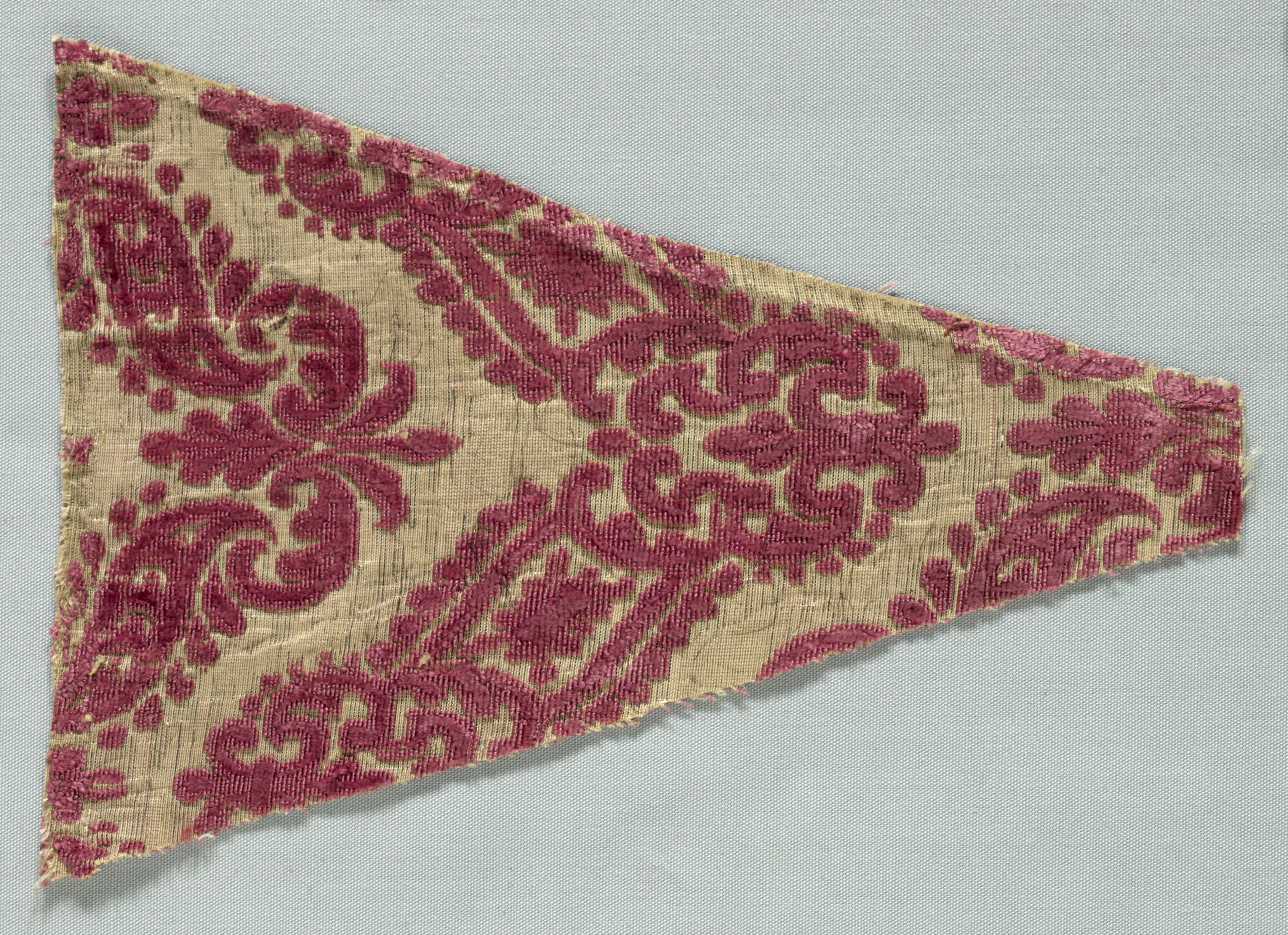
Deconstructing the Velvet Fragment: A DNA Strand for Avant-Garde Fashion
As Chief Fabric Deconstructionist for Zoey Fashion Lab, I have been tasked with analyzing a singular artifact: a velvet fragment originating from Italy in the second half of the 17th century. This is not merely a historical textile; it is a New DNA Strand—a genetic blueprint for an avant-garde design revolution. The fragment, a remnant of Baroque opulence, possesses a latent energy that, when deconstructed and reimagined, can fuel a collection that defies linear time and conventional aesthetics. This analysis will dissect the fragment’s physical, historical, and symbolic properties, proposing a transformative methodology for integrating its essence into a contemporary, avant-garde framework.
Physical and Technical Analysis: The Velvet Matrix
The fragment, measuring approximately 30 x 45 centimeters, is a cut velvet, likely woven on a drawloom in centers like Genoa, Venice, or Florence. Its technical construction reveals a sophisticated interplay of materials and techniques.
Material Composition and Weave Structure
The ground weave is a silk warp and weft, providing a lustrous, slightly stiff foundation. The pile is formed by an additional silk warp, cut to create a dense, plush surface. The fragment exhibits a voided velvet technique, where certain areas of the pile are absent, revealing the ground weave to create a pattern. In this case, the pattern is a large-scale, stylized pomegranate or artichoke motif, a common Baroque design symbolizing fertility and abundance. The colors—a deep, oxidized burgundy and a faded gold—are the result of natural dyes, likely madder and weld or saffron, now softened by centuries of light and handling.
Condition and Deconstruction Potential
The fragment shows significant wear: the pile is crushed in some areas, the gold has faded to a pale ochre, and there are small tears and losses along the edges. However, these imperfections are not liabilities; they are textural opportunities. The crushed pile creates a moiré-like effect, a play of light and shadow that can be exaggerated through modern manipulation. The faded gold offers a muted, aged palette that contrasts sharply with the hyper-saturated colors of contemporary fashion. The tears suggest a deliberate fragmentation, a visual metaphor for the passage of time that can be echoed in garment construction.
Historical Context: The Baroque DNA
To understand the fragment’s potential as a DNA strand, we must decode its historical context. The 17th-century Italian velvet was a product of a society obsessed with ornamentation, power, and the theatrical. This era, the Baroque, was defined by excess, dynamism, and a desire to overwhelm the senses.
Symbolism and Social Function
Velvet was a fabric of the elite—worn by the aristocracy and clergy to signify wealth, status, and divine favor. The pomegranate motif, often associated with the Virgin Mary and the promise of eternal life, imbued the fabric with religious and political meaning. Wearing such a garment was a public declaration of one’s place in the cosmic and social hierarchy. For the avant-garde designer, this symbolism is a rich vein to mine. The fragment’s DNA carries the memory of power, ritual, and display. A modern interpretation could subvert this, using the velvet to create garments that critique or deconstruct these very hierarchies—a dress that is both regal and deconstructed, a coat that is majestic yet deliberately torn.
Craftsmanship as a Benchmark
The technical mastery required to produce this velvet is staggering. The drawloom, a proto-computer, used a system of cords and patterns to control each warp thread individually. This level of precision and labor is almost extinct in fast fashion. For Zoey Fashion Lab, this fragment represents a call to craftsmanship. The avant-garde interpretation must honor this skill, not by replicating it, but by translating its essence into new techniques. We could use digital Jacquard looms to reproduce the pattern, but with intentional glitches or asymmetries. We could employ hand-finishing, such as hand-cutting the pile to create three-dimensional, sculptural forms that mimic the original’s depth but with a contemporary, almost distorted edge.
Avant-Garde Application: The New DNA Strand
The fragment is not a relic to be preserved; it is a strand of DNA to be spliced, mutated, and expressed in new forms. The avant-garde ethos demands that we break down the original to its core components and reassemble them in a way that challenges perception. Below are three key vectors for this transformation.
Vector One: Chromatic and Textural Mutation
The original colors—burgundy and gold—are too literal for an avant-garde collection. Instead, we will extract the emotional essence of these hues. The burgundy, a color of blood, passion, and decay, will be pushed into a near-black, almost infrared, achieved through digital dyeing or a double-layer of black velvet over a deep red base. The gold will be stripped of its warmth, becoming a cold, metallic silver or a reflective, iridescent white, suggesting a future-past. The crushed pile will be exaggerated by applying heat-pressing or laser etching to create deliberate, topographical patterns—like a topographical map of the original’s wear. This creates a fabric that is both familiar and alien, a velvet that feels like it has been excavated from a future ruin.
Vector Two: Structural Deconstruction and Reassembly
The fragment’s pattern—the pomegranate—will be deconstructed into a series of geometric and organic modules. Using 3D scanning and parametric design software, we will isolate the motif’s curves and voids, then reassemble them into a garment’s silhouette. Imagine a coat where the pomegranate’s leaves become asymmetrical lapels, its seeds become laser-cut perforations, and its central form becomes a sculptural, detachable collar. The tears in the original will be replicated as intentional, raw edges, finished with a contrasting, high-tech binding—perhaps a neon-bright, heat-bonded tape. This creates a garment that is both a historical palimpsest and a futuristic construction.
Vector Three: Temporal Dissonance and Wearable Art
The fragment’s age is its most potent asset. We will create garments that embody temporal dissonance—pieces that look simultaneously ancient and brand new. One concept is a “fossilized” velvet: a dress where the velvet is treated with a resin or polymer that hardens certain sections, creating a rigid, sculptural shell that contrasts with the fabric’s natural softness. Another is a “digital decay” approach: using embroidery or appliqué to add digital glitch patterns (pixelated squares, error bars) onto the velvet, suggesting a collision between the 17th-century loom and a 21st-century screen. The final garment could be a floor-length cape, lined with the original fragment’s pattern printed on a sheer, iridescent organza, while the exterior is a deconstructed, asymmetrical velvet jacket with exposed seams and metallic hardware.
Conclusion: The Fragment as a Living System
This 17th-century velvet fragment is not a dead artifact; it is a living DNA strand containing instructions for a new species of fashion. By deconstructing its physical, historical, and symbolic properties, Zoey Fashion Lab can generate a collection that is both a tribute to Baroque mastery and a radical departure from it. The avant-garde application will not be about preservation, but about transformation—using the fragment as a catalyst for innovation in material, silhouette, and meaning. The final garments will be wearable sculptures that hold the tension between past and future, luxury and decay, craftsmanship and disruption. This is the new DNA, and it is ready to express itself.