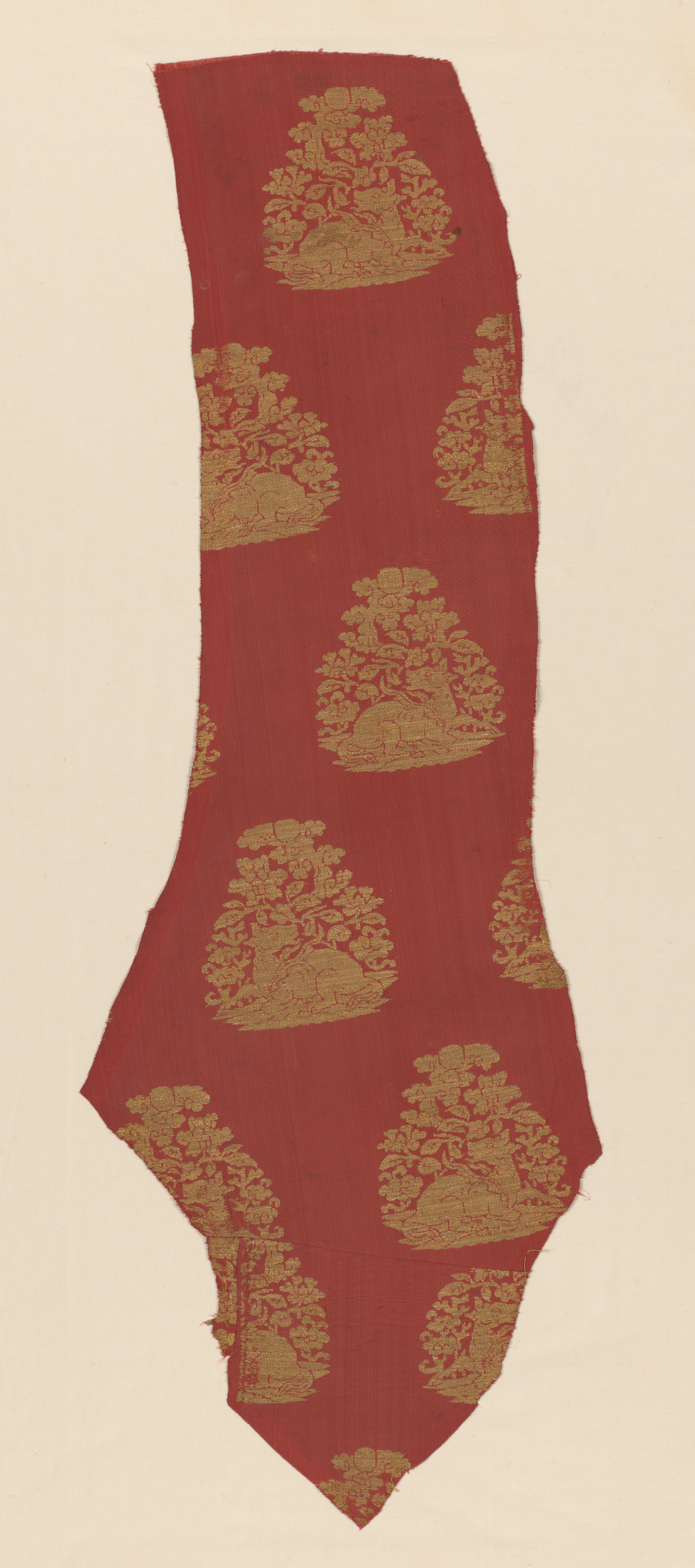
Technical Deconstruction & Material Analysis: Brocade with Djeiran Gazing at the Moon
This Jin dynasty fragment represents a pinnacle of textile engineering and symbolic audacity. The foundation is a tabby-woven silk ground, providing a stable, luminous canvas. Upon this, the brocading technique introduces supplementary wefts of gold thread, likely gold leaf wound onto a silk core. This creates the raised, metallic motif. The technical mastery lies in the precision required to integrate these disparate materials—the supple, organic silk and the stiffer, more brittle metal thread—into a cohesive whole. The weave structure would have demanded a sophisticated drawloom, indicating production within a major imperial workshop. The preservation of both the silk's subtle sheen and the gold's reflective quality, despite centuries, speaks to an extraordinary level of craftsmanship and material purity.
Narrative Archaeology: Decoding the Iconography
The depicted scene, a djeiran (Central Asian gazelle) gazing at a moon, is a profound cultural cipher. During the Jin dynasty, ruled by the Jurchen people, artistic motifs were not merely decorative but statements of identity and cosmology. The djeiran, an animal of the Central Asian steppes, connects to the nomadic heritage and territorial reach of the Jin. Its tranquil posture and upward gaze subvert typical hunting scenes, proposing a moment of poetic contemplation. The moon, a universal symbol, could reference Turkic or Mongol celestial beliefs, while also resonating with Chinese poetic traditions of longing and beauty. This fragment is not a simple textile; it is a woven diplomacy, a conscious fusion of steppe culture (the djeiran) with a classic poetic trope (gazing at the moon), crafted in the ultimate Chinese luxury medium: silk and gold brocade. It embodies a moment of confident cultural synthesis.
Archive Resonance: A Lens for Reinterpretation
The provided archival fragment—"在人类文明的长河中,器物与绘画不仅是时代技艺的结晶,更是文化碰撞与美学交融的无声见证。十六至十七世纪...."—though referencing a later period, provides our critical methodological lens. It frames objects as silent witnesses to cultural collision and aesthetic fusion. We apply this principle retroactively to the Jin dynasty brocade. The 12th-13th century was a period of intense interaction across Eurasia. This textile is a material node in that network. The gold thread technology may trace influences from the West; the animal style resonates with broader Eurasian nomadic art; the execution is impeccably Chinese. It is a prelude to the global dialogues of the 16th-17th centuries, proving that such fusion is a constant, dynamic force in human creativity, not a historical anomaly.
Avant-Garde Proposition: The Zoey Fashion Lab Intervention
For Zoey Fashion Lab, this artifact is not a relic but a progenitor of avant-garde principles. Our deconstruction moves beyond literal pattern reproduction. We engage with its core DNA: the collision of disparate elements to create a new, resonant whole.
Conceptual Framework: "Gazing at the Moon" becomes a metaphor for contemporary longing and digital contemplation. The djeiran is our modern individual—agile, connected to primal instincts yet searching for meaning in a vast (digital) cosmos. The gold is not mere decoration; it is data, signal, the gilded layer of our online personas.
Material & Technical Transposition:
We replace silk tabby with biodegradable polymer mesh or upcycled technical taffeta, creating a ground that is both fragile and strong. The gold brocade thread is transposed into conductive metallic yarns and heat-bonded foil degradation prints. The motif is not statically woven but emerges through a combination of laser etching (suggesting the tabby ground) and programmable, shimmering LED sequences (representing the brocaded gold), allowing the "moon" to phase or the "gaze" to flicker in response to environmental data (light, sound).
Silhouette & Construction:
The garment structure rejects historical replication. Imagine a deconstructed overcoat where the "fragment" is the entire garment—raw, frayed edges referencing archaeological recovery. The djeiran motif is broken, pixelated, or mirrored across seams, appearing in full only when the wearer assumes a specific pose (gazing upward). We employ slash-and-pull techniques on the technical fabric to create a textured "ground," and inflatable tubing woven with conductive threads to create a raised, three-dimensional "brocade" that can alter its form.
This analysis concludes that the "Brocade with Djeiran Gazing at the Moon" is a foundational codex for the modern avant-garde. It teaches us that true innovation lies at the intersection of technical mastery, cultural hybridity, and poetic narrative. Zoey Fashion Lab's task is to decode this ancient algorithm and recompile it for a new era, transforming silent historical witness into a loud, articulate, and profoundly contemporary sartorial statement. The past is not a template; it is the most radical collaborator in the room.