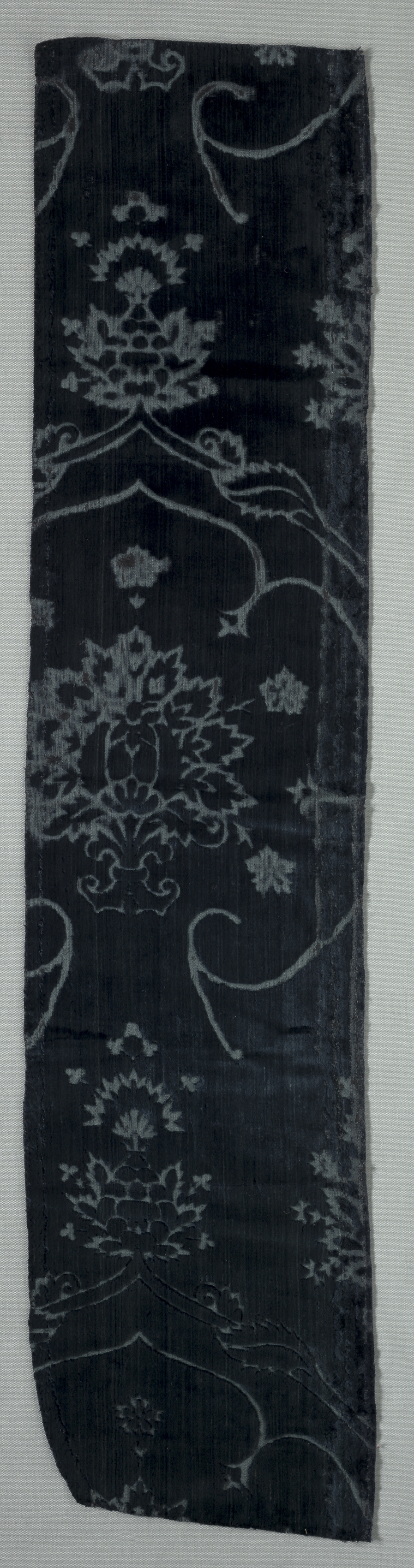
Deconstructing the Velvet Fragment: A 15th-Century Italian Blueprint for Avant-Garde Fashion
As Chief Fabric Deconstructionist for Zoey Fashion Lab, I have the distinct privilege of analyzing a singular textile artifact: a fragment of cut and voided velvet from 15th-century Italy. This is not merely a historical relic; it is a New DNA Strand—a genetic code that, when sequenced and reinterpreted, can catalyze revolutionary designs for our avant-garde collections. The fragment’s technical mastery, its interplay of light and shadow, and its inherent narrative of luxury and power offer a profound departure point for a new aesthetic language. This analysis will dissect the fragment’s physical and conceptual properties, proposing a framework for its transformation into a contemporary, avant-garde garment.
Technical Autopsy: The Cut and Voided Velvet Construction
The fragment’s core identity lies in its construction: cut and voided velvet. This is not a simple pile weave. The process involves weaving two layers of fabric simultaneously—a ground weave (typically silk) and a supplementary warp that forms the pile. In voided velvet, the pile is selectively cut and then sheared, leaving areas of the ground weave exposed. This creates a stark, sculptural contrast between the dense, plush pile and the flat, often lustrous ground. The 15th-century Italian weavers were masters of this technique, using it to create intricate, often metallic-infused patterns that played with light and depth.
For Zoey Fashion Lab, this technical contrast is a primary design catalyst. The voided areas are not absences; they are deliberate negative spaces that define the positive form. In our avant-garde reinterpretation, we can manipulate this principle by using modern materials. Imagine a base layer of liquid, iridescent polyester microfilament (for a sleek, reflective ground) juxtaposed with a pile of recycled metallic yarns or even bio-engineered cellulose fibers that mimic the plushness of silk. The voiding can be achieved through laser-cutting or chemical etching, allowing for hyper-precise, asymmetrical patterns that the 15th-century loom could never achieve. This technical upgrade transforms the fragment’s historical precision into a tool for digital-age deconstruction.
Surface and Depth: The Dialogue of Light and Texture
The velvet fragment’s genius is its manipulation of surface. The cut pile absorbs light, creating a deep, velvety black (or rich jewel tone), while the voided ground reflects it, producing a shimmering, almost liquid effect. This creates a dynamic, three-dimensional topography that shifts with movement and angle. For our avant-garde collection, this is not just a visual effect; it is a tactile and conceptual statement.
We can amplify this dialogue by introducing gradient pile heights—areas where the velvet is cut at varying lengths, from a short, dense micro-pile to a longer, flowing shag. This would create a fabric that feels like a living landscape, with peaks and valleys of texture. Combine this with a thermochromic or photochromic ground that changes color or opacity in response to body heat or UV light. The voided areas could become windows to a reactive, digital skin, while the pile remains a static, luxurious anchor. This fusion of historical texture with smart materials embodies the avant-garde ethos: honoring the past while hacking its DNA for the future.
Pattern and Narrative: Decoding the 15th-Century Motif
The fragment’s pattern—likely a pomegranate, thistle, or stylized floral motif—was a symbol of abundance, fertility, and status in Renaissance Italy. These patterns were not arbitrary; they were encoded narratives of wealth and power. For Zoey Fashion Lab, we must deconstruct this narrative and reassemble it as a commentary on contemporary identity and consumption.
Our reinterpretation will use generative design algorithms to create a pattern that is both organic and chaotic. The traditional pomegranate motif can be broken into its constituent parts—seeds, rind, calyx—and recombined into a fractal, glitch-like pattern that references digital decay. The voided areas will not just be empty spaces; they will be QR-code-like matrices that, when scanned, reveal a hidden digital layer: a video of the fabric’s production process, or a poem about labor and luxury. This transforms the garment from a static object into a wearable narrative, a conversation between 15th-century craftsmanship and 21st-century data.
Silhouette and Structure: From Flat Fragment to Avant-Garde Form
The fragment is a flat, two-dimensional piece. Our task is to extrapolate its principles into a three-dimensional, avant-garde silhouette. The key is to treat the fabric not as a surface to be draped, but as a structural material that can be shaped through tension, compression, and layering.
Consider a deconstructed doublet inspired by the fragment’s voided areas. The garment would be constructed from multiple panels of our upgraded velvet, each with its own voided pattern. These panels would be connected by exposed, architectural seams made of stainless steel or carbon fiber, creating a exoskeleton that holds the fabric in tension. The voided areas would align with the body’s joints—shoulders, elbows, hips—creating negative-space cutouts that reveal the wearer’s skin or a secondary, contrasting garment underneath. This is not mere deconstruction; it is a structural re-engineering that celebrates the fragment’s core principle: the interplay of presence and absence.
For a more dramatic statement, we can create a transformable garment that changes shape through pneumatic or mechanical systems. The velvet pile could be inflated or deflated to alter the garment’s volume, while the voided areas act as hinges or vents. This would be a living garment, a direct descendant of the 15th-century velvet’s love of theatrical luxury, but now powered by technology. The wearer becomes a cyborg aristocrat, embodying a new form of power that is both ancient and futuristic.
Conclusion: The Fragment as a Living Blueprint
The 15th-century Italian velvet fragment is not a museum piece; it is a New DNA Strand for Zoey Fashion Lab. Its technical mastery of cut and voided velvet, its manipulation of light and depth, and its encoded narratives of power provide a rich, complex foundation for avant-garde innovation. By upgrading its materials with smart fibers and digital processes, by deconstructing its patterns into generative algorithms, and by reimagining its structure as a dynamic, architectural form, we can create garments that are both a homage to history and a leap into the unknown. This is the essence of our work: to deconstruct the past in order to reconstruct the future, one fragment at a time.