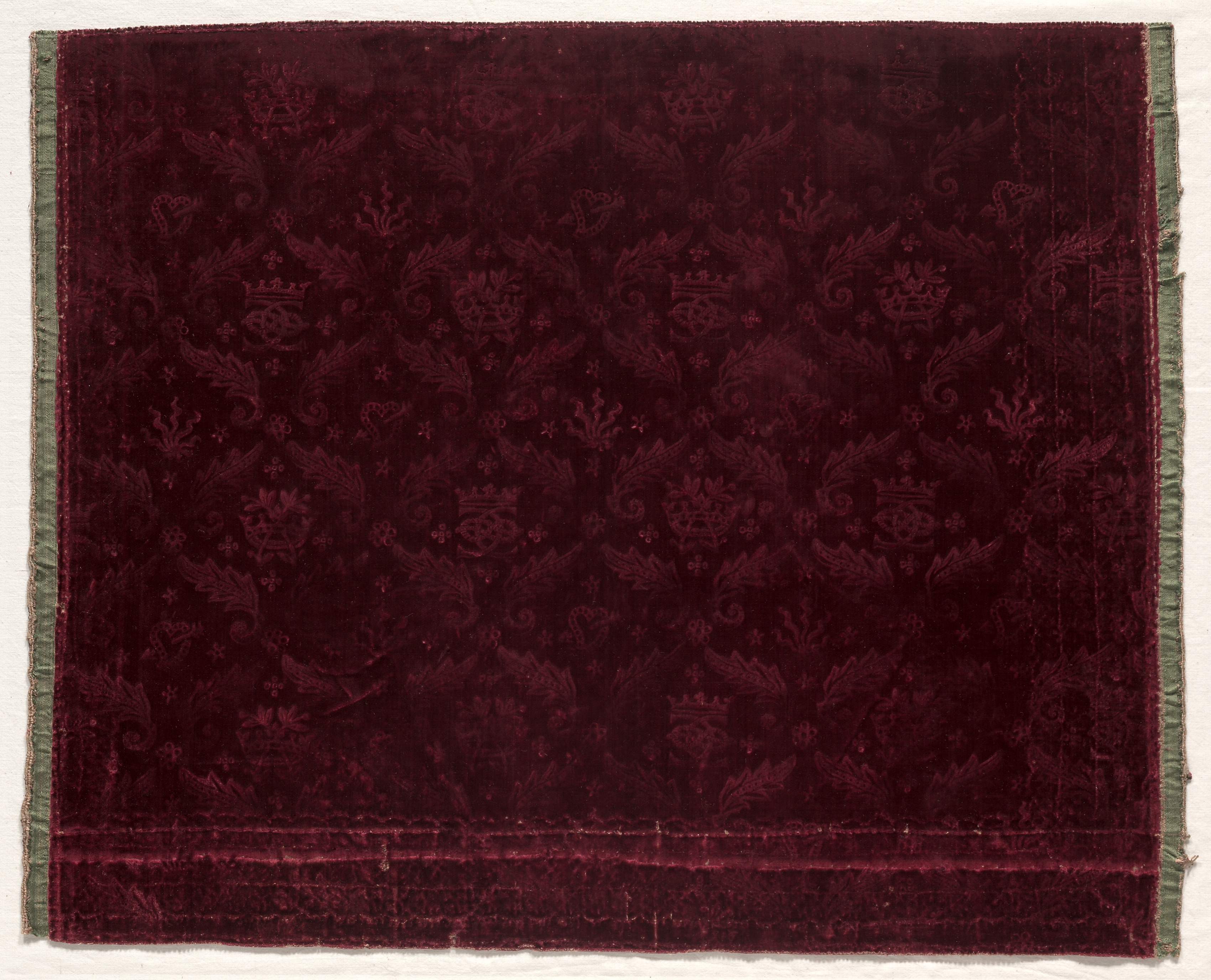
Executive Analysis: Deconstructing the Fragment of Stamped Velvet
At Zoey Fashion Lab, the role of the Chief Fabric Deconstructionist is to interrogate the material past in order to blueprint the textile future. The subject of this analysis—a fragment of stamped velvet, likely originating from 18th or 19th century France or Spain—presents a paradox of opulence and decay. This is not merely a relic; it is a New DNA Strand for avant-garde design. The velvet’s crushed pile, metallic sheen, and fragmented edges offer a lexicon of texture, light, and structural tension that can be recombined into garments that defy conventional silhouette and wearability.
Historical Provenance and Technical Anatomy
The fragment’s origins in France or Spain place it within a lineage of luxury textile production. French velours frappé (stamped velvet) from Lyon or Spanish terciopelo estampado from Valencia both utilized intricate metal rollers or heated stamps to compress the pile, creating a permanent, embossed pattern. The technical process involves a base weave—often silk or a silk-linen blend—with a cut pile that is selectively flattened under high pressure and heat. The result is a dual-surface fabric: a raised, soft pile and a recessed, reflective ground. In this fragment, the pattern is a baroque arabesque, likely a pomegranate or thistle motif, symbolizing fertility and resilience.
From a deconstructionist perspective, the fragment’s condition is its most valuable asset. The edges are frayed, the pile is worn in areas, and the metallic thread (likely a silver or gold-wrapped silk) has tarnished to a muted bronze. This is not a flaw but a temporal marker. The degradation of the pile reveals the underlying weave structure—a plain weave ground with supplementary wefts for the pile—offering a blueprint for how to engineer a fabric that ages with intention. The fragment’s stiffness, due to the metallic content and the stamping process, suggests that it was originally used for ecclesiastical vestments or aristocratic court dress, where the fabric’s rigidity contributed to a sculptural, almost architectural form.
Deconstruction as a Creative Methodology
For Zoey Fashion Lab, the fragment is not a source of nostalgia but a genetic code for new material expressions. The first step in deconstruction is to isolate the fabric’s core DNA: its structural, optical, and tactile properties. Structurally, the stamped velvet is a composite of two opposing forces—the soft, absorbent pile and the hard, reflective ground. This dichotomy can be exploited in avant-garde design by selectively destroying the pile through laser etching, chemical dissolution, or mechanical abrasion. Imagine a garment where the baroque pattern is only partially visible, emerging from a field of raw, undulating pile, creating a visual echo of the original motif without literal reproduction.
Optically, the metallic thread introduces a dynamic light response. The tarnished areas absorb light, while the intact metallic sections reflect it, creating a chiaroscuro effect. In a deconstructed garment, this can be amplified by reversing the fabric—using the tarnished side as the exterior to emphasize the underlying weave, while the pristine metallic side is hidden in linings or interior panels. The result is a garment that changes appearance with movement, a living surface that challenges the static nature of traditional luxury.
Tactilely, the fragment’s stiffness is a constraint that can be transformed into a design advantage. Rather than attempting to soften the fabric (which would destroy its character), the deconstructionist can fragment the fragment itself. Cut the velvet into geometric shards—triangles, trapezoids, or irregular polygons—and reassemble them on a flexible, knit base. This technique, which I term “tessellated decay,” allows the rigid velvet pieces to move independently, creating a mosaic effect that references the original pattern while introducing a new, kinetic structure. The gaps between the shards reveal the base fabric, which can be a contrasting material like sheer organza or raw silk, adding depth and transparency.
Avant-Garde Applications: The New DNA Strand
The concept of a New DNA Strand implies a re-sequencing of the fabric’s genetic material. In practice, this means extracting the fragment’s core design principles—pattern, texture, light interaction—and recombining them with contemporary technologies. For example, the baroque arabesque can be digitized and used as a mask for digital embroidery or 3D printing. The pattern is not replicated but mutated: the curves are exaggerated, the lines are broken, and the negative space is filled with conductive threads or thermochromic pigments. The result is a fabric that responds to heat or touch, a living archive of the original pattern.
Another application involves biomimicry. The fragment’s crushed pile mimics the surface of a forest floor, where light filters through leaves. By analyzing the density and direction of the pile, we can create a fabric that channels light in specific ways. Using a laser cutter, we can etch micro-channels into a new velvet, directing light along predetermined paths. This “photonic velvet” could be used in garments that display changing patterns based on ambient light, a direct evolution of the stamped velvet’s original play of light and shadow.
Furthermore, the fragment’s historical symbolism—the pomegranate motif representing rebirth—lends itself to sustainable deconstruction. The degraded metallic thread can be extracted and recycled into new conductive yarns for smart textiles. The silk base can be composted or re-spun into a new fiber. The entire fragment becomes a closed-loop system, where nothing is wasted and every element is repurposed. This aligns with Zoey Fashion Lab’s commitment to avant-garde design that is also ecologically responsible.
Structural Innovation: Wearable Ruins
The final stage of deconstruction is the creation of a garment that is itself a fragment—a wearable ruin. Imagine a coat where the left sleeve is constructed from the original stamped velvet, preserved in its historical state, while the right sleeve is a deconstructed version: the pile removed, the metallic thread exposed, and the pattern reduced to a ghostly outline. The body of the coat is a hybrid: a base of recycled polyester felt, onto which the velvet shards are attached with visible, contrasting stitching. The seams are raw, the edges are frayed, and the lining is made from the tarnished side of the fabric, visible through cut-outs in the shell. This garment is not a reproduction but an archaeological artifact of the future—a commentary on the transient nature of luxury and the beauty of decay.
Conclusion: The Fragment as Prototype
The fragment of stamped velvet from France or Spain is not a historical curiosity but a prototype for the next generation of avant-garde textiles. Its structural duality, optical complexity, and temporal decay offer a rich vocabulary for designers who seek to challenge the boundaries of fabric and form. By deconstructing its DNA—separating pile from ground, pattern from texture, light from shadow—we can reassemble it into garments that are both a homage to the past and a leap into the unknown. At Zoey Fashion Lab, this fragment is not a relic; it is a living strand of material intelligence, waiting to be re-coded into the future of fashion.