Deconstructing the Afterlife: The Funerary Mask Turban as a Blueprint for SS26 Silhouette Innovation
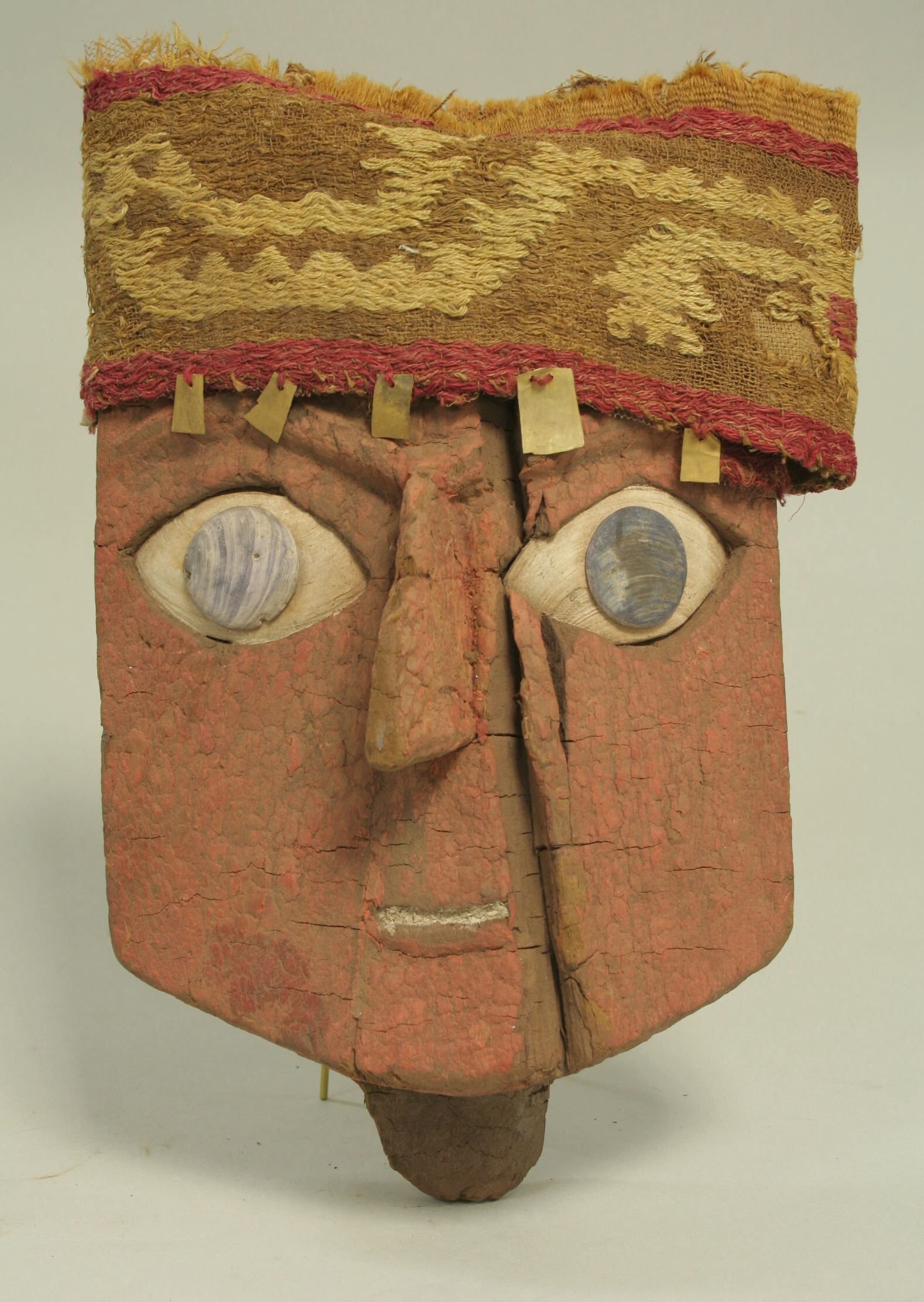
The intersection of pre-Columbian funerary rites and the relentless forward momentum of avant-garde fashion is a fertile, if unsettling, ground for innovation. At Zoey Fashion Laboratory, our SS26 collection seeks to sever the temporal cord, drawing not from the past as a nostalgic reference, but from the past as a technological and spiritual blueprint. The Funerary Mask Turban, sourced from the Ica region of Peru, is not merely an artifact of mortuary practice; it is a masterclass in structural compression, material hierarchy, and the architectural framing of the human form. Composed of carved wood, polychrome paint, gold leaf, woven cloth, and shell inlay, this object transcends its funerary context to become a radical proposition for the future of headwear and, by extension, the entire upper-body silhouette.
The artifact’s origin in Ica—a desert region known for its dry preservation of textiles and organic matter—offers a critical lesson in material resilience. The mask’s composite construction, where rigid wood supports pliable cloth and brittle shell, creates a dynamic tension. This tension is the conceptual and structural core of our SS26 exploration. We are not replicating the mask; we are deconstructing its logic of layered, protective, and ornamental compression. The turban, in its original form, is a volume of cloth that simultaneously conceals and announces status. When fused with the funerary mask’s rigid facial architecture, we arrive at a new typology: the “Bio-Sarcophagus Hood.” This is a garment that encases the head not as a hat, but as a second skull—a protective exoskeleton for the neural center of the future human.
Structural Innovation: From Compression to Expansion
The primary structural innovation derived from the Ica artifact is the concept of “compressive armature.” The mask’s wooden base acts as a rigid internal skeleton, while the cloth and paint form a tensioned skin. In SS26, this principle is inverted and expanded. We propose a series of “Exo-Cranial” headpieces and integrated neck-to-shoulder garments that use a lightweight, 3D-printed biopolymer lattice—inspired by the geometric shell inlays—as the internal structure. Over this lattice, a liquid-crystal-infused textile, capable of shifting opacity and texture under electrical current, is tensioned. The result is a living garment that can transition from a matte, funerary stillness to a reflective, metallic state, mirroring the gold leaf’s ancient luminosity.
Furthermore, the mask’s composite layering informs our approach to the “Floating Silhouette.” Traditional tailoring relies on the body’s static points—shoulders, waist, hips. The Funerary Mask Turban, however, creates a new focal point: the cranial apex. By anchoring the garment’s primary structural tension at the crown of the head and the occipital bone at the back, we can suspend the rest of the garment away from the body. This creates a dramatic, volumetric space between the textile and the torso, reminiscent of the mask’s void behind the face. For SS26, we are developing a “Zero-Gravity Mantle” that connects from a rigid, mask-like collar to a floating panel of engineered silk that hovers above the shoulders, never touching the clavicle. This is not a cape; it is a controlled, architectural void.
Material Dialogue: The Temporal Spectrum
The material palette for SS26 is a direct dialogue with the Ica artifact’s four primary components: wood, paint, gold, and shell. We reject the notion of “natural” versus “synthetic.” Instead, we embrace a “temporal spectrum” of materials that exist between decay and permanence.
Wood is translated into “Lignin-Reinforced Cellulose Fiber.” This is a bio-fabricated material grown from mycelium and wood waste, then compressed into a leather-like substance that retains the grain and rigidity of the original mask’s wooden core. It is used for structural panels in our “Funerary Bodice.” Paint becomes “Chromatic Memory Pigments”—micro-encapsulated dyes that react to heat and pressure, allowing the garment to “remember” the touch of the wearer, leaving ghostly traces of color that fade and reappear, mimicking the mask’s original polychrome which has faded and been restored over centuries. Gold is not used as a precious metal, but as a “Vapor-Deposited Titanium Nitride” coating on carbon fiber elements. This achieves the same reflective, incorruptible quality as the gold leaf, but with a futuristic, industrial edge. Finally, shell is reinterpreted as “Bio-Ceramic Discs”—laser-cut from recycled oyster shells and bound with a biodegradable resin. These discs are sewn onto the garment’s surface in overlapping, scale-like patterns, creating a shimmering, protective carapace that references both the original inlay and the armor of a cyborg.
Contextual Fracture: The Archive Node of Angkor Wat
The aesthetic correlation with our archive node—a worn ceramic mold fragment from Angkor Wat depicting musicians in eternal, silent performance—is not coincidental. Both artifacts, separated by continents and millennia, share a fundamental obsession with the frozen gesture. The Ica mask freezes the face of the deceased in a state of eternal presence. The Angkor Wat mold freezes the musicians in an eternal act of creation. For SS26, this translates into garments that are “kinetic archives.” The wearer’s movements are not simply facilitated; they are recorded and re-performed by the garment itself.
We are developing “Shape-Memory Alloy” filaments woven into the fabric of the turban and the associated bodice. These filaments, trained to a specific “silent performance” pose—a head tilted in listening, a hand raised in a gesture of offering—will activate when the garment detects stillness. In a gallery or a quiet moment, the garment will slowly, almost imperceptibly, move toward that frozen pose, becoming a living sculpture that echoes the Angkor Wat musicians. This is the ultimate synthesis of the funerary and the futuristic: the garment becomes a monument to the act of becoming, a perpetual performance of the self that transcends the wearer’s conscious control.
The SS26 Silhouette: A New Human Topography
The final silhouette for SS26 is defined by a radical re-proportioning of the human form. The Funerary Mask Turban dictates a new cranial volume—elongated, asymmetrical, and structured. The neck is no longer a connector but a “transitional zone” of rigid, interlocking plates. The shoulders are de-emphasized, replaced by the “Floating Mantle” that creates a horizontal plane of volume above the torso. The waist is redefined by the “Funerary Bodice,” which cinches not at the natural waist but at the lower ribcage, compressing the torso into a single, powerful column.
This is not a silhouette for the passive observer. It is a silhouette for the post-human curator—an individual who treats their own body as an artifact in progress, a vessel for memory, technology, and ritual. The Funerary Mask Turban of Ica, through the lens of Zoey Fashion Laboratory, is no longer a relic of death. It is the first sketch of a new kind of life, where fashion is not worn, but inhabited. The future is not a clean slate; it is a palimpsest, written in wood, gold, and the silent music of lost worlds.