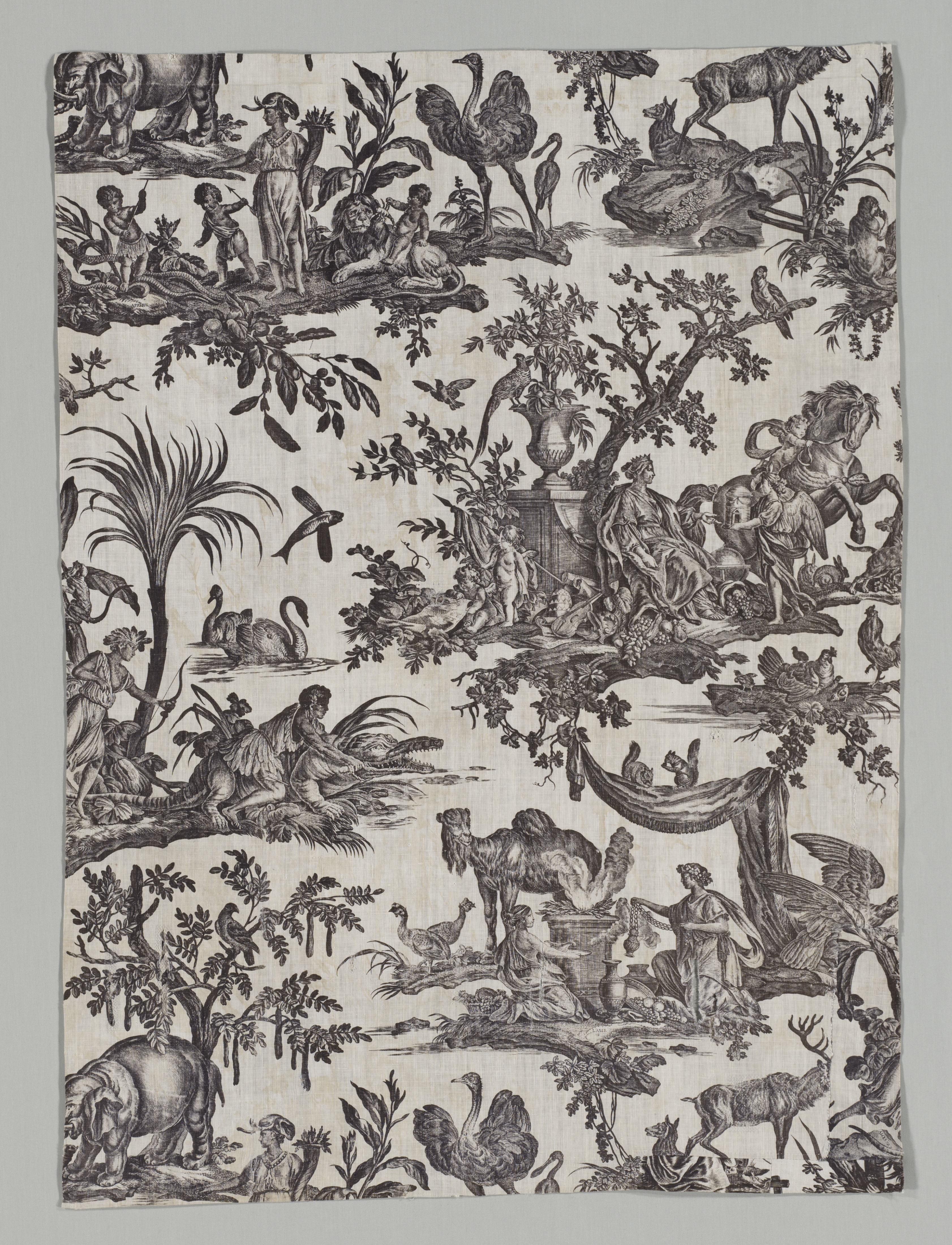
Deconstructing the Archive: The Four Continents as Avant-Garde Provocation
At Zoey Fashion Lab, our mission is not merely to preserve historical textiles but to deconstruct their embedded narratives and reconstruct them as radical statements for the contemporary wardrobe. The subject of this analysis—a French, 18th-century copperplate-printed cotton textile depicting the allegory of The Four Continents—presents a uniquely potent artifact. It is a document of colonial ambition, a masterpiece of technical printmaking, and a silent witness to the birth of globalized aesthetics. For the avant-garde designer, this fabric is not a relic to be revered but a code to be cracked, its visual language ripe for fragmentation, subversion, and reanimation.
Technical Genesis: The Copperplate Revolution
The technical choice of copperplate printing on cotton is itself a declaration of modernity. In the 18th century, this process—imported from England and perfected in France at centers like Jouy-en-Josas—represented a quantum leap in textile fidelity. Unlike woodblock printing, copperplate engraving allowed for continuous, sinuous lines, minute cross-hatching, and a tonal depth previously reserved for paper engravings. The resulting fabric was not just cloth; it was a printed narrative on a wearable canvas.
For the avant-garde designer, this technical precision is a starting point for distortion. The crisp, linear clarity of the copperplate line can be magnified, blurred, or warped through digital manipulation. Imagine taking a single detail—the flowing robe of a European allegorical figure—and scaling it to architectural proportions, then printing it on a laser-cut, deconstructed garment. The original's meticulous craftsmanship becomes the foundation for a deliberate technical violence, a commentary on the fragility of mastery in the face of industrial reproduction.
Iconographic Archaeology: The Four Continents as Colonial Cartography
The allegory of the Four Continents—Europe, Asia, Africa, and the Americas—is a cartography of power. In 18th-century French decorative arts, this theme was ubiquitous, from Sèvres porcelain to Gobelins tapestries. It presented a hierarchical world order: Europe, often crowned and holding a scepter or globe, sits at the center or top; Asia, with incense and exotic animals, reclines in opulence; Africa, often partially nude with a sun motif, gestures with a sense of wild abundance; and the Americas, feathered and armed, embodies a savage nobility.
This visual taxonomy is a colonialist fantasy, a projection of French imperial ambition onto a global stage. The copperplate print captures this with an almost ethnographic detail—the flora, fauna, and dress of each continent are rendered with a mix of observation and invention. For the avant-garde designer, this iconography is not a neutral decorative scheme but a charged political text. The task is not to reproduce the allegory but to interrogate its gaze.
Consider a garment that takes the figure of "America" and isolates her feathered headdress, then recontextualizes it as a structural collar made from recycled plastics. Or a dress that prints the entire composition but digitally erases the central European figure, leaving a void that questions the very notion of a "center" of civilization. The allegory becomes a palimpsest of power, where the original narrative is overwritten with contemporary critiques of cultural appropriation and geopolitical imbalance.
Archive Resonance: Echoes from the Sixteenth and Seventeenth Centuries
As referenced in Archive Resonance, the period from the sixteenth to the seventeenth centuries was a crucible of cultural collision. The flow of goods—Chinese porcelain, Indian chintz, Ottoman silks—reshaped European aesthetics. The Four Continents motif is a direct descendant of these exchanges, a synthesis of global motifs filtered through a European lens. The copperplate printer borrowed from Mughal floral patterns, Chinese landscape conventions, and African textile geometries, all while asserting a French compositional order.
This hybridization is the avant-garde designer's raw material. The original fabric is already a site of multiple influences, a woven archive of cross-cultural encounters. To deconstruct it is to unravel these threads and re-weave them into new constellations. Imagine a garment that uses the negative space of the print—the unprinted cotton ground—as a field for hand-embroidered fragments from non-European textile traditions: a Japanese sashiko stitch on the robe of the European figure, a West African indigo resist pattern on the Americas' feathered skirt. The original colonial allegory is disrupted and enriched by the very cultures it sought to categorize.
Avant-Garde Strategies: Fragmentation, Scale, and Materiality
To translate this 18th-century artifact into an avant-garde collection, Zoey Fashion Lab proposes three core strategies:
1. Fragmentation and Reassembly. The copperplate print is a continuous narrative, but the avant-garde thrives on rupture. By cutting the fabric into geometric shards—hexagons, trapezoids, asymmetrical panels—and reassembling them on a laser-cut base, the designer can create a garment that is both a homage and a critique. The allegory is shattered into a kaleidoscope, each fragment a displaced memory of the whole. A jacket might feature the European figure's hand on one sleeve and the African figure's foot on another, creating a disorienting, non-linear body map.
2. Scale Warping. The original print is intimate, meant to be viewed at arm's length. For the avant-garde, scale is a weapon. Enlarge a single detail—the eye of a camel in the Asian scene, the feathers of an American parrot—to 500% and print it on a billowing silk organza overlay. The result is a monumental abstraction that obscures the original narrative while retaining its graphic power. The garment becomes a walking fragment of a forgotten world, where the micro becomes macro and the decorative becomes architectural.
3. Material Subversion. The original cotton is soft, breathable, domestic. The avant-garde designer can invert this materiality. Bond the cotton to a rigid, industrial substrate like neoprene or recycled PET felt. The fluid drape of the 18th-century fabric is frozen into a sculptural shell. The print, once a gentle narrative, becomes a hardened surface, a relic of a world that can no longer bend. Alternatively, dissolve the cotton in a controlled chemical process, leaving only the copperplate ink as a fragile, ghostly web. This vanishing act speaks to the erasure of colonial histories and the fragility of cultural memory.
Conclusion: The Fabric as Provocation
The 18th-century French copperplate print of The Four Continents is not a decorative curiosity; it is a provocation in cloth. It embodies the technical virtuosity of its age, the political ambitions of its patrons, and the global currents that shaped it. For Zoey Fashion Lab, this artifact is a launchpad for deconstruction—a chance to question who gets to represent whom, how power is woven into pattern, and what it means to wear a world on one's back.
By fragmenting its narrative, warping its scale, and subverting its material, the avant-garde designer can transform this colonial allegory into a contemporary manifesto. The garment becomes a site of critical engagement, where the past is not preserved in amber but reanimated as a living argument. In the hands of Zoey Fashion Lab, the Four Continents is no longer a map of the world as it was—it is a blueprint for the world as it could be, deconstructed and rebuilt with every stitch, cut, and print.