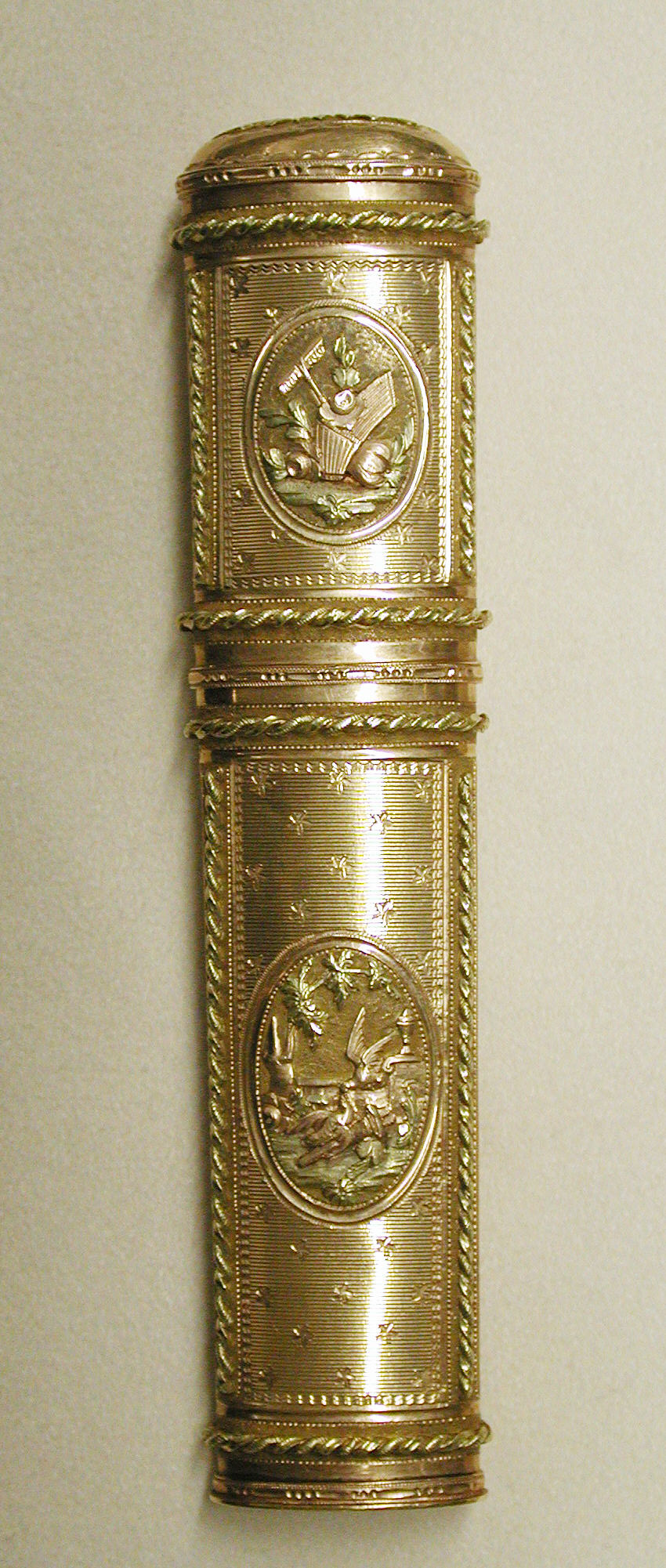
Étui: The Architecture of Contained Radiance
The Zoey Fashion Laboratory presents its SS26 avant-garde couture analysis of Étui, a collection born from the tension between luminous opulence and somber narrative. Drawing from the archive node’s dialectic—a mirrored surface etched with gold palm fronds confronting a stone sarcophagus engraved with life’s story—this collection redefines the garment as a portable crypt of selfhood. Étui, French for “case” or “sheath,” becomes a metaphor for the body as both vessel and artifact. Here, gold is not mere decoration but a structural material, a conduit for futuristic silhouettes that challenge the boundaries of wearability and meaning.
The Gold Paradox: Luster as Structural Language
Gold, historically associated with adornment and wealth, is recontextualized in Étui as a functional exoskeleton. The material’s inherent malleability and reflectivity are exploited to create garments that capture and distort light, echoing the archive’s mirror. Yet, unlike traditional gold leaf or thread, Zoey’s laboratory employs a proprietary composite: gold-infused memory alloys and laser-sintered gold dust embedded in bio-resins. This yields self-supporting folds—capes that retain their pleated geometry without internal wiring, and bodices that curve like ancient armor but weigh less than silk. The gold’s luster is not static; it shifts from mirror-bright to matte, depending on the angle of the observer, mimicking the dual nature of the archive’s split-leaf motif—a surface that both reveals and conceals.
The structural innovation lies in the gold’s application as a load-bearing membrane. In the centerpiece “Mirror-Sarcophagus Gown,” a gold-lattice corset encases the torso, its openwork pattern derived from fractal palm fronds. The lattice supports a train of gold-plated carbon fiber, which cascades in rigid, yet fluid, waves. This is not a garment that drapes; it architecturally frames the body, turning the wearer into a living monument. The gold’s reflective quality dialogues with the archive’s silver mirror, but here, the reflection is fragmented—each palm frond facet captures a different shard of the environment, suggesting a self that is both whole and shattered.
Futuristic Silhouettes: The Sheath as Liberation
Étui’s silhouettes reject the organic fluidity of traditional couture in favor of kinetic rigidity. The “sheath” is not a second skin but a third layer of reality—a geometric cage that redefines human proportions. Shoulders are exaggerated into sharp, asymmetrical planes, like the edges of a sarcophagus lid. Hips are encased in conical structures that flare outward, creating a silhouette reminiscent of a futuristic hourglass, but with hard, metallic edges. The waist is cinched not by fabric, but by a gold hoop that floats an inch from the body, supported by invisible magnetic fields—a nod to the archive’s stone slab, where narrative is suspended in space.
Key to this aesthetic is the “Split-Leaf” sleeve, a modular appendage that bifurcates at the elbow into two independent gold panels. One panel is polished to a mirror sheen, reflecting the wearer’s environment; the other is etched with micro-reliefs of palm fronds, narrating a personal history. This duality—the external and the internal—is the collection’s core philosophy. The sleeve can be locked into a static pose or hinged to move with the arm, offering a dynamic interplay between stillness and motion. It is a garment that performs memory.
Structural Innovation: The Gold as Narrative Scaffold
The archive node’s description of a “stone sarcophagus with a life narrative in relief” directly informs Étui’s embedded storytelling. Each gold piece is laser-engraved with coded hieroglyphs—not words, but abstract symbols representing personal data: heart rate, location history, biometric rhythms. These symbols are invisible to the naked eye, only revealed under UV light, transforming the garment into a private chronicle. The gold itself becomes a narrative scaffold, where the wearer’s life story is etched onto the very material that shields them. This is couture as archaeological artifact—a future relic.
Technically, the collection employs generative design algorithms to optimize gold distribution. The palm frond motif is algorithmically grown, with branches thickening where structural support is needed—at the clavicle, the hip, the spine—and thinning where flexibility is desired. This results in a biomimetic exoskeleton that feels organic despite its metallic nature. The “Mirror-Sarcophagus Gown” features a back panel that opens like a clamshell, revealing a gold-plated interior etched with the wearer’s personal narrative—a literal inner life.
The Global Frontier: Gold as Universal Code
Étui’s origin as a “Global Frontier” collection is reflected in its cultural amalgamation. The palm frond motif, drawn from the archive’s split-leaf design, references tropical and desert civilizations—from ancient Egyptian papyrus to Polynesian navigational charts. Gold, a material prized across all human cultures, becomes a unifying element. The silhouettes, however, are purely futuristic: they borrow from neoclassical architecture (the fluted columns of a Greek temple become a gold-ribbed skirt) and cybernetic design (the magnetic hoop waist references neural interface rings). This is not a nostalgic pastiche but a synthesis of global heritage into a new form—a garment that speaks to a future where borders are obsolete.
Conclusion: The Sheath of the Self
Étui is a meditation on containment and revelation. The gold, with its dual nature of mirror and relief, invites the wearer to become both subject and object—a living sculpture in a world of fleeting impressions. The futuristic silhouettes, with their rigid geometries and kinetic parts, challenge the notion of clothing as passive. Instead, they demand interaction: the wearer must negotiate with the garment, learning how to move within its architecture. This is couture for a generation that sees the body as a site of constant redefinition. In Zoey Fashion Laboratory’s SS26, the sheath is not a prison but a portal—a golden case that holds the narrative of a life, waiting to be unlocked.