Deconstructing the Nomadic Code: A Technical Analysis of the Isfahan Silk Landscape
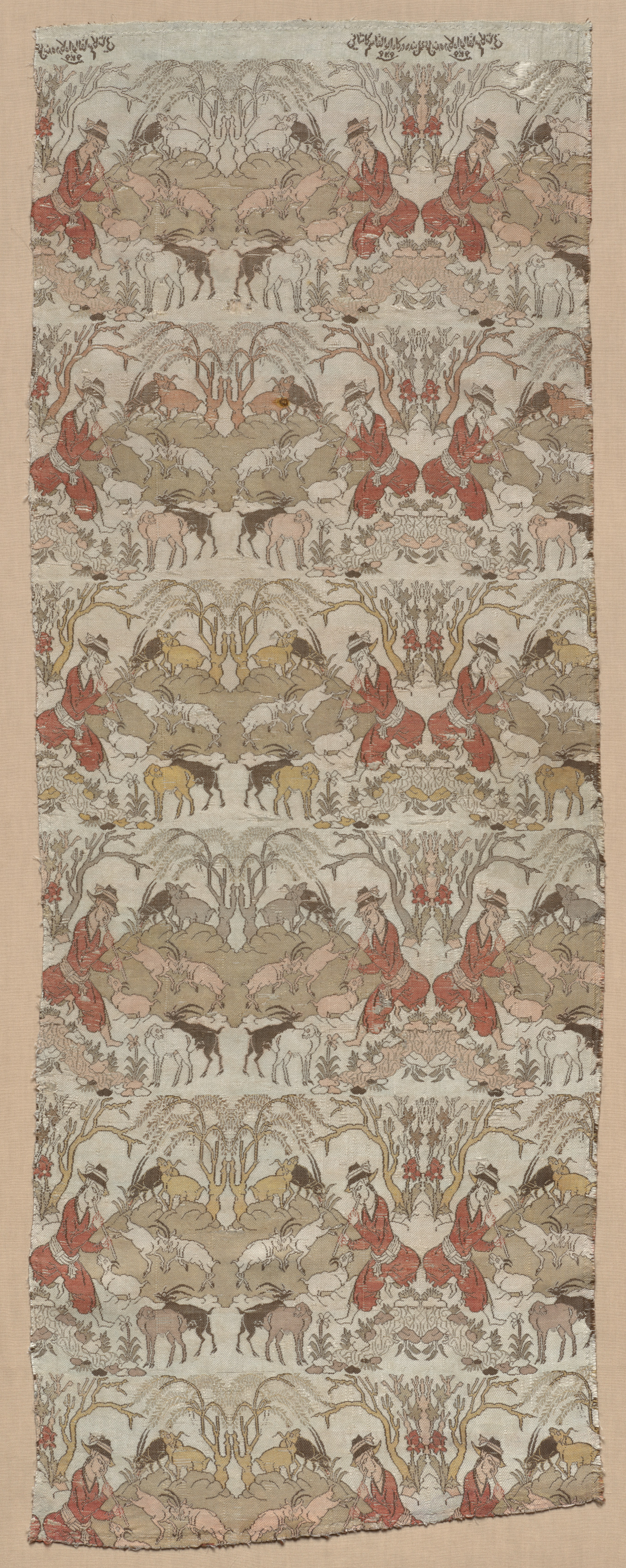
As the Chief Fabric Deconstructionist for Zoey Fashion Lab, I have the privilege of dissecting textiles that challenge the boundaries of material culture. The subject of this analysis is a remarkable artifact: an Iranian silk textile from Isfahan, depicting goatherds in a landscape, executed in a lampas weave. This piece, which we have designated as a "New DNA Strand" for our avant-garde collection, offers a profound intersection of historical technique and radical reinterpretation. Our objective is not merely to preserve its heritage but to extract its latent potential for disruptive, forward-thinking design.
Technical Foundation: The Lampas Weave and Its Structural DNA
The lampas weave is a complex, compound structure that defines the textile's physical and aesthetic properties. Unlike simpler weaves, lampas involves two or more warp and weft systems. In this Isfahan piece, a fine silk warp provides the ground, while a thicker, often colored silk weft creates the pattern. The technical genius lies in the binding: the pattern weft is bound by the ground warp in a specific, repeated sequence, allowing for intricate, multi-colored designs without the limitations of a single-weave structure. This creates a fabric that is simultaneously dense, durable, and capable of extraordinary detail.
For Zoey Fashion Lab, this structural complexity is a source of inspiration. We see the lampas weave not as a fixed historical technique but as a generative system. The interplay of warp and weft, the tension between ground and pattern, mirrors the conceptual tension we seek in our avant-garde garments. We are deconstructing this DNA by isolating its components: the warp as a linear, time-based element (the narrative thread of the landscape) and the weft as a lateral, disruptive force (the goatherds' movement). By digitally mapping the weave's pattern repeats, we can algorithmically generate new, asymmetric structures that retain the original's integrity while introducing visual chaos—a hallmark of our aesthetic.
Iconography and Narrative: The Goatherds as Avant-Garde Subjects
The depicted scene—goatherds in a landscape—is deceptively simple. In traditional Persian art, such imagery often symbolizes pastoral harmony, the cycle of life, and the relationship between human and nature. The goatherd is a figure of resilience, moving through a terrain that is both harsh and beautiful. The landscape, likely rendered in stylized floral and geometric motifs, serves as a cosmic backdrop, reflecting the Safavid era's fascination with paradise gardens and celestial order.
In our avant-garde context, we re-read this narrative as a code of displacement and transformation. The goatherds are not static figures; they are agents of movement, herding not just animals but the very fabric of tradition. The landscape becomes a map of resistance—a terrain where historical boundaries dissolve. We extract this by isolating the goatherd's silhouette and the landscape's contour lines, then reinterpreting them as cut-out panels, laser-etched leather, or transparent silk overlays. The result is a garment that tells a story of nomadic identity, where the wearer becomes both the herder and the herded, navigating the urban landscape as a modern-day pastoralist.
Materiality and Sensory Deconstruction: Silk as a Conduit
Silk, the primary material, is a paradoxical substance. It is simultaneously strong and delicate, lustrous and matte, warm and cool. In this Isfahan textile, the silk's natural sheen amplifies the lampas weave's depth, creating a moiré effect that shifts with light. The tactile experience is equally complex: the raised pattern wefts create a subtle topography, inviting touch and close inspection.
For our deconstruction, we treat silk not as a precious material to be preserved but as a medium for intervention. We subject it to controlled degradation: enzymatic washes to soften the weave, selective dyeing to create gradient fades that mimic the landscape's atmospheric perspective, and heat-pressing to create permanent creases that echo the goatherds' paths. The goal is to produce a fabric that retains its original DNA—its weave structure and fiber composition—while acquiring a new, distressed texture that speaks to the passage of time and the fragility of heritage. This is not destruction but revelation; we expose the underlying tension between the silk's natural elegance and the harsh realities of its production and history.
Pattern and Geometry: From Symmetry to Fracture
The Isfahan textile's pattern is likely organized around a central axis or repeated medallions, a common feature of Safavid design. The goatherds and landscape elements are arranged in a balanced, harmonious composition, reflecting the mathematical precision of Islamic geometry. The lampas weave allows for sharp, clean edges between colors, creating a crisp, almost graphic quality.
Our avant-garde approach disrupts this symmetry. We extract the pattern's fundamental geometric units—the circle, the arch, the diagonal line—and subject them to fractal distortion. Using computational design tools, we generate new patterns that maintain the original's visual vocabulary but introduce irregularities: broken medallions, displaced goatherds, overlapping landscape planes. The result is a textile that appears to be in a state of controlled collapse, where the historical order is visible but actively unraveling. This is applied to garment construction: a coat with a perfectly symmetrical front panel but a back panel that is a chaotic re-arrangement of the same motifs, or a dress where the goatherds' silhouettes are printed in a gradient that fades into abstraction.
Cultural and Conceptual Implications: The Avant-Garde as Ethical Reclamation
Working with a textile from Isfahan, a city with a rich but politically complex history, requires a nuanced ethical approach. The avant-garde often risks cultural appropriation, treating artifacts as mere aesthetic resources. At Zoey Fashion Lab, we counter this through conceptual transparency. Our deconstruction is not a theft but a dialogue. We acknowledge the textile's origin, its makers, and its cultural significance, and we frame our interventions as a form of reclamation—giving a historical object a new life in a contemporary context.
The "New DNA Strand" designation is key here. We view this textile as a genetic code that can be recombined, not erased. By isolating its technical and iconographic elements, we create a hybrid identity that honors the past while embracing the future. The goatherds become symbols of migration, the landscape a metaphor for the globalized world, and the lampas weave a testament to the enduring power of craftsmanship. Our garments are not costumes but wearable manifestos, challenging the viewer to see heritage not as a static relic but as a living, evolving force.
Conclusion: A Blueprint for Future Deconstructions
This analysis of the Isfahan silk textile with goatherds in a landscape reveals a fabric of immense complexity and potential. Its lampas weave structure, narrative iconography, material properties, and geometric patterns provide a rich vocabulary for avant-garde design. By deconstructing these elements—structurally, conceptually, and ethically—Zoey Fashion Lab transforms a historical artifact into a catalyst for innovation. The resulting garments are not reproductions but evolutions, carrying the DNA of the past into a future where tradition and disruption coexist. This is the essence of our work: to honor the craft while breaking its boundaries, to preserve the story while rewriting it in the language of the new.