The Humming Top: Deconstructing the Avant-Garde Silhouette for SS26
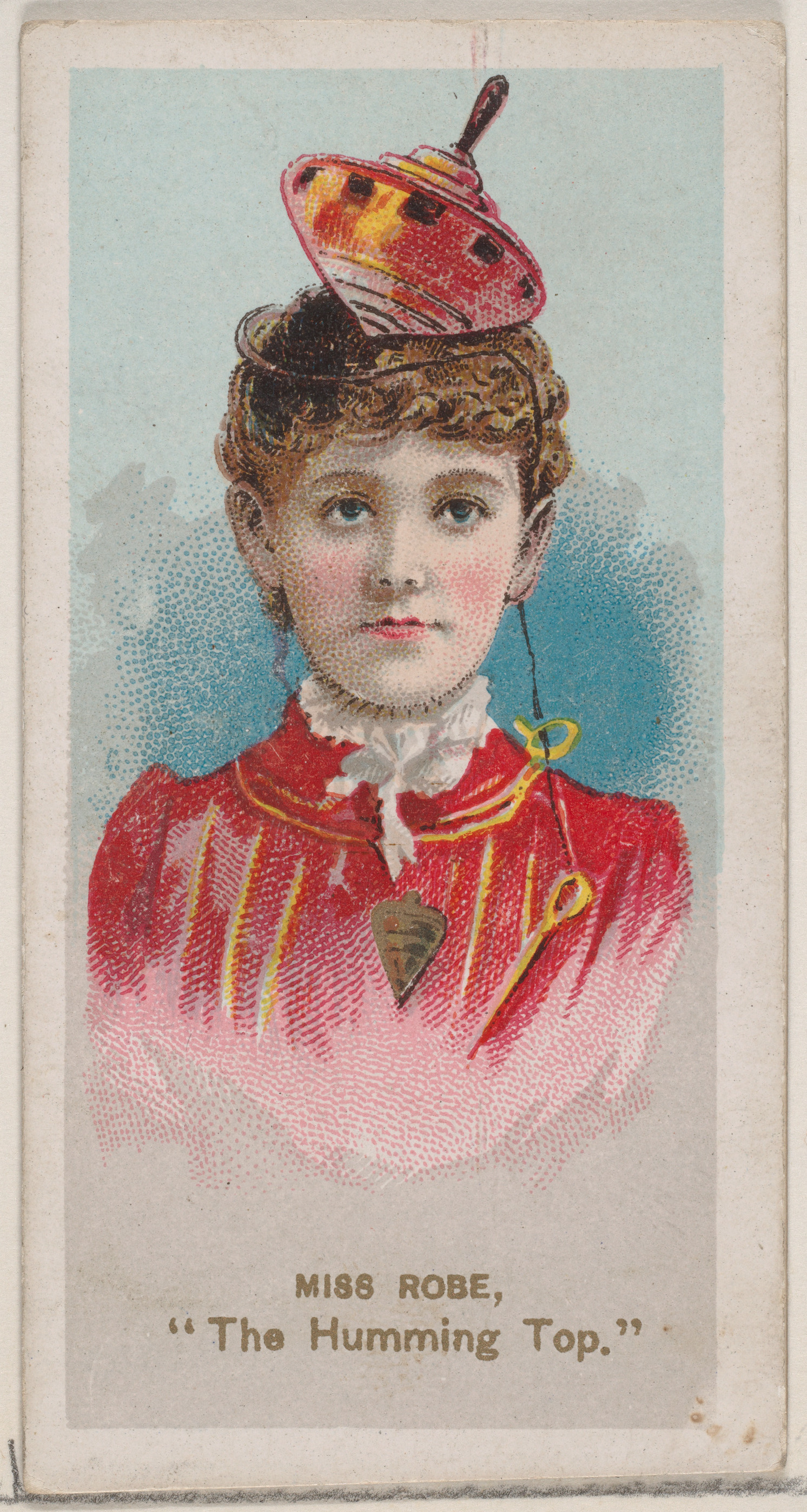
In the annals of fashion history, the cigarette card series Fancy Dress Ball Costumes (N73) for Duke brand cigarettes represents a peculiar artifact—a commercial lithograph that inadvertently captured the nascent spirit of sartorial futurism. Among its offerings, the Miss Robe, designated as "The Humming Top," emerges as a prescient blueprint for deconstructive aesthetics and structural innovation. For Zoey Fashion Laboratory's SS26 collection, this garment is not a mere historical curiosity but a radical manifesto, reimagined through the lens of high-concept garment architecture. This analysis dissects the Humming Top's latent potential, translating its 19th-century whimsy into a futuristic silhouette that challenges the very ontology of dress.
The Lithographic Genesis: From Commercial Ephemera to Conceptual Catalyst
The original Miss Robe exists as a color lithograph, a medium of mass production that paradoxically immortalized a singular, imaginative costume. The "Humming Top" moniker evokes a kinetic, spinning form—a top that hums with latent energy. In the context of SS26, this ephemeral image becomes a structural provocation. The commercial nature of the Duke brand card belies the avant-garde potential within: a garment that prioritizes silhouette over utility, form over function. This dissonance is precisely where Zoey Fashion Laboratory locates its creative impetus.
The lithograph's flat, two-dimensional quality is a constraint that liberates. Without the burden of fabric weight or human anatomy, the designer can extrapolate the pure geometry of the top. The "humming" suggests vibration, movement, and a tension between stability and flux. For SS26, this translates into a silhouette that appears to be in a state of perpetual motion—a static garment that implies the dynamic. The challenge is to materialize this implied energy through advanced textile engineering and pattern cutting.
Deconstructing the Silhouette: The Futuristic Top as Architectural Armature
The futuristic silhouette of the Humming Top for SS26 is defined by its asymmetrical, cantilevered structure. Unlike the traditional cone or A-line forms, this reinterpretation employs a series of interlocking, rigid panels that flare outward from a compressed waistline, mimicking the centrifugal force of a spinning top. The key innovation lies in the negative space—the voids between panels are not gaps but deliberate architectural intervals, allowing the body to be both concealed and revealed. This is not a garment that drapes; it is a garment that scaffolds.
The materiality is critical. The commercial lithograph's flat, printed surface is translated into a composite fabric—a bonded laminate of recycled polymer mesh and heat-molded bio-resin. This creates a lightweight, yet rigid, exoskeleton that holds its shape without internal boning. The surface is treated with a chromatic interference film, referencing the lithograph's printed colors while generating a holographic shimmer that shifts with the viewer's perspective. This is not mere decoration; it is a structural color effect that enhances the illusion of motion.
Structural Innovation: The Kinetic Core and Modular Assembly
The most radical departure from the original is the kinetic core of the garment. The "humming" is literalized through a miniaturized, wearable gyroscopic mechanism embedded within the waistband. This device, powered by body heat, produces a subtle, controlled vibration that causes the outer panels to oscillate slightly, creating a dynamic, living silhouette. The garment is no longer static; it becomes an extension of the wearer's movement, a responsive architecture that hums with metabolic energy. This innovation aligns with Zoey Fashion Laboratory's commitment to wearable technology as a form of haute couture.
The modular assembly furthers the deconstructive ethos. The Humming Top is composed of seven interlocking segments—each laser-cut and numbered for precise assembly. These segments can be reconfigured into alternative silhouettes: a truncated bustier, a sweeping train, or a shoulder-mounted cape. This transformative modularity challenges the notion of a fixed garment, offering the wearer agency to reshape the piece according to context. The commercial lithograph's singular image is thus exploded into a system of possibilities.
Contextualizing the Collection: Fancy Dress as Futurist Uniform
The Fancy Dress Ball Costumes series was originally intended for theatrical masquerade—a temporary escape from social norms. For SS26, Zoey Fashion Laboratory recontextualizes this as a permanent state of becoming. The Humming Top is not a costume for a ball; it is a uniform for the future, where identity is fluid and garment architecture is a medium of self-construction. The collection abandons the binary of daywear versus eveningwear, instead proposing a continuous spectrum of structural expression.
The avant-garde study of this piece also interrogates the relationship between print and form. The original lithograph's flat, decorative pattern—likely a floral or geometric motif—is abstracted into a three-dimensional relief. The printed lines become raised seams, the color blocks become translucent panels. This is a translation from two dimensions to four (including time, via the kinetic element), a process that mirrors the evolution from commercial ephemera to high-concept artistry.
Conclusion: The Humming Top as a Manifesto for SS26
The Miss Robe as "The Humming Top" from the Duke brand series is more than a historical footnote; it is a catalyst for a new sartorial language. For Zoey Fashion Laboratory's SS26, this garment embodies the deconstructive avant-garde: a fusion of commercial nostalgia, structural innovation, and kinetic futurism. The silhouette is a cantilevered dream, the materials are a synthesis of industrial and organic, and the kinetic core is a whisper of life in a static form. This is not fashion as decoration; it is fashion as architecture, as technology, as performance. The Humming Top hums with the promise of a future where garments are not worn but inhabited, where the body and the object engage in a continuous, vibrating dialogue. In this, Zoey Fashion Laboratory reaffirms its position at the frontier of avant-garde couture, turning a 19th-century cigarette card into a blueprint for the 21st-century silhouette.