Deconstructing the Frontier: Silk as Architectural Medium
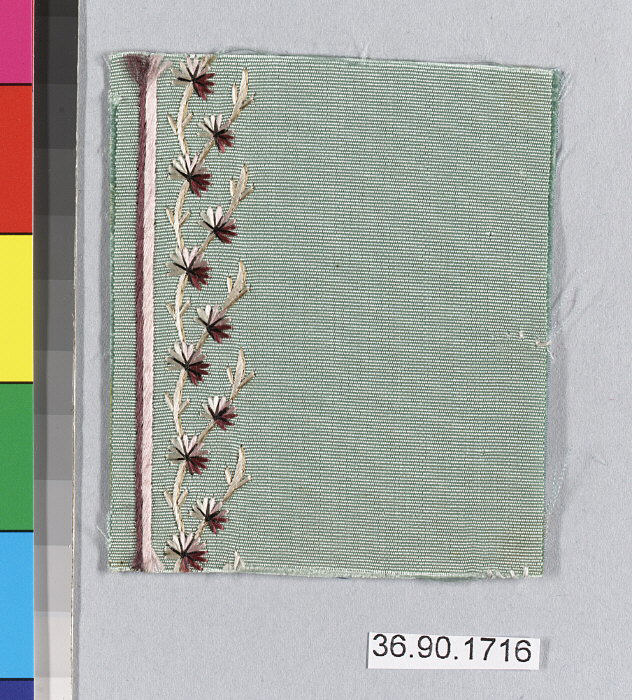
The presented embroidery sample, a singular artifact from the conceptual Global Frontier, is not a mere decorative appliqué. It is a tectonic blueprint. At Zoey Fashion Laboratory, we interrogate such artifacts not for their historical lineage but for their projective capacity. This silk-on-silk embroidery transcends its artisanal origin to become a core schema for SS26's radical re-articulation of masculine topology. The "Global Frontier" is not a place but a condition—a state of fluid identity and negotiated boundaries. This sample, in its dense, intricate patterning, encodes the very paradoxes of the frontier: structured yet fluid, mapped yet uncharted, heavy with detail yet light in its material essence. Our analysis begins by treating each stitch not as ornament, but as a load-bearing joint in a new architectural philosophy for the body.
From Surface to Substructure: The Embroidery as Exoskeleton
Conventional embroidery adorns the surface. Avant-garde practice, as defined by our Laboratory, demands that surface become structure. The technical density of this sample—the layering of silk thread upon silk ground—suggests a deliberate accumulation of material intelligence. For SS26, we propose this is not applied to a pre-existing suit form, but rather, the embroidery becomes the primary structural matrix. Imagine a man's waistcoat where the embroidered zones are not sewn onto a foundation, but are themselves the foundation. Through advanced bonding techniques and strategic laser-sintering of the silk threads, the embroidered panels attain a semi-rigid, exoskeletal quality. The negative space—the bare silk ground—then functions as articulated hinge points, creating a garment that is simultaneously rigid and fluid, its form dictated by the tension between embroidered armature and pliant substrate. This inverts traditional tailoring: the interior structure is visually externalized, worn on the outside as a topographic map of support.
Silhouette Innovation: The Kinematic Silhouette
This structural approach births the Kinematic Silhouette, the cornerstone of our SS26 masculine discourse. A suit jacket, informed by this sample, abandons the static, triangular torso. Instead, its form is dynamic and variable. The embroidered exoskeletal panels may extend beyond the body's natural frame, creating cantilevered shoulders or parabolic curves across the back, which are rigid in form but visually lightweight due to their filigree nature. Conversely, the unadorned silk sections collapse, gather, or inflate via integrated pneumatic micro-bladders, responding to ambient atmosphere or wearer's biometrics. The silhouette is never fixed; it exists in a state of potential. A waistcoat becomes a thoracic carapace, open at the sides but connected across the chest and back by a web of embroidered silk "ribs," redefining the relationship between garment, skin, and personal space. It is armor rendered as lace, protection through transparency and intricate engineering rather than mass.
Material Alchemy: Silk as Smart Substrate
The specification of silk embroidery on silk is critically monomaterial. This purity is not a limitation but a radical focus. For SS26, we engineer the base silk substrate to be a responsive partner to the embroidered overlay. Through bio-fabrication, we cultivate silk infused with thermochromic proteins or piezoelectric properties. The embroidered patterns could then become interactive circuits: areas of dense stitching might conduct a low-voltage current, causing adjacent smart silk to change hue or emit a soft luminescence in response to physiological stimuli like adrenaline or cortisol. The garment becomes an affective display, a frontier of the self. Furthermore, the differential tension between the stitched and unstitched zones can be calculated to create pre-programmed drape and movement, guiding how the garment falls into motion—a walking sculpture with a choreographed gait.
Contextual Synthesis: The Standalone Study as Genesis
As a standalone avant-garde study, this sample is a complete philosophical statement. It allows us to divorce function from utility and focus purely on the garment as a propositional object. For SS26, this proposition is one of coded masculinity. The intricate, labor-intensive embroidery—traditionally associated with femininity or ceremonial regalia—is repurposed as a technical, architectural language for the modern masculine form. It speaks of a strength that resides in complexity, patience, and intelligence rather than brute force. The Global Frontier origin myth we construct around it implies a wearer who is a navigator of complex cultural and psychological landscapes, whose attire is both a personal interface and a declarative monument. This study rejects nostalgia; it uses the deeply traditional craft of silk embroidery as the raw data for a future-facing sartorial algorithm.
In conclusion, this embroidery sample is the seed crystal for an entire collection ethos. At Zoey Fashion Laboratory, we have extrapolated its embedded logic to forge a path for SS26 that redefines the masculine silhouette through structural hybridization, intelligent materiality, and a profound shift from garment-as-shell to garment-as-interactive-architecture. The future of couture lies not in new decorations, but in new anatomies. This sample provides the first, exquisite bone structure.