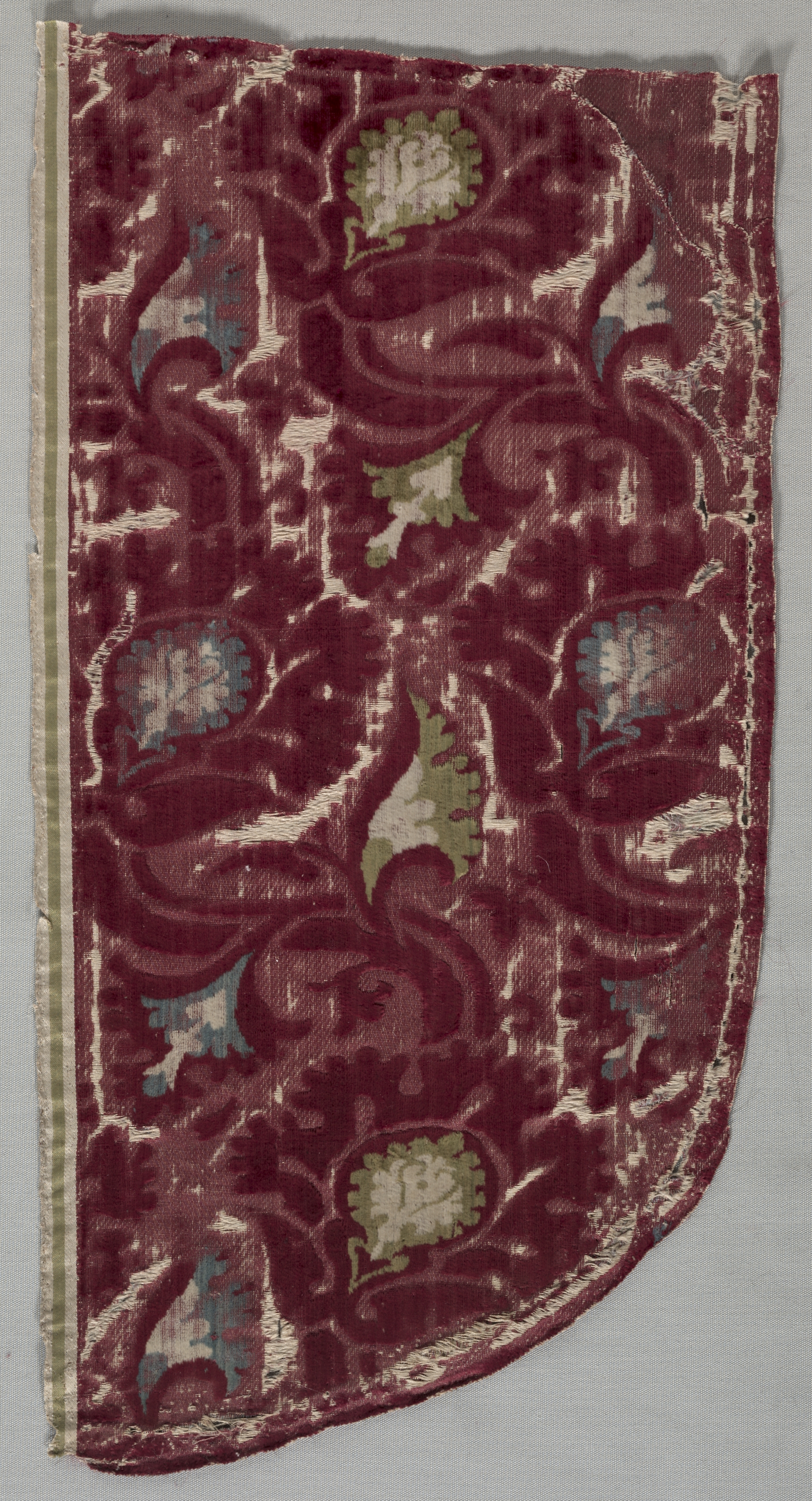
Deconstructing the Sacred: An Avant-Garde Analysis of a 15th-Century Italian Velvet Fragment
At Zoey Fashion Lab, the act of deconstruction is not an act of destruction, but one of revelation. We dissect historical textiles not to reduce them to their component parts, but to extract their latent DNA—the structural, textural, and symbolic codes that can be re-sequenced into the language of tomorrow’s fashion. The subject of this analysis, a fragment of cut and voided silk velvet, likely from a chasuble, originating in early 15th-century Italy, presents a singular opportunity. This is not merely a piece of cloth; it is a frozen moment of sacred artistry, a technological marvel of its time, and a profound source code for an avant-garde aesthetic that challenges the very boundaries of garment construction and meaning.
I. The Material Genome: Cut and Voided Velvet as a Technical Blueprint
The technical construction of this fragment is the first strand of its new DNA. Cut velvet is a labor-intensive process where loops of silk pile are sheared to create a dense, plush surface that catches light with a deep, almost liquid luminosity. Voided velvet is its counterpoint, a technique where the pile is selectively omitted, leaving the flat ground weave exposed. The resulting pattern is a dialogue between elevation and absence, between the tactile richness of the pile and the stark, often metallic, gleam of the ground (in this case, likely a silk or silver-gilt thread).
For the avant-garde designer, this is a structural manifesto. The velvet fragment instructs us to think in terms of volumetric contrast. The cut pile becomes a sculptural element, a topographical map of texture. The voided areas are negative space, the breath between the fabric’s beats. In a contemporary context, this can be translated into modular garment systems. Imagine a jacket where laser-cut panels of high-pile velvet are bonded to a sheer, structural base, creating a pattern of “voids” that reveal the skin or an under-layer. The 15th-century weaver’s binary code of pile/no-pile becomes a modern tool for creating garments that are both opaque and transparent, heavy and ethereal, in a single, seamless surface.
Furthermore, the silk itself is a material of immense consequence. Its natural protein fiber has a unique ability to reflect light in a way that mimics the human eye’s perception of depth. An avant-garde interpretation would not merely use silk; it would expose its structure. Deconstruct the velvet’s reverse side, revealing the raw, un-cut loops and the floating warp threads. This “wrong side” becomes the right side, a deliberate display of the garment’s inner mechanics. The fragment teaches us that the most luxurious effect can be achieved not by hiding the construction, but by celebrating its inherent geometry and fragility.
II. The Sacred Provenance: From Liturgical Vestment to Profane Object
The fragment’s likely origin as part of a chasuble—the outermost vestment worn by a priest during the Eucharist—is its most potent semantic charge. This was not a garment for the mundane world. It was a vessel for ritual, a fabric coded with spiritual hierarchy and divine light. The patterns, often pomegranates, artichokes, or stylized floral motifs, were not merely decorative; they were symbols of immortality, resurrection, and the Virgin Mary.
To re-contextualize this sacred fragment for the avant-garde is to perform a radical act of sacrilege-as-reverence. The chasuble’s form—a large, poncho-like shape with an opening for the head—is a powerful archetype. It is a garment that envelops, conceals, and transforms the wearer into a living icon. An avant-garde designer might extract this silhouette, but subvert its purpose. A floor-length, hooded coat in black, voided velvet, with the “sacred” pattern rendered in a reflective, almost holographic material, becomes a garment for the secular cathedral of the nightclub or the gallery. The wearer is no longer a priest of God, but a priest of the self, a high-priestess of the avant-garde.
The fragment also speaks to the concept of fragmentation itself. A chasuble is whole; this is a piece. This incompleteness is a powerful aesthetic tool. It suggests history, loss, and the passage of time. An avant-garde collection could build entire looks around this principle of the “sacred fragment.” A perfectly tailored, minimalist suit might be “slashed” to reveal a panel of the historical velvet, or a modern dress could be constructed from a single, asymmetrical panel of the fabric, its raw edges left unfinished, a deliberate scar on an otherwise pristine surface. The fragment is not a flaw; it is a feature, a narrative of survival.
III. The New DNA Strand: Translating the Code into an Avant-Garde Collection
To synthesize these findings, Zoey Fashion Lab proposes a new design language derived from this single fragment. This is not about reproduction; it is about genetic expression. The following principles form the core of this new DNA strand:
1. The Topography of Texture: The cut/voided binary is re-imagined as a three-dimensional surface. We will develop new techniques using thermoforming, resin-bonded flocking, and laser etching to create “velvet” patterns on non-traditional materials like neoprene, latex, or recycled synthetics. The goal is to achieve the same dramatic light-play and tactile contrast without using any silk or animal-derived pile. The pattern of the 15th-century chasuble becomes a digital file, a code to be printed, burned, or grown onto a 21st-century substrate.
2. The Ritual of the Envelope: The chasuble’s silhouette is abstracted into a series of “envelope” garments. These are not simple cloaks. They are engineered pieces with hidden zippers, magnetic closures, and asymmetric draping that allow the wearer to modulate the garment’s volume and shape. A single piece can be worn as a full-length cape, a short tunic, or a sculptural collar. The wearer becomes the officiant of their own ritual, controlling the garment’s transformation.
3. The Aesthetic of the Sacred Scar: The fragment’s torn, partial nature is celebrated. Garments will feature deliberate “fragments” of texture or pattern, as if a piece of a larger, lost whole has been embedded into the new form. Raw, frayed edges are not finished but stabilized with clear silicone or metallic thread, turning the potential for decay into a deliberate design element. This is a fashion that acknowledges its own mortality and history.
4. Light as a Structural Material: The velvet’s ability to absorb and reflect light is paramount. We will explore the use of iridescent, dichroic films and micro-LEDs woven into the voided areas. The pattern of the chasuble will not only be seen but will emit light, creating a garment that is both a textile and a screen, a sacred object for the digital age.
In conclusion, this 15th-century velvet fragment is not a relic. It is a Rosetta Stone. It contains the technical, symbolic, and aesthetic codes for a new kind of fashion—one that is deeply rooted in history yet aggressively forward-looking, sacred in its intent yet profane in its execution. At Zoey Fashion Lab, we have sequenced its DNA. The next step is to let it grow.