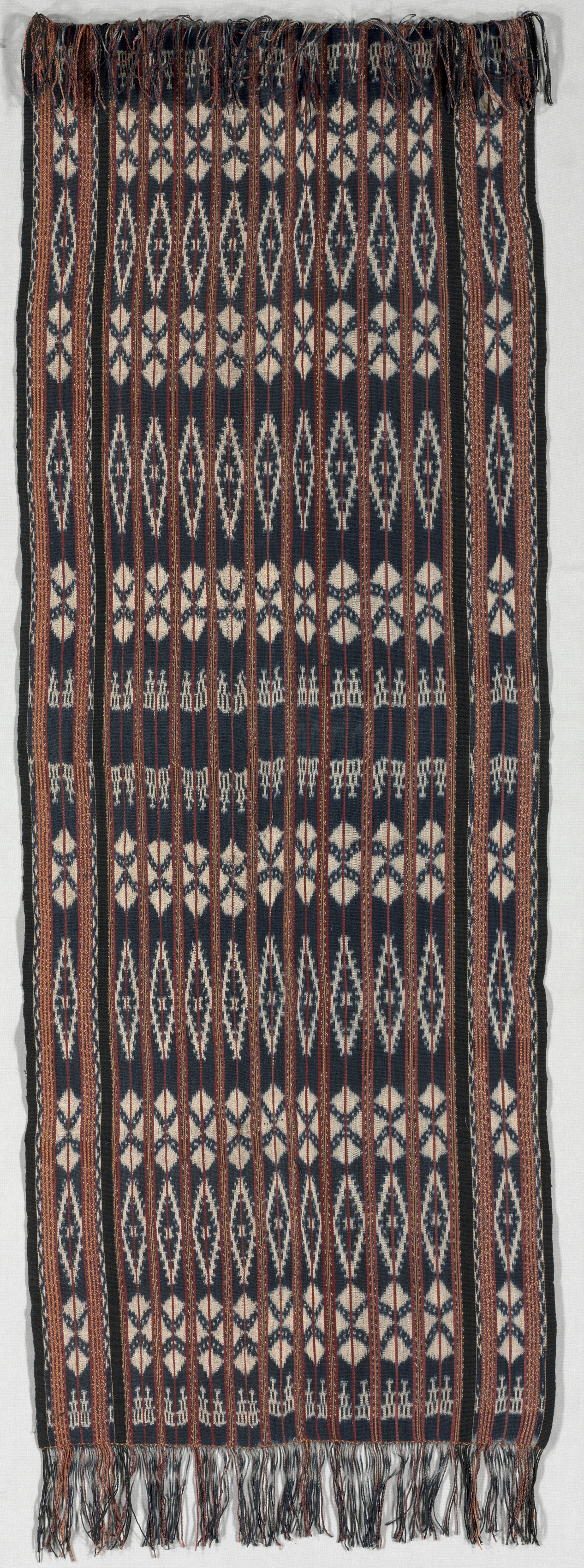
Deconstruction Analysis: Selimut (Man's Textile) – Savu, Indonesia, 20th Century
Introduction: The Avant-Garde as a Lens for Traditional Textiles
As the Chief Fabric Deconstructionist for Zoey Fashion Lab, I approach the Selimut—a man’s textile from the island of Savu, Indonesia, dated to the 20th century—not merely as a historical artifact but as a living, breathing document of cultural resilience and aesthetic innovation. This piece, crafted from cotton and dyed using the ikat technique, embodies a paradox: it is both a product of ancient tradition and a precursor to avant-garde design principles. The archive resonance referenced—spanning the 16th to 17th centuries—underscores how such textiles serve as silent witnesses to cultural collisions, where materiality and symbolism converge. In this analysis, I will deconstruct the Selimut’s technical, symbolic, and structural elements, reimagining its potential within a contemporary avant-garde framework.
Technical Deconstruction: Ikat as a Radical Act of Precision
The Selimut’s construction begins with ikat, a resist-dyeing technique where threads are bound, dyed, and woven to create patterns. This process is inherently avant-garde in its non-linear approach to design: the weaver must visualize the final pattern in reverse, accounting for the blurring of edges that occurs during dyeing. The cotton fibers, while humble, are transformed through this meticulous labor into a canvas of controlled chaos. For Zoey Fashion Lab, this technique resonates with the deconstructivist ethos—where the process of making is as significant as the final form. The Selimut’s warp and weft threads, often dyed in indigo, rust, and ochre, reveal a palette that is both earthy and electric, challenging the notion of “primitive” color theory. Instead, these hues prefigure the bold, saturated tones of 20th-century avant-garde movements like Fauvism, where color is liberated from representation.
The textile’s structure—a rectangular panel typically measuring 200 cm by 100 cm—offers a study in modularity. The ikat patterns, often geometric and repetitive, create a rhythm that is both hypnotic and disruptive. In deconstructing this, I identify how the Selimut’s design anticipates the grid of modernism, yet subverts it through intentional asymmetry. The weaver’s hand introduces micro-variations—a slight shift in alignment, a thread pulled too tight—that imbue the textile with a sense of organic imperfection. This aligns with the avant-garde’s rejection of industrial perfection, celebrating the flaw as a marker of authenticity.
Symbolic Deconstruction: The Selimut as a Site of Cultural Collision
The Selimut is not merely a garment; it is a narrative device. On Savu, these textiles are worn by men during ceremonial events, often as shoulder cloths or hip wrappers. The motifs—ranging from stylized ancestral figures to abstract representations of nature—encode social hierarchies, spiritual beliefs, and clan histories. For the avant-garde fashion lab, this symbolic layer is a goldmine for deconstruction. The Selimut’s patterns, when isolated and abstracted, can be read as proto-typographic symbols, prefiguring the semiotic experiments of artists like Cy Twombly or Jean-Michel Basquiat. The textile becomes a text to be read, its ikat “glyphs” challenging the viewer to decode a language that is both lost and reborn.
The archive resonance of the 16th to 17th centuries—a period of intense European exploration and trade in the Indonesian archipelago—adds a layer of postcolonial critique. The Selimut’s ikat technique, while indigenous, was influenced by Indian patola and Chinese silks, demonstrating a global exchange of ideas long before globalization. In deconstructing this, Zoey Fashion Lab can reframe the Selimut as a hybrid artifact, one that resists purity and embraces the friction of cultural contact. This is a core tenet of the avant-garde: the refusal to be contained by singular narratives. The Selimut’s patterns, when read through this lens, reveal a dialogue between local and foreign aesthetics, a conversation that is as relevant today as it was centuries ago.
Structural Deconstruction: Materiality and the Body
The Selimut’s function as a man’s textile—worn draped, tied, or folded—invites a reimagining of the body’s relationship to fabric. Unlike Western tailoring, which imposes a rigid structure on the body, the Selimut is unstructured, allowing the wearer to define its form. This aligns with the avant-garde’s fascination with deconstruction in fashion, as pioneered by designers like Rei Kawakubo or Yohji Yamamoto. The Selimut’s cotton, while soft and pliable, becomes a medium for exploring volume, drape, and negative space. When deconstructed, the textile can be cut, reassembled, or layered to create new silhouettes that challenge conventional masculinity. For example, the ikat patterns can be fragmented and repositioned to form a collage, disrupting the original narrative while honoring its essence.
The dyeing process—using natural indigo and other plant-based pigments—introduces a temporal dimension. Over time, the colors fade, creating a patina that records the textile’s history. In an avant-garde context, this aging is not a flaw but a feature, a form of performative decay that echoes the work of artists like Anselm Kiefer, who use materials to evoke memory and loss. The Selimut’s cotton, when handled, retains the scent of its origin—earth, smoke, and sea—grounding the viewer in a sensory experience that transcends visual analysis.
Recontextualization: The Selimut in the Avant-Garde Fashion Lab
For Zoey Fashion Lab, the Selimut is not a relic to be preserved but a catalyst for creation. Its deconstruction involves three key strategies: fragmentation, reassembly, and abstraction. First, the ikat patterns are isolated from their original context, scanned, and digitized. These motifs are then distorted through digital manipulation—stretched, rotated, and layered—to create new patterns that retain the essence of the original while embracing the chaos of the digital age. Second, the physical textile is cut into strips, which are then rewoven using a jacquard loom, blending the handcrafted with the industrial. This hybrid technique produces a fabric that is both nostalgic and futuristic, a material that speaks to the tension between tradition and innovation.
Third, the Selimut’s symbolic elements are abstracted into graphic prints for use in avant-garde garments. For instance, the ancestral figure motifs are simplified into geometric forms, applied to oversized coats or deconstructed trousers. The resulting designs challenge the wearer to engage with the textile’s history while projecting a new identity. This approach aligns with the avant-garde’s goal of estrangement—making the familiar strange, forcing the viewer to question their assumptions about culture, gender, and materiality.
Conclusion: The Selimut as a Living Archive
The Selimut from Savu is more than a textile; it is a resonant archive that speaks to the enduring power of craft in an age of mass production. Through deconstruction, Zoey Fashion Lab transforms this artifact into a tool for critical inquiry, exploring how traditional techniques can inform avant-garde aesthetics. The ikat dyeing, the cotton fibers, the symbolic motifs—all are reimagined as elements of a new visual language that honors the past while disrupting the present. In doing so, the Selimut becomes a testament to the avant-garde’s core belief: that true innovation emerges not from erasing history, but from engaging with it, deconstructing it, and rebuilding it in ways that challenge and inspire.