Deconstructive Alchemy: The Akan Chair Gold Weight as a Blueprint for SS26 Avant-Garde Couture
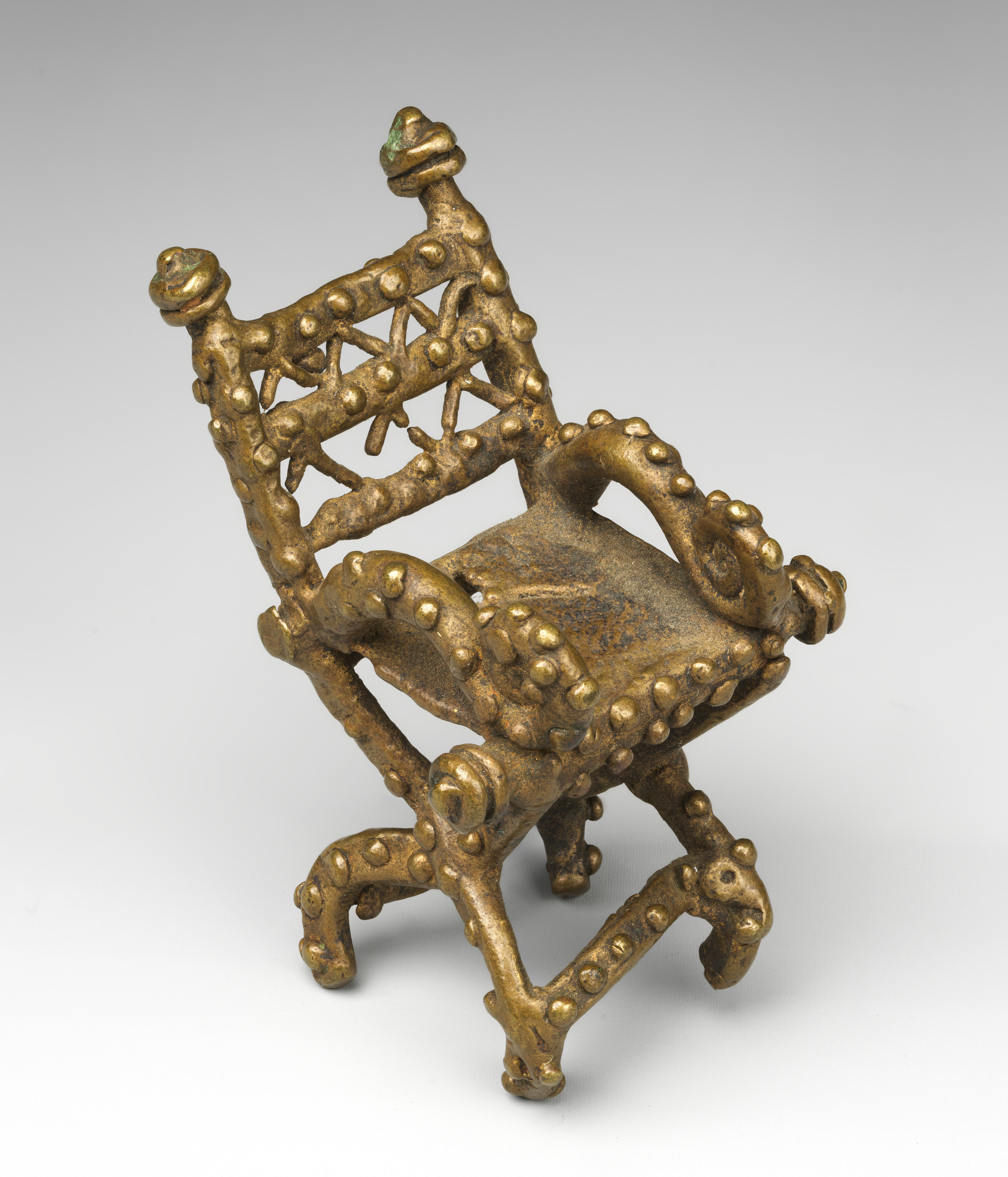
In the rarefied atmosphere of Zoey Fashion Laboratory, where the boundaries of garment architecture are perpetually dissolved and reimagined, the Akan brass chair gold weight emerges not as a mere ethnographic artifact, but as a radical, load-bearing manifesto for the SS26 collection. This miniature object—a symbol of status, trade, and metaphysical weight in Akan culture—transcends its historical context to become a proto-futuristic structural node. Its dense, geometric silhouette, cast in the enduring medium of brass, offers a lexicon of tension, balance, and gravitational defiance. For the avant-garde curator, this is not a motif; it is a generative algorithm for rethinking the human form as a site of architectural intervention. The chair gold weight compels us to ask: How can couture bear the weight of history while launching into a weightless, speculative future?
The Object as Structural Prototype: From Miniature to Monument
The chair gold weight, typically no larger than a palm, is a masterclass in compressed monumentality. Its form—a throne, a seat of power—is reduced to its essential planes: a horizontal seat, vertical backrest, and diagonal supports. For SS26, Zoey Fashion Laboratory translates this reductionist logic into exoskeletal silhouettes that treat the body as a scaffold. The brass’s inherent rigidity is not softened but amplified through laser-sintered metal mesh and carbon-fiber-infused organza, creating garments that are simultaneously armor and second skin. The chair’s legs become articulated struts extending from the hip to the floor, while the backrest morphs into a corseted spine that rises above the shoulders, framing the wearer’s head like a throne’s finial. This is not adornment; it is habitable architecture.
The material transposition from brass to couture fabric is critical. Brass’s cold, reflective surface is reimagined through liquid metal finishes on recycled polyester, achieved via vacuum metallization. The result is a chromatic weightlessness—a paradox where the garment appears heavy yet moves with fluid, almost ethereal grace. The gold weight’s patina, a testament to time and touch, is echoed in oxidized copper appliqués that map the body’s kinetic pressure points. Each piece becomes a wearable artifact, bearing the scars of a future history.
Futuristic Silhouettes: The Weight of Inversion
The SS26 silhouette revolution begins with inverted gravity. The chair gold weight’s function—to measure value through mass—is subverted. Zoey Fashion Laboratory proposes a top-heavy, anti-gravitational profile where the weight is concentrated above the waist. Imagine a brass-knitted bolero that extends into a cantilevered train, its structure supported by a hidden titanium alloy exoskeleton. The lower half is deliberately minimal: sheer, laser-cut silk that falls in vertical, almost liquid pleats, referencing the gold weight’s linear legs. This creates a dialectic of mass and void—the upper body as a throne, the lower as a shadow.
Another archetype reimagines the chair’s seat as a floating pelvic cradle. A 3D-printed brass composite forms a rigid, saddle-like structure that suspends the wearer’s hips, allowing the legs to move freely beneath a cascade of metallic organza filaments. This silhouette challenges the conventional waistline, relocating the garment’s anchor point to the pelvis. The effect is primordial yet interstellar—a nod to the Akan stool as a symbol of lineage, but rendered in a material language of zero-gravity engineering.
Structural Innovation: The Articulated Joint
The articulated joint is the collection’s technical signature. Inspired by the gold weight’s cast connections between seat and legs, Zoey Fashion Laboratory develops modular hinges that allow garments to transform. A brass-plated steel joint at the shoulder enables a jacket’s sleeve to detach and reattach as a handheld fan or headpiece. This is not mere versatility; it is perpetual evolution. The wearer becomes a living architect, reconfiguring the garment’s weight distribution in real time. The kinetic gold weight—a small, polished brass orb—is embedded at the end of each hinge, serving as a counterbalance. As the wearer moves, these weights chime with a resonant, bell-like tone, creating an acoustic landscape that mirrors the object’s original function as a currency of sound and substance.
The corset is redefined as a load-bearing chassis. Using parametric design software, each corset is modeled after the gold weight’s geometric proportions. The front panel is a single, seamless brass sheet perforated with a Fibonacci spiral, allowing for ventilation and flexibility. The back panel is a network of tension cables connected to a central brass disc—a direct reference to the weight’s circular base. This system distributes the garment’s mass across the torso, reducing fatigue while maintaining a rigid, sculptural presence. The result is a second skeleton that amplifies the wearer’s posture into a statement of authority.
Cultural Weight and Temporal Dissonance
The Akan gold weight is a mnemonic device, encoding proverbs and social hierarchies. For SS26, this cultural weight is not fetishized but abstracted into a temporal dissonance. The collection’s palette—oxidized brass, patinated copper, and tarnished silver—evokes a future where objects have aged beyond their original context. Garments are deliberately distressed through galvanic erosion, creating patterns that mimic the gold weight’s surface. This is not decay; it is accelerated archaeology. The wearer inhabits a garment that has already lived a thousand years, yet is born in the SS26 moment.
The proverbial weight of the Akan chair—often associated with the saying, “The stool does not speak, but it knows its owner”—is translated into silent, embedded narratives. Each garment includes a micro-engraved brass tag with a proverb in Twi, visible only under UV light. This is a hidden language for the initiated, a code that connects the wearer to a lineage of power and trade. The avant-garde gesture is not to explain but to provoke curiosity, to make the garment a living document that demands interpretation.
Conclusion: The Weight of Tomorrow
The Akan chair gold weight, in its dense, miniature perfection, offers Zoey Fashion Laboratory a radical thesis: weight is not a burden but a foundation. For SS26, the collection does not seek to lighten or escape mass; it reorients gravity as a creative force. The silhouettes are heavy with meaning, yet light in their engineering—a paradox that defines true avant-garde work. The brass is not a material but a philosophical state: enduring, reflective, and infinitely malleable under heat and pressure. As the SS26 season approaches, Zoey Fashion Laboratory stands at the intersection of ancestral craft and speculative design, proving that the most futuristic silhouettes are often forged from the most ancient weights. The chair gold weight is no longer a relic; it is a blueprint for a new gravity—one that holds the body in a state of perpetual, poised becoming.