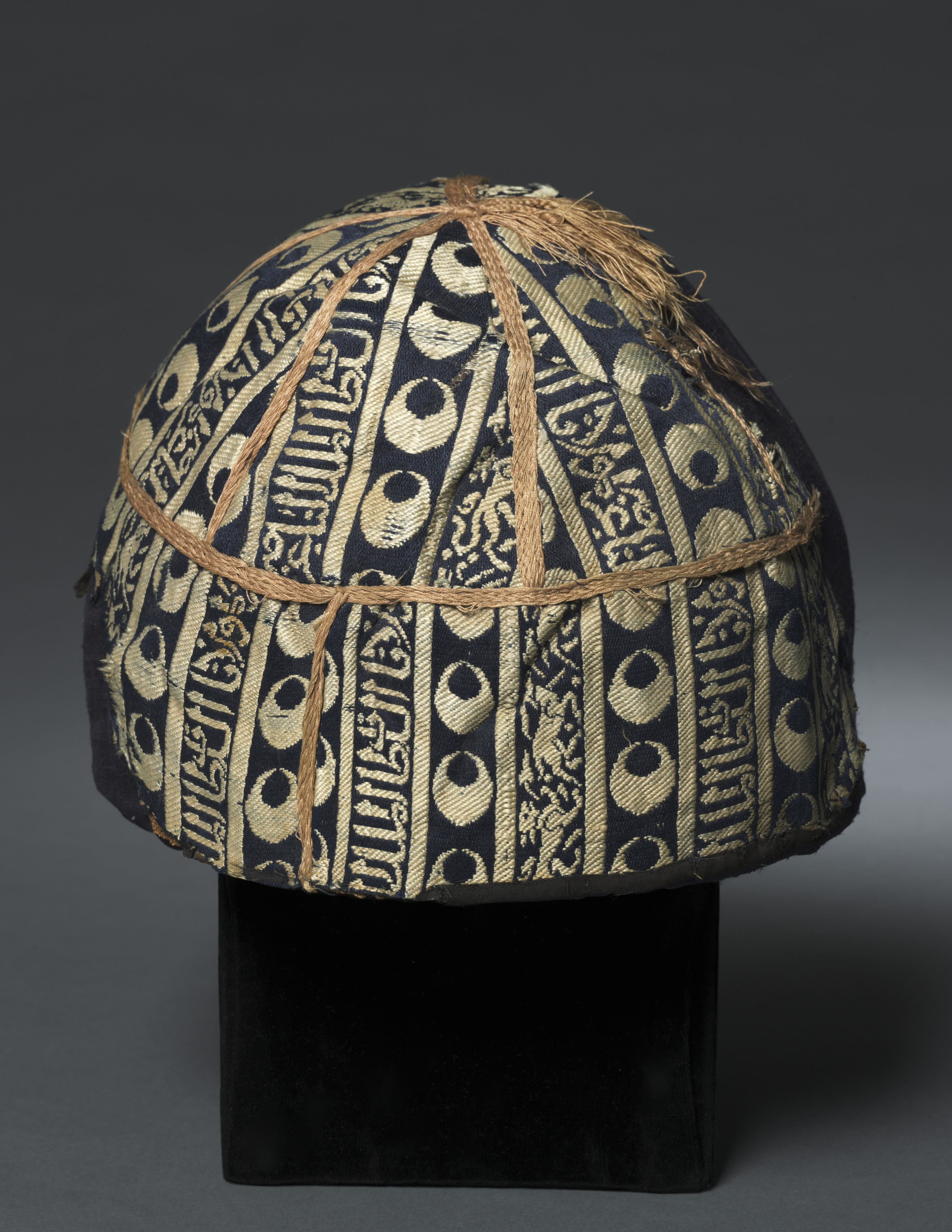
Deconstructing the Cap with Striped Inscribed Silk: A Mamluk Artifact Reimagined for the Avant-Garde
Introduction: The Intersection of History and Innovation
As the Chief Fabric Deconstructionist for Zoey Fashion Lab, I am tasked with dissecting not only the physical composition of garments but also their cultural, technical, and symbolic DNA. The subject of this analysis—a cap with striped inscribed silk from the Mamluk Sultanate (Egypt or Syria)—presents a unique challenge and opportunity. This artifact, dating from the 13th to 16th centuries, embodies a sophisticated textile tradition that predates modern industrial methods. Yet, its potential for avant-garde reinterpretation lies in its structural complexity, material integrity, and the encoded messages within its stripes and inscriptions. By treating this cap as a "new DNA strand," we can extract its core elements—tension, repetition, and sacred geometry—and re-engineer them for a contemporary, disruptive fashion narrative.
Technical Analysis: The Silk Structure and Striped Inscription
The cap is constructed from striped inscribed silk, a material that demands close scrutiny. Silk, as a protein-based fiber, possesses a natural luster and tensile strength that allows for intricate weaving. In Mamluk textiles, stripes were often achieved through twill or compound weaves, where contrasting colors—typically indigo, crimson, or gold—were interlocked to create parallel bands. The inscriptions, likely calligraphic verses from the Quran or honorific titles, were woven using brocading or supplementary weft techniques. This means the script is not printed or embroidered but integrated into the fabric’s very structure, making it a permanent, tactile feature.
From a deconstructionist perspective, the stripe serves as a repetitive rhythm, a visual beat that guides the eye across the cap’s curved surface. The inscription, meanwhile, introduces a narrative interruption—a break in the pattern that demands interpretation. In avant-garde fashion, such juxtaposition is critical: it challenges the wearer to engage with the garment as a text, a code, or a manifesto. The cap’s original form—likely a taqiyya or skullcap—was designed for functionality (protection from sun or ritual cleanliness) and status (displaying wealth and piety). For Zoey Fashion Lab, we must strip this functionality and recontextualize it as a sculptural accessory that disrupts conventional headwear.
Cultural DNA: The Mamluk Legacy as a Design Blueprint
The Mamluk Sultanate, centered in Cairo and Damascus, was a nexus of trade, art, and religious devotion. Silk production was a state-controlled industry, and inscribed textiles were often diplomatic gifts or ceremonial garments. The stripes in this cap may represent Mamluk livery—colors associated with specific sultans or military ranks. The inscriptions, likely in thuluth or naskh script, were not merely decorative but carried political and spiritual weight. To deconstruct this DNA, we must ask: What happens when sacred text is removed from a religious context and placed on a runway? The answer lies in subversion. By preserving the inscription but altering its scale, orientation, or material (e.g., using laser-cut metallic thread instead of silk), we can create a tension between reverence and irreverence—a hallmark of avant-garde design.
Furthermore, the cap’s circular form echoes the dome of a mosque or the celestial sphere, reinforcing a sense of cosmic order. In Zoey Fashion Lab’s hands, this geometry can be deconstructed into modular components: the stripe becomes a detachable band, the inscription a removable patch, allowing the wearer to reassemble the cap as a customizable piece. This mirrors the Mamluk tradition of repurposing textiles—where garments were often dismantled and remade into new objects—while embracing contemporary sustainability.
Avant-Garde Reinterpretation: The Cap as a New DNA Strand
To treat this cap as a "new DNA strand" is to view it as a biological blueprint for future garments. In genetic terms, DNA is a sequence of instructions; here, the stripes and inscriptions are the instructions for a wearable code. For an avant-garde collection, I propose the following transformations:
- Material Mutation: Replace the silk with a bioengineered fabric—such as lab-grown spider silk infused with conductive threads. The stripes could be programmed to change color via micro-LEDs, responding to the wearer’s heartbeat or ambient sound. The inscription, originally static, becomes a dynamic text that scrolls across the cap like a digital ticker, referencing the Mamluk practice of inscribing political slogans.
- Structural Deconstruction: The cap’s dome shape is deconstructed into interlocking panels held together by magnetic seams. The stripes, once continuous, are fragmented into asymmetrical bands that wrap around the head in a non-linear pattern. This echoes the broken symmetry often found in Mamluk architecture, where intentional flaws were introduced to remind viewers of human imperfection.
- Inscription as Performance: The calligraphy is reimagined as a 3D-printed lattice that casts shadows on the wearer’s face. The text is legible only from certain angles, forcing viewers to move around the wearer to read it—a metaphor for the layered meanings of Mamluk art.
These interventions do not erase the original artifact but rather amplify its contradictions: the tension between permanence and change, sacred and profane, tradition and disruption. The cap becomes a wearable archive, preserving the Mamluk DNA while encoding new possibilities.
Conclusion: From Artifact to Catalyst
The cap with striped inscribed silk is more than a historical curiosity; it is a catalyst for avant-garde innovation. By deconstructing its technical, cultural, and symbolic layers, Zoey Fashion Lab can extract a design vocabulary that speaks to both the past and the future. The stripes offer a grammar of repetition; the inscriptions, a syntax of meaning; and the silk, a medium of transformation. As we re-engineer this cap into a new DNA strand, we honor its Mamluk origins while propelling it into a realm where fashion is not just wearable but thinkable—a statement that challenges the very definition of what a garment can be.
For the lab, this analysis serves as a blueprint for deconstruction: a methodology that can be applied to any artifact, from a pharaonic linen to a contemporary polyester blend. The goal is not to replicate but to metabolize—to absorb the DNA of the past and express it in forms that are radically new. The cap, in its original state, was a symbol of order and devotion. In its avant-garde incarnation, it becomes a symbol of disruption and dialogue, a testament to the enduring power of textiles to tell stories across centuries.