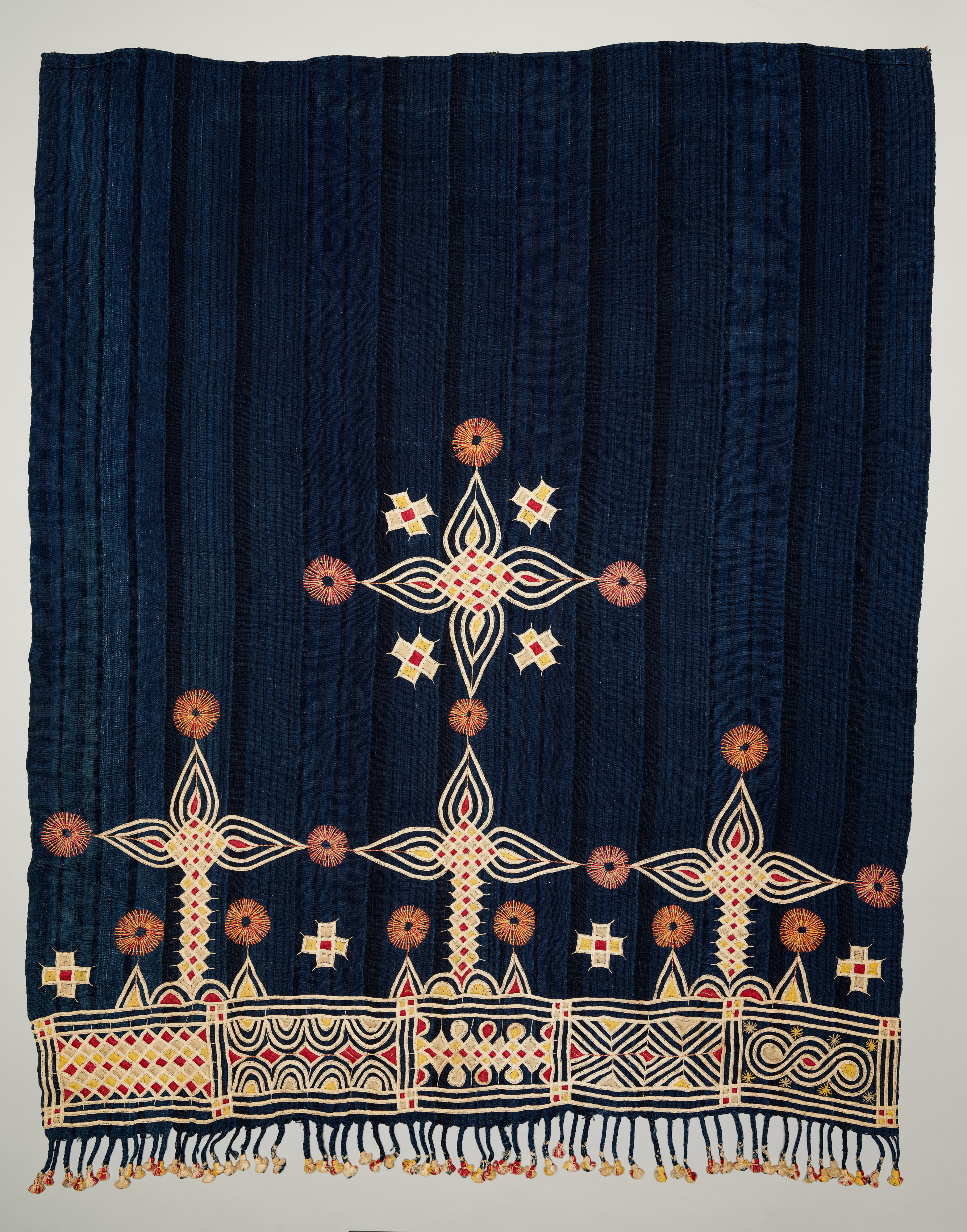
Deconstructing the Draped Identity: A Zoey Fashion Lab Analysis of a West African Shawl
At Zoey Fashion Lab, our mission is to dismantle the conventional and reconstruct it through an avant-garde lens. We approach historical artifacts not as relics, but as living blueprints for future design. The object of our current analysis—a woman’s shawl or head covering from Côte d’Ivoire, attributed to the Hausa or Dyula peoples—is a masterclass in this philosophy. Created by unknown hands using cotton, silk, and natural indigo dyes, this piece is far more than a garment. It is a portable archive of trade, spirituality, and resistance. Our deconstruction will focus on three primary vectors: material alchemy, structural geometry, and chromatic subversion.
Material Alchemy: The Silk Road in a Single Thread
The shawl’s composition—a blend of locally grown cotton and imported silk—immediately signals a history of trans-Saharan commerce. The Hausa and Dyula were legendary traders, and this textile is a physical record of their networks. The cotton, robust and absorbent, grounds the piece in the earth of West Africa. The silk, likely traded from North Africa or even further afield, introduces a foreign element of luxury and sheen. This is not a simple fusion; it is a deliberate juxtaposition of the utilitarian and the opulent.
From an avant-garde perspective, this material dichotomy is a powerful design tool. We see this as a precursor to modern mixed-media work. The shawl’s makers did not blend the fibers into a homogeneous yarn. Instead, they wove them as distinct warp and weft threads, creating a surface that catches light unevenly. In our lab, we would amplify this effect. Imagine a contemporary iteration where the cotton is left raw, unbleached, and the silk is dyed with reactive, almost neon pigments. The historical piece whispers of trade; our reconstruction would scream of globalization’s fractured, hyper-real present. The unknown maker’s choice to combine these materials is a statement of agency—a declaration that one can incorporate the foreign without being subsumed by it.
Structural Geometry: The Architecture of Draping
The shawl’s form is deceptively simple: a rectangular expanse designed to be wrapped, folded, and tied. This is not a tailored garment; it is a modular system. The wearer becomes the architect, the shawl a flexible building material. The Hausa and Dyula women who wore this piece would have used it to signal status, age, and even mood through the style of draping. The same textile could be a modest head covering, a protective shoulder wrap, or a sling for a child.
Our avant-garde analysis focuses on this transformative potential. The shawl’s geometry is based on a grid—the woven structure—but its application is entirely organic. We see this as a precursor to contemporary deconstructionist fashion, where garments are designed with multiple, non-prescriptive uses. In the Zoey Fashion Lab, we would deconstruct this further. We would cut the rectangle into angular, asymmetrical panels, adding zippers or snaps that allow the wearer to reconfigure the piece in real-time. The historical shawl has one silhouette; our version would have twenty. We would also explore the tension between concealment and revelation. The shawl can hide the body or frame the face. This ambiguity is a powerful tool for creating a garment that challenges the male gaze, allowing the wearer to control their own visibility.
Chromatic Subversion: Indigo as a Language of Rebellion
The use of indigo—one of the oldest natural dyes—is the most intellectually rich element of this piece. In West Africa, indigo was not merely a color; it was a medium of cultural and spiritual expression. The deep blue was associated with the Tuareg and other nomadic groups, and it was often seen as a protective color. However, the dye process itself is a form of alchemy. The leaves are fermented, the fabric is dipped multiple times, and the final color is a result of oxidation—a chemical transformation from green to blue in the open air.
For our avant-garde analysis, we focus on the subversive nature of indigo. In many West African societies, indigo dyeing was a female-dominated craft. This shawl, then, is not just a product of labor; it is a product of female knowledge and power. The deep, almost black-blue of the shawl is a statement of authority. It absorbs light, creating a void that draws the eye. In our lab, we would push this to its extreme. We would experiment with over-dyeing, creating gradients from midnight blue to near-black. We would also introduce metallic threads—silver or copper—that catch the light against the dark field, creating a star-field effect. The historical indigo is a color of earth and sky; our version would be a color of the cosmos, a nod to the infinite possibilities of the future.
Archive Resonance: The Echo of Colliding Worlds
The reference to “Archive Resonance” in the brief is crucial. This shawl is not a static object; it is a node in a network of cultural exchange. The Hausa and Dyula peoples were intermediaries between the Islamic north and the animist south. The shawl’s design may incorporate geometric patterns that echo Islamic art, yet its use as a head covering is a pre-Islamic tradition. This syncretism is a form of resilience. The unknown makers navigated multiple worlds and created a garment that could belong to all of them.
In our avant-garde reconstruction, we would honor this resonance by making the shawl a literal archive. We would embed tiny, invisible pockets containing QR codes that link to oral histories, maps of trade routes, and videos of contemporary West African weavers. The garment becomes a wearable museum, a tool for education and subversion. We would also use digital printing to overlay ghostly images of the original shawl onto our new fabric, creating a palimpsest effect. The wearer carries the past on their shoulders, but the past is mutable, open to reinterpretation.
Conclusion: The Future of the Draped Form
This woman’s shawl from Côte d’Ivoire is a testament to the power of the unknown maker. It challenges the fashion industry’s obsession with named designers and celebrity endorsements. The true innovation often comes from anonymous hands working within deep traditions. For Zoey Fashion Lab, this artifact is a call to action. We must move beyond mere inspiration and into deep structural analysis. We must ask not only what a garment looks like, but how it was made, who made it, and what it meant to them. The shawl’s cotton and silk, its indigo dye, its modular geometry—these are not just aesthetic choices. They are decisions born of history, ecology, and power. By deconstructing them, we do not destroy the past; we unlock its potential to shape a more radical, more inclusive future of fashion.