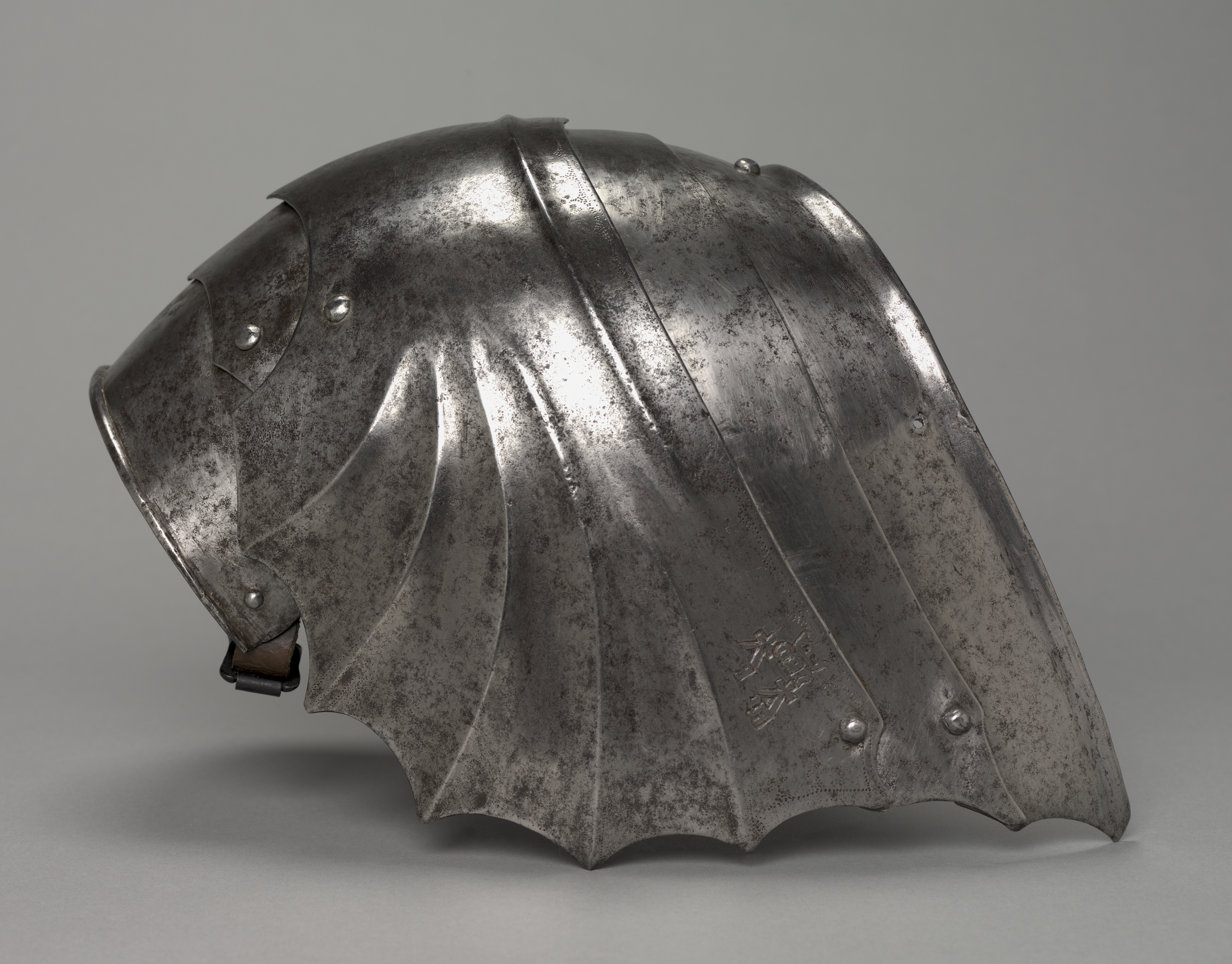
Deconstructing the Gothic Fan-Shaped Pauldron: An Avant-Garde DNA Analysis
At Zoey Fashion Lab, the role of the Chief Fabric Deconstructionist is to dissect historical artifacts not merely as relics, but as genetic material—a New DNA Strand that can be spliced, mutated, and re-engineered for the future of fashion. Today’s subject is the Gothic Fan-Shaped Pauldron (left), a piece of steel armor from Milan, Italy, dating to the late 15th century. This object, forged for protection on the battlefield, is now being analyzed for its potential as a foundational element in an Avant-garde collection. We will deconstruct its material, form, and cultural resonance to reveal the blueprint for a new sartorial language.
Material Integrity: The Steel as a Structural Canvas
The pauldron is constructed from low-carbon steel, hammered and shaped through a process of hot forging and cold finishing. To the traditional armorer, this material represents strength, resilience, and the absolute necessity of defense. To the avant-garde designer, however, steel is a medium of architectural possibility. Its rigidity is not a limitation but a provocation. The pauldron’s surface bears the patina of age—micro-scratches, slight oxidization, and the faint hammer marks of its maker. These are not flaws; they are textural narratives. In our deconstruction, we treat the steel as a primary structural canvas. The material’s ability to hold a precise, sharp edge is critical. It allows for the creation of forms that defy the soft, draping nature of traditional textiles. This pauldron, therefore, is not just armor; it is a pre-fabricated 3D textile. The challenge for Zoey Fashion Lab is to translate this metallic rigidity into a wearable, kinetic form without losing its inherent power. We consider techniques such as laser-cut perforation to reduce weight while retaining the fan shape, or chemical etching to introduce organic, lace-like patterns into the steel surface, creating a dialogue between the hard and the delicate.
Form and Function: The Fan-Shape as a Kinetic Sculpture
The defining characteristic of this pauldron is its fan-shaped silhouette. Unlike the simpler, rounded pauldrons of earlier periods, the Gothic fan is a dramatic, flared structure that extends outward from the shoulder. This shape is not merely decorative; it served a functional purpose in combat—deflecting blows away from the neck and armpit. In our avant-garde analysis, we see this as a kinetic sculpture. The fan shape is a dynamic vector, a visual arrow that directs the eye outward and upward. It creates a powerful silhouette of power, exaggerating the wearer’s presence. The pauldron’s articulation—the overlapping lames (metal plates) that allow for arm movement—is a masterclass in modular design. Each lame is a discrete unit that contributes to the whole, yet can move independently. This is the New DNA Strand: a system of interlocking, scalable elements that can be reconfigured. For Zoey Fashion Lab, we propose a deconstructed reconstruction. The fan shape can be broken down into its individual lames, each one a separate, wearable component. Imagine a jacket where the shoulder is built from a series of these fan-shaped steel scales, attached to a flexible, laser-cut leather base. The wearer can adjust the angle of each scale, changing the silhouette from a sharp, aggressive wedge to a softer, more fluid curve. This is wearable architecture that responds to the body, not just covers it.
Cultural Resonance: The Milanese Gothic as a Symbol of Defiance
Milan in the 15th century was a crucible of innovation, a city where art, commerce, and warfare converged. The Gothic style in armor, with its sharp lines, fluted surfaces, and exaggerated forms, was a statement of technological superiority and aristocratic status. The fan-shaped pauldron was not just protection; it was a symbol of defiance and dominance. In our deconstruction, we extract this cultural DNA and recontextualize it for the contemporary avant-garde. The pauldron becomes a metaphor for personal armor in a modern world—a shield against societal pressures, a declaration of individuality. The sharp, angular lines of the Gothic fan evoke a punk aesthetic, a rejection of softness and conformity. This is not armor for a king; it is armor for the rebel, the artist, the iconoclast. Zoey Fashion Lab can amplify this by incorporating asymmetrical design. The left pauldron, being the one we are analyzing, naturally creates imbalance. We can exaggerate this by pairing it with a completely bare, exposed shoulder on the right side, or by using a contrasting material like transparent acrylic or molded resin. The steel fan becomes a single, powerful statement—a focal point that draws the eye and demands attention. It is a piece of wearable armor for the psyche, not the body.
The New DNA Strand: Splicing History with Technology
The reference to a New DNA Strand is critical. We are not replicating this pauldron; we are extracting its genetic code and splicing it with contemporary technology. The steel’s structural integrity allows for integration with smart textiles. Imagine embedding micro-LEDs into the fan’s fluted ridges, creating a light pattern that shifts with the wearer’s movement. Or incorporating shape-memory alloys that cause the fan to furl and unfurl in response to temperature or sound. This transforms the pauldron from a static object into a responsive, living garment. The Milanese armorer’s craft is the analog ancestor of today’s 3D printing and parametric design. We can use generative design algorithms to create a fan shape that is optimized for both visual impact and weight distribution, then fabricate it in titanium or carbon fiber for a futuristic, lightweight version. The overlapping lames can be reimagined as modular jewelry—a necklace or a bracelet that can be expanded or contracted. The pauldron’s DNA is a blueprint for modularity, strength, and dramatic form.
Conclusion: A Blueprint for the Avant-Garde
The Gothic Fan-Shaped Pauldron (left) from Milan is far more than a historical artifact. It is a masterclass in structural design, material integrity, and symbolic power. For Zoey Fashion Lab, it represents a New DNA Strand that can be deconstructed, mutated, and re-engineered. By analyzing its steel as a canvas, its fan shape as a kinetic sculpture, and its cultural resonance as a symbol of defiance, we have a clear path forward. The avant-garde collection will feature deconstructed armor pieces that are not heavy but light, not static but responsive, not historical but futuristic. The pauldron’s DNA will manifest in modular shoulder structures, laser-cut metal textiles, and asymmetrical, power-defining silhouettes. This is not a revival of the past; it is a re-engineering of its genetic potential. The result will be a line that is both brutal and beautiful, protective and provocative—a true expression of the avant-garde spirit. The work begins now.