Technical Deconstruction: The Anatomy of a Fragment
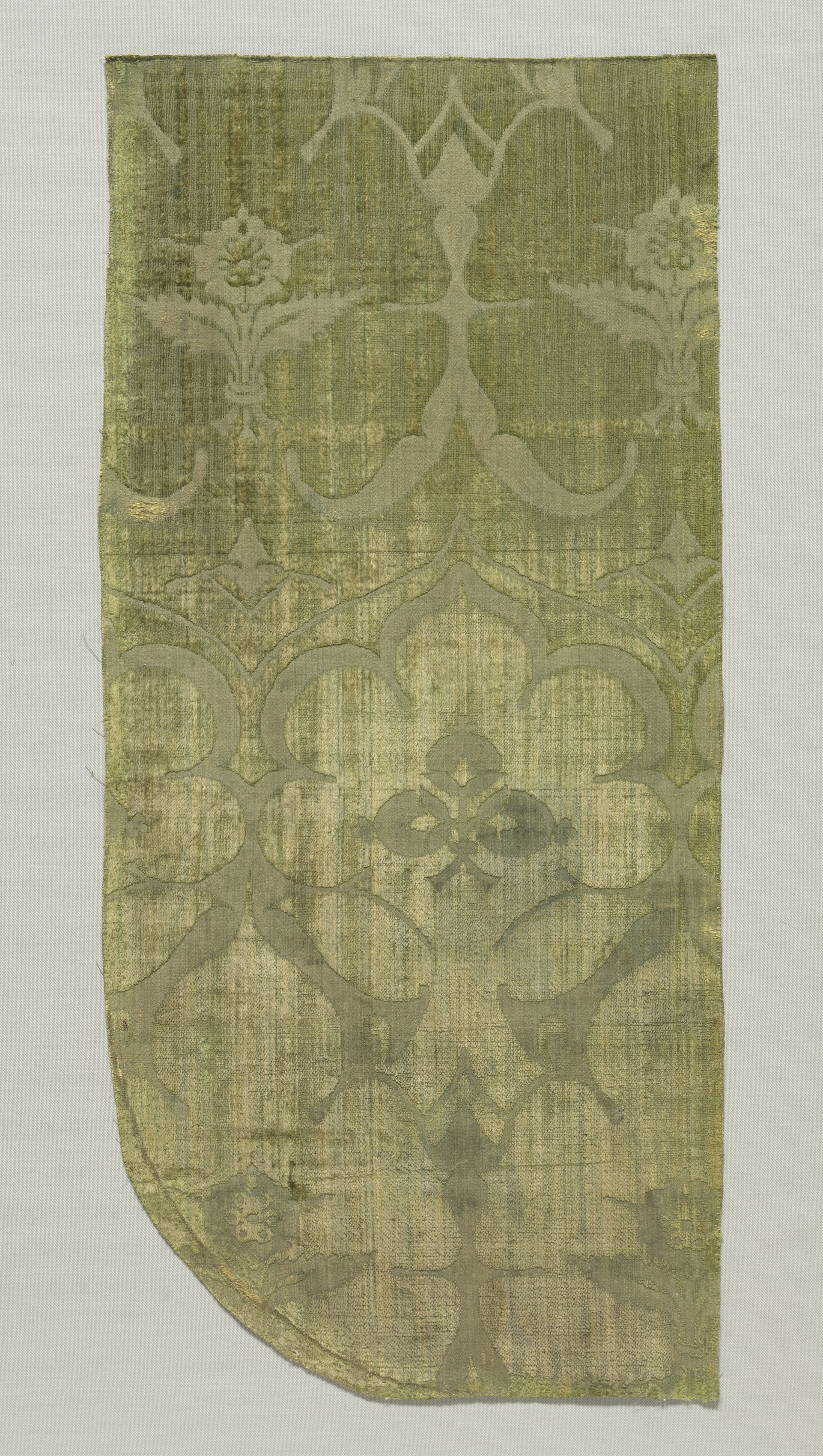
This artifact, a fragment of what was once a liturgical chasuble, presents a profound case study in historical technique repurposed for avant-garde discourse. Originating from Italy, the heart of Renaissance textile innovation, its base material is silk—the ultimate symbol of luxury, trade, and ecclesiastical power. The specific technique, cut and voided velvet, represents a pinnacle of pre-industrial loom technology. This is not a simple, uniformly piled fabric. "Voided" indicates areas where the pile is absent, creating a smooth, satin-ground pattern that contrasts dramatically with the lush, raised "cut" velvet areas. This requires a complex loom setup with multiple warp systems, allowing the weaver to literally "draw" with thread, leaving some zones in resplendent relief and others in subdued recession.
The tactile and visual dichotomy is critical. Under raking light, the fragment becomes a topographic map: the velvet pile absorbs light, appearing deep and somber, while the voided satin channels reflect it, creating luminous lines. The original pattern, now lost to fragmentation, would have been a large-scale repeat of pomegranates, acanthus leaves, or other symbology laden with theological meaning—eternity, resurrection, the church itself. The fragment we hold is but a syllable of a once-grand sermon woven in thread.
The Foundational Reference: New DNA Strand
The directive to reference a New DNA Strand is not a stylistic whim but a core methodological lens. It instructs us to view this historical artifact not as a dead relic, but as a living, coded sequence holding information ripe for recombination. Like DNA, this textile is a double helix of meaning: one strand encodes its original function (sacramental vestment, symbol of office, a vessel of the divine), while the complementary strand encodes pure material intelligence (the structural genius of voided velvet, the alchemy of dye, the hand of the weaver).
Avant-garde practice, in our Lab's philosophy, operates as a form of biomimetic splicing. We isolate the "gene" for structural contrast from the velvet technique, and the "gene" for coded symbolism from its ecclesiastical use. These are then spliced into a new aesthetic organism. The fragment is our primer. It provides the foundational base pairs (warp/weft, pile/ground, sacred/profane) from which we can amplify, mutate, and express entirely new sequences.
Avant-Garde Synthesis: From Relic to Prototype
The avant-garde impulse here is not to mimic, but to transcribe and translate. Our analysis moves from deconstruction to speculative reconstruction, guided by the DNA metaphor.
1. Material Transcription: Encoding Structure into Form
The cut and voided technique is a masterclass in controlled contrast. For Zoey Fashion Lab, this translates beyond textile into silhouette and construction. Imagine a garment that applies the "voided" principle to its very architecture: areas of voluminous, textural fullness (the "cut pile") juxtaposed against sleek, minimalist, second-skin panels (the "voided ground"). The body itself becomes the loom, with clothing sections acting as warp and weft. We could engineer new textiles where the velvet pile is not merely silk but incorporates recycled technical polymers, creating a hybrid tactile language—historic opulence fused with futurist resilience. The "cut" could become laser-etched, and the "void" could be a translucent membrane.
2. Symbolic Translation: Recoding the Sacramental
The chasuble's original purpose was to transform the wearer into a symbol, setting them apart for a sacred ritual. The avant-garde recodes this notion of ritual-specific transformation. What are our contemporary rituals? The performance of self in digital space, the communion of a club, the silent ceremony of urban isolation. A Zoey Lab garment inspired by this fragment might create a "vestment" for these modern rites. The large-scale, symbolic patterns of the original could be fragmented further, pixelated, or transformed into glitch-art motifs that only resolve into recognition under the scan of a smartphone camera or in the strobe light of a dance floor. The garment becomes an interactive interface, its meaning voided and repopulated by context.
3. The Poetics of Fragmentation
Most critically, we must honor the fragment itself. Its frayed edges and incomplete pattern are not flaws but its most avant-garde attribute. It speaks of time, entropy, and history as a force of editing. This directly informs a design philosophy of non-finito—the deliberately unfinished. Collections could feature garments that appear to be in a state of deconstruction, with velvet panels seemingly peeling away to reveal voided underlayers, or hems that dissolve from dense weave into sheer, thread-bare trails. It celebrates the beauty of the partial, the suggestive over the declarative, inviting the wearer to complete the narrative.
Conclusion: The Living Strand
This Italian velvet fragment, through our analytical process, ceases to be a remnant of the past. It is a viable seed culture for a future fashion organism. Its technical DNA—the binary of pile and void, the luxury of silk married to complex handcraft—provides a template for innovative material science. Its symbolic DNA—the encoding of meaning into wearable form—offers a blueprint for garments that communicate and transform.
For Zoey Fashion Lab, the avant-garde path forward is clear: we must not merely archive such fragments, but activate them. By treating this textile as a New DNA Strand, we initiate a process of cladistic evolution. The next collection can branch from this point, growing garments that bear the unmistakable, recombinant heritage of a 16th-century Italian weaver's genius, yet speak in the utterly contemporary language of fragmented identity, digital ritual, and conscious materiality. The chasuble clothed a priest for mass. Our derivative creations will clothe the individual for the complex, layered, and deeply symbolic mass of modern existence.