Deconstructing the Velvet Fragment: An Avant-Garde Analysis for Zoey Fashion Lab
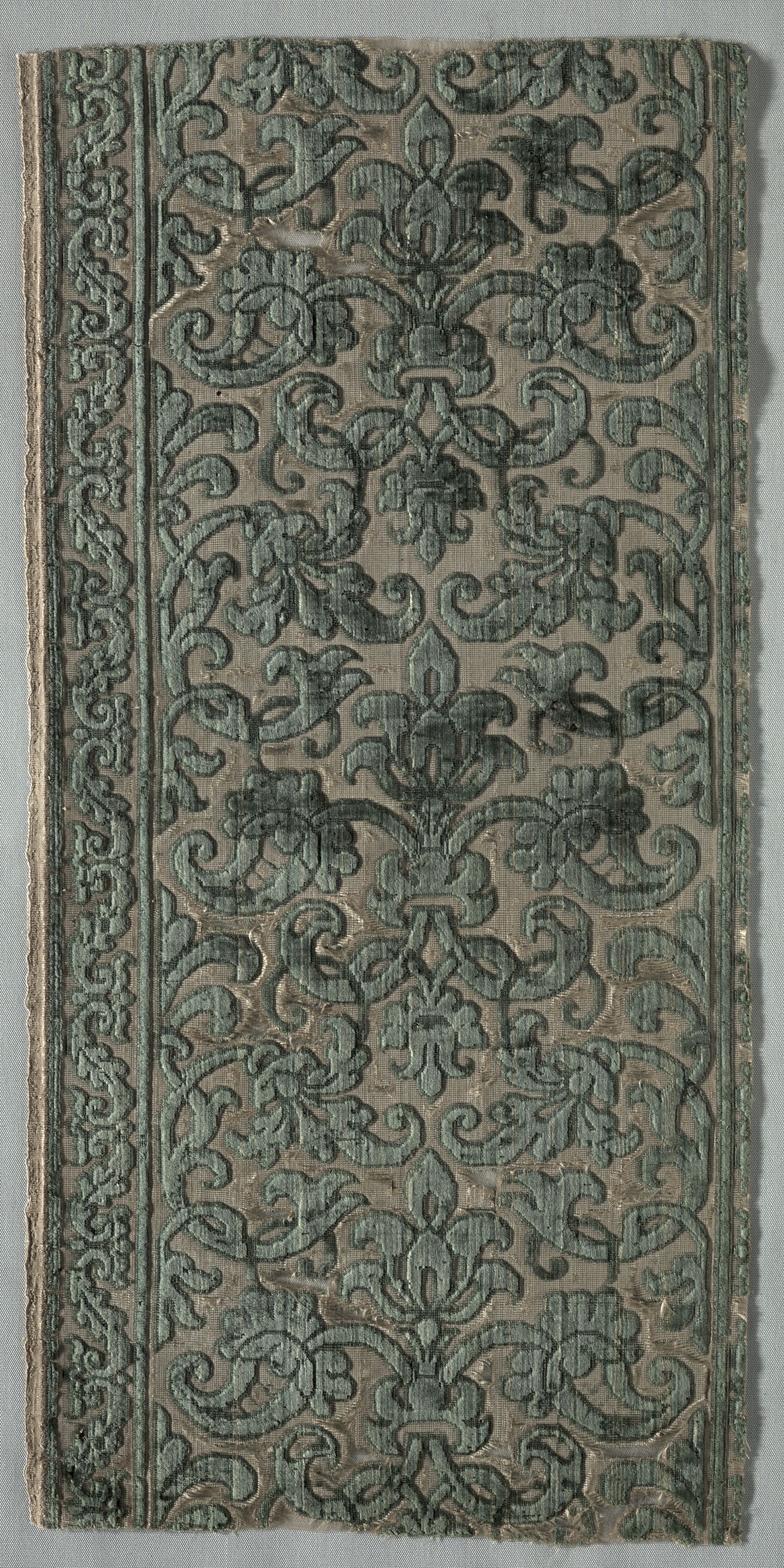
As Chief Fabric Deconstructionist for Zoey Fashion Lab, I present the following analysis of a velvet fragment originating from Italy in the late 16th century. This piece, composed of cut and uncut silk velvet, serves as a profound archaeological artifact. Its technical complexity and historical weight offer a unique substrate for avant-garde reinterpretation. We shall treat this fragment not as a relic to be preserved, but as a New DNA Strand—a genetic code capable of generating entirely novel forms, textures, and conceptual frameworks.
1. Technical Dissection: The Dual Nature of Cut and Uncut Velvet
The fragment’s primary technical innovation lies in its simultaneous employment of cut and uncut velvet. In traditional velvet weaving, loops (piles) are formed by weaving supplementary weft threads over wires. When the wires are removed, the loops remain. If the loops are left intact, the result is uncut velvet, characterized by a soft, matte, and slightly irregular surface. If the loops are sliced open, the result is cut velvet, which yields a dense, lustrous, and plush pile. The late 16th-century Italian master weavers of Genoa or Venice achieved a sophisticated interplay between these two states within a single fabric.
Structural Implications: The coexistence of cut and uncut piles creates a dynamic surface of variable light absorption and reflection. The uncut loops trap air, producing a muted, textured backdrop, while the cut piles stand erect, catching light and creating a shimmering, almost liquid effect. This duality is not merely decorative; it is a tactile and optical dialectic. For Zoey Fashion Lab, this suggests a design language based on binary opposition—hard/soft, matte/glossy, smooth/rough. We can deconstruct this by isolating the two pile types into separate, modular components. For instance, a garment might feature a base of uncut velvet for its sound-dampening, sculptural quality, with cut velvet applied as a secondary, reflective skin that shifts with movement.
2. Material Provenance: Silk as a Conduit for Time
The fragment is entirely silk—a material that, in the late 16th century, was a symbol of wealth, trade, and power. Silk’s molecular structure is protein-based, making it hygroscopic, resilient, and capable of holding intricate dye patterns. The specific dyes used—likely derived from cochineal for reds, woad for blues, and iron mordants for blacks—are now faded, creating a patina of age. This patina is not a flaw but a record. It documents centuries of exposure to light, humidity, and handling.
Avant-Garde Application: We can treat this silk as a living material. Rather than attempting to restore its original vibrancy, we should amplify its aged characteristics. Using bio-fabrication techniques, we can introduce microbial dyes that respond to the fragment’s chemical residues, creating new color gradients that mimic the original fading process. Alternatively, we can deconstruct the silk into its constituent fibers and re-spin them with modern synthetics, creating a hybrid yarn that carries the historical DNA of the original while possessing new tensile strength or elasticity. This process transforms the fragment from a static artifact into a dynamic, evolving substrate.
3. The New DNA Strand: Conceptual Replication and Mutation
Our reference to the fragment as a New DNA Strand is central to the avant-garde methodology. In genetic terms, DNA carries instructions for development, function, and reproduction. Here, the fragment’s DNA is its structural logic: the ratio of cut to uncut piles, the weave density, the dye chemistry, and the pattern repeat. We can sequence this logic to generate a family of related but mutated forms.
Sequencing Protocol:
- Extraction: Digitally scan the fragment at 1000x magnification to create a 3D map of pile heights and loop geometries.
- Transcription: Translate this map into a parametric algorithm that defines variables such as pile density, loop radius, and cut depth.
- Mutation: Introduce controlled variables—for example, increasing the loop radius by 200% or reducing the cut pile density by half. These mutations produce fabrics that are recognizable as descendants of the original yet are functionally and aesthetically distinct.
- Expression: Use robotic weaving or 3D-knitting technologies to realize these mutated forms. The result is a collection of fabrics that range from exaggerated, oversized loops to micro-scale, almost invisible piles.
This approach allows Zoey Fashion Lab to replicate not the appearance, but the essence of the historical velvet. The new fabrics will carry the genetic memory of the 16th century while being born into the 21st.
4. Avant-Garde Synthesis: From Fragment to Garment
The avant-garde style demands a radical departure from conventional garment construction. The velvet fragment, with its inherent duality, suggests a deconstructed silhouette. Imagine a coat where the left side is constructed entirely from uncut velvet loops, creating a soft, bulbous form reminiscent of organic growth, while the right side is made from cut velvet, sharp and reflective, like a polished surface. The seam between the two sides is left raw, exposing the weave structure—a visible DNA helix of the fabric’s origin.
Wearable Architecture: The fragment’s historical use in courtly attire—doublets, gowns, and mantles—can be subverted. We can scale the pile to extreme proportions. A skirt might feature uncut loops six inches long, creating a kinetic, moss-like texture that shifts with the wearer’s gait. Alternatively, cut piles can be laser-engraved with patterns that echo the original 16th-century motifs (pomegranates, thistles, or arabesques) but are then overlaid with digital prints of microscopic fabric scans, creating a palimpsest of time.
5. Sustainability and Narrative: The Ethical Imperative
Deconstruction is not merely aesthetic; it is ethical. The original fragment represents a resource-intensive process—silk production required thousands of silkworms, and the dyeing process used toxic mordants. By treating this fragment as a New DNA Strand, we advocate for a circular economy. The mutated fabrics can be designed for disassembly and recomposition. After their first life as garments, they can be broken down into their component pile types and re-woven into new textiles, creating a closed-loop system that honors the original material’s longevity.
Narrative Layer: Each garment derived from this analysis will include a digital passport—a QR code that links to the fragment’s history, the sequencing algorithm, and the mutations applied. This transforms the wearer into a custodian of a living archive, bridging the gap between Renaissance opulence and avant-garde innovation.
Conclusion: The Fragment as a Living Code
The late 16th-century Italian velvet fragment is not a dead object. It is a New DNA Strand—a code waiting to be read, mutated, and expressed. Through technical deconstruction, material hybridization, and algorithmic replication, Zoey Fashion Lab can generate a new lineage of fabrics that honor the past while forging an avant-garde future. The cut and uncut piles, the faded silk, the dualistic surface—all become tools for a radical redefinition of what velvet can be. The fragment’s true value lies not in its preservation, but in its potential for transformation.