Deconstructing the Commode: Structural Alchemy for SS26
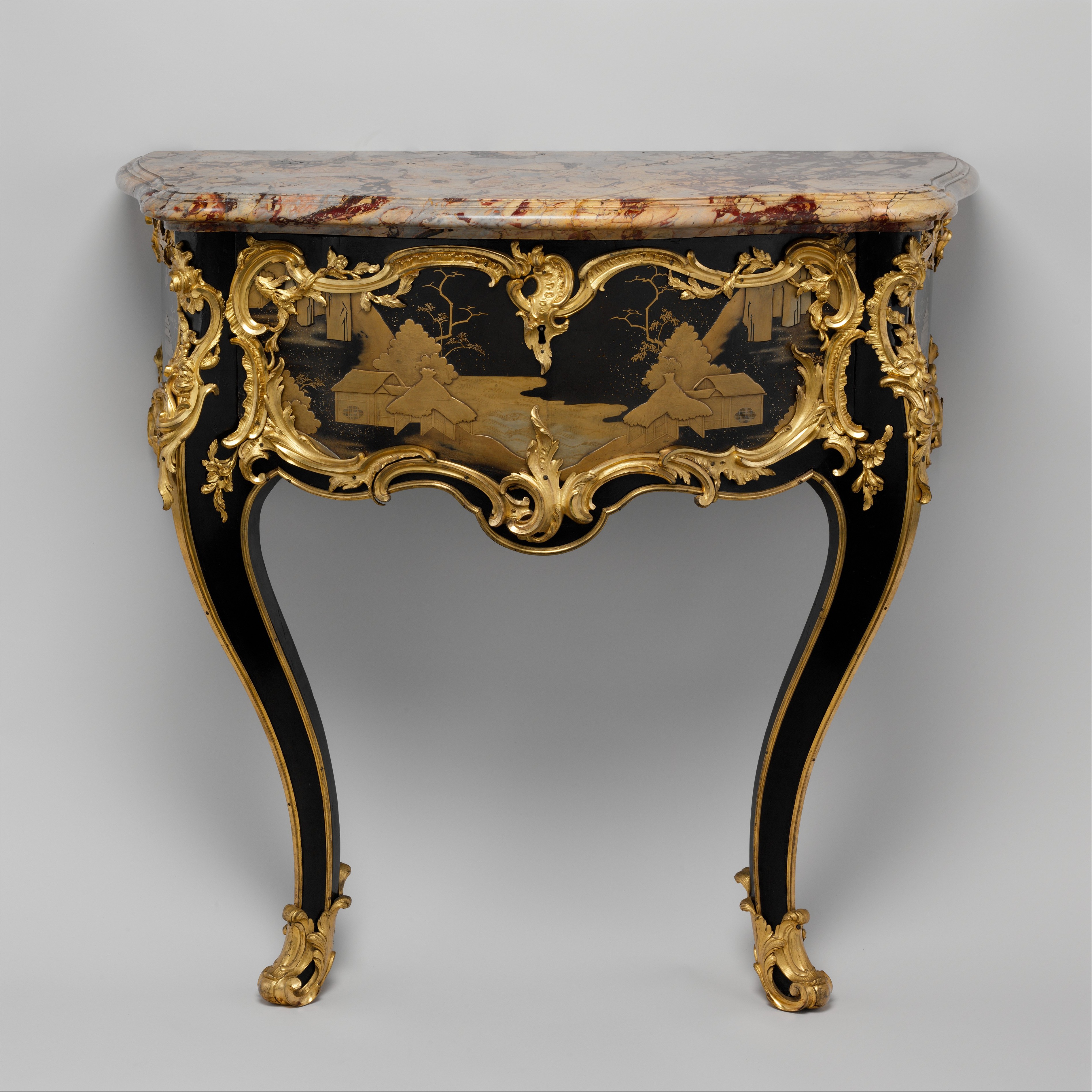
The commode en console, a relic of 18th-century domestic opulence, undergoes a radical transmutation within the Zoey Fashion Laboratory. No longer a passive vessel for storage, this object—rendered in oak and pine, lacquered black, and veneered with Japanese black and gold lacquer, accented by gilt-bronze mounts and a Sarrancolin marble top—becomes a masterclass in structural innovation. For SS26, we dissect its formal language, extracting a blueprint for futuristic silhouettes that challenge the very notion of garment architecture. This is not an homage; it is a violent, necessary deconstruction.
I. The Lacquered Shell: A Study in Negative Space and Armor
The piece’s black lacquer, a glossy, impenetrable surface, is the genesis of a new silhouette. We interpret this not as a solid, but as a negative space envelope. The garment becomes a second skin, a carapace that defines the body’s absence as much as its presence. Consider a jacket constructed from high-gloss, patent-leather panels, their seams articulated with gilt-bronze zippers that act as structural ribs. The silhouette is rigid, almost architectural, with shoulders that flare outward like the commode’s projecting marble top. Yet, the interior is hollow, a void that the wearer fills. This is the armored void: a protective shell that reveals the fragility of the form it encloses.
The Japanese gold lacquer, with its subtle, irregular flecks, introduces a textural counterpoint. We replicate this through laser-cut metallic foil appliqués on matte black neoprene. The gold is not decorative; it is a structural marker, a map of stress points where the garment bends or folds. The result is a silhouette that oscillates between opacity and shimmer, between the solid and the spectral.
II. The Marble Top: Weightlessness Through Structural Tension
The Sarrancolin marble top, a heavy, variegated slab of fossilized luxury, presents a paradox: how to translate its mass into a garment that defies gravity? The answer lies in tension structures. We envision a skirt or a cape that mimics the marble’s veined pattern—not through printing, but through a woven metallic mesh inlaid with black and gold threads. The garment is suspended from a rigid, cantilevered shoulder piece, echoing the commode’s marble projection. The hem is weighted with tiny, concealed brass beads, creating a dynamic, undulating fall that mimics the stone’s geological strata. The silhouette is not draped; it is tensed, held in a state of perpetual, precarious balance. The wearer becomes a living sculpture, the marble’s weight transformed into a visual and kinetic force.
This approach extends to the gilt-bronze mounts—the ornate handles and escutcheons. We abstract these into 3D-printed titanium clasps that function as both closures and structural joints. They are not applied; they are integral, holding the garment’s disparate panels in a state of architectural compression. The bronze’s patina is simulated through an electrochemical finish, creating a surface that ages and evolves with the wearer.
III. The Oak and Pine Skeleton: Deconstructing the Frame
Beneath the lacquer and marble lies the skeleton: oak and pine, sturdy and utilitarian. For SS26, we expose this structure as an exoskeleton. The garment’s internal framework becomes its primary aesthetic. Consider a dress whose seams are not hidden, but exaggerated into lacquered wooden ribs that cage the torso. These ribs, crafted from lightweight carbon fiber (a modern analogue to oak), are hinged with miniature brass joints, allowing for articulation. The silhouette is at once primitive and futuristic—a return to the corset, but reimagined as a piece of engineering. The pine’s grain is mimicked through embossed leather panels that wrap around the ribs, creating a contrast between the rigid and the supple.
This deconstruction is not about chaos; it is about revealing the logic of construction. The garment’s hemline, for instance, is not a clean edge but a series of jagged, asymmetrical panels that reference the commode’s geometric feet. The silhouette is deliberately fragmented, a visual essay on how a piece of furniture’s structural integrity can be translated into a garment’s kinetic freedom.
IV. The Global Frontier: Hybridity as a New Silhouette
The commode’s origin—Global Frontier—speaks to a fusion of European craftsmanship and Asian aesthetics. This hybridity is the cornerstone of SS26’s futuristic vision. We propose a silhouette that is neither East nor West, but a third form. The garment’s left side might echo the rigid, lacquered lines of a Japanese komon, while the right side adopts the voluminous, sculptural drape of a French robe à la française. The asymmetry is not random; it is a deliberate dialogue between two formal languages.
The black and gold lacquer, a nod to maki-e techniques, is translated into a digital jacquard fabric that shifts between matte and gloss depending on the angle of light. The Sarrancolin marble is echoed in a sheer organza overlay printed with a fractal pattern of its veins, creating a ghostly, layered effect. The gilt-bronze mounts become metallic thread embroidery that traces the garment’s structural seams, a cartography of fusion.
V. Futuristic Silhouettes: The Garment as Object and Subject
The final silhouette for SS26 is a study in contradiction. It is heavy yet buoyant, rigid yet fluid, ancient yet hyper-modern. The commode’s marble top inspires a cantilevered shoulder that extends beyond the body’s natural line, a gesture of defiance against gravity. The lacquered shell becomes a second skin of mirrored panels that reflect and distort the environment, rendering the wearer both present and absent. The skeleton is exposed as a network of articulated joints, allowing the garment to shift and morph with movement.
This is not fashion as adornment; it is fashion as architectural intervention. The wearer becomes a living commode, a vessel for the future. The garment’s silhouette is a statement: that the most avant-garde forms are born not from fabric alone, but from the radical reinterpretation of the objects that surround us. The commode en console, in its deconstructed state, is no longer a piece of furniture; it is a manifesto for a new kind of bodily architecture.