Deconstructing the Safavid Velvet: A Technical and Aesthetic Analysis for Zoey Fashion Lab
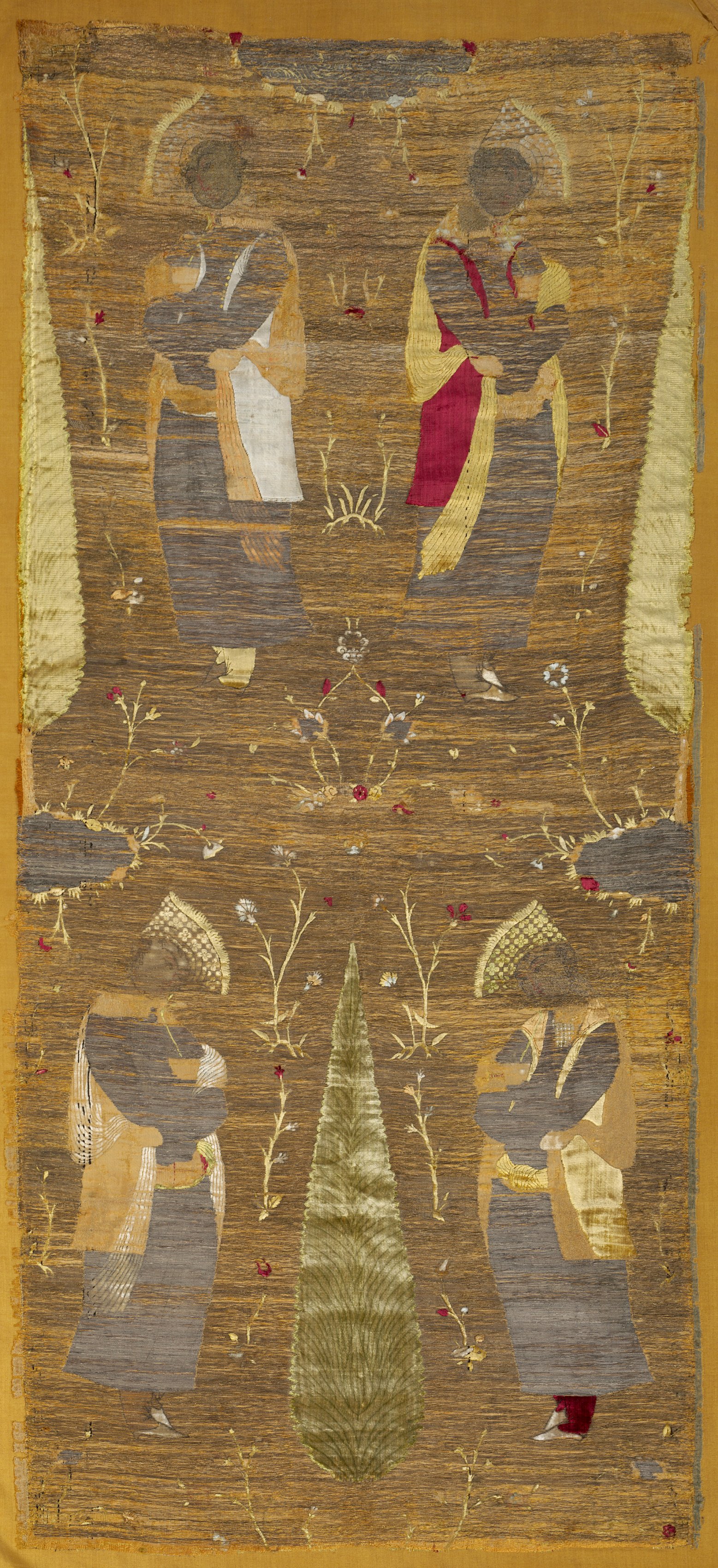
This analysis, prepared for the Chief Fabric Deconstructionist at Zoey Fashion Lab, examines a singular artifact: a velvet panel from Safavid Iran, likely woven in Isfahan or Yazd between the 16th and 18th centuries. The panel depicts four youths engaged in the act of smelling flowers, a motif resonant with Persian poetic and mystical traditions. The technical execution—silk velvet with brocading, pile-warp substitution, and the lavish use of gilt- and silver-metal thread—elevates this textile beyond mere decoration into a sophisticated narrative medium. The reference to a "New DNA Strand" and the "Avant-garde" style mandates a radical reinterpretation, not of the object’s historical context, but of its structural and conceptual DNA as a blueprint for contemporary design.
Technical Mastery: The Fabric as a System of Codes
The Safavid velvet is not a single surface but a layered, three-dimensional system. The foundation is a silk velvet, achieved through the use of two warps: a ground warp and a pile warp. The pile warp is cut to create the plush, raised surface that gives velvet its characteristic depth and light-absorbing quality. The process of pile-warp substitution is the critical innovation here. In standard velvet, the pile is uniform across the fabric. In this panel, the pile warp is selectively raised or lowered, creating areas of high pile (the youths’ robes, the flower petals) and low or no pile (the background, the faces). This is not merely decorative; it is a form of tactile coding. The viewer’s hand, as much as the eye, reads the narrative: the soft, plush petals invite touch, while the smooth, flat faces suggest distance or reverence.
The brocading technique adds a second layer of complexity. Brocading involves the insertion of supplementary weft threads—here, gilt- and silver-metal thread—that are not part of the ground weave. These threads float on the surface, creating shimmering, reflective patterns. In this panel, the metal threads are used to delineate the youths’ halos, the outlines of their garments, and the stems of the flowers. The effect is a binary visual system: the matte, absorbent velvet of the pile versus the reflective, metallic gleam of the brocading. This contrast is not static; it shifts with ambient light, making the panel a dynamic, living object. The gilt thread, likely made of silver-gilt (silver wire wrapped in gold leaf), would have been incredibly costly, signifying the panel’s original function as a courtly or religious gift, perhaps for a shrine or a noble’s private chamber.
Narrative and Symbolism: The Youths and the Flowers
The four youths are not generic figures. They are positioned in a frieze-like arrangement, each turning slightly toward a central point—perhaps an unseen garden or a symbolic axis. Their act of smelling flowers is a direct reference to the Persian concept of gol o bolbol (rose and nightingale), but here the nightingale is replaced by the human figure. The flower is not merely a decorative motif; it is a metaphor for divine presence. In Sufi mysticism, the act of smelling a flower—capturing its fleeting scent—represents the soul’s yearning for union with the divine. The youths’ closed eyes and tilted heads suggest a state of wajd (ecstatic absorption). The metal-thread halos reinforce this reading, positioning them as semi-divine beings or as initiates in a spiritual garden.
From a deconstructionist perspective, the panel’s narrative is not linear. It is a fractal pattern. Each youth is a variation on a theme: the same posture, the same gesture, but with subtle differences in the angle of the head, the shape of the flower, the color of the robe. This repetition-with-variation is a hallmark of Safavid design, but it also anticipates the avant-garde’s fascination with seriality and the grid. The panel can be read as a visual score, where each youth is a note, and the flowers are rests. The metal threads function as accents, like a cymbal crash in a quiet composition.
The "New DNA Strand": Reconstructing the Fabric’s Core Logic
The directive to treat this panel as a "New DNA Strand" requires a shift from historical analysis to structural biology. The fabric’s DNA is not its physical fibers but its algorithmic logic. The pile-warp substitution is a binary code: pile up/pile down. The brocading is a secondary code: metal thread present/absent. The colors of the silk (likely madder red, indigo blue, and saffron yellow) form a third code. Together, these codes create a three-dimensional matrix that can be read as a data set. The youths’ positions, the flowers’ types, and the metal-thread halos are not arbitrary; they are nodes in a network of symbolic relationships.
For Zoey Fashion Lab, the "New DNA Strand" means extracting this logic and re-encoding it into a contemporary material system. Imagine a fabric where the pile-warp substitution is controlled by a heat-sensitive polymer, so that the pattern changes with body temperature. The metal threads could be replaced by conductive fibers, turning the garment into a touch-sensitive interface. The youths’ act of smelling flowers becomes a metaphor for sensory input: the garment could respond to the wearer’s breath or to the scent of a flower, altering its texture or color. This is not mere decoration; it is a responsive architecture for the body.
Avant-Garde Application: From Artifact to Interface
The avant-garde style, as defined by Zoey Fashion Lab, rejects the nostalgic and embraces the disruptive. This Safavid velvet is not a relic to be preserved but a template for rupture. The four youths, in their repetitive, meditative pose, can be reinterpreted as a chorus of digital avatars. The flowers they smell are data points. The metal-thread halos are Wi-Fi signals. The velvet’s pile becomes a pixelated surface, where each tuft is a unit of information. The act of smelling is a search query; the flower is the result.
A garment based on this DNA would be a wearable algorithm. It might feature a grid of micro-actuators that raise and lower pile in response to environmental data (air quality, humidity, or even the wearer’s heart rate). The metal threads could be replaced by electroluminescent wires, creating a garment that glows in patterns derived from the original panel’s brocading. The youths’ halos become circular LED arrays, pulsing with data. The avant-garde here is not about shock but about recontextualization: taking a 400-year-old system of tactile and visual coding and translating it into a language for the 21st century.
Conclusion: The Fabric as a Living System
The Safavid velvet panel is not a dead object. It is a living system of codes, materials, and narratives. Its technical complexity—velvet, brocading, pile-warp substitution, metal threads—is a manual for how to build depth, contrast, and meaning into a fabric. Its narrative of youths smelling flowers is a meditation on sensory perception and spiritual yearning. For Zoey Fashion Lab, the "New DNA Strand" means treating this panel as a genetic blueprint for a new generation of responsive, intelligent textiles. The avant-garde application is not to copy the pattern but to mutate its logic, creating fabrics that are not just worn but experienced—fabrics that see, feel, and respond. The four youths, frozen in their act of smelling, become the architects of a new sensory world.