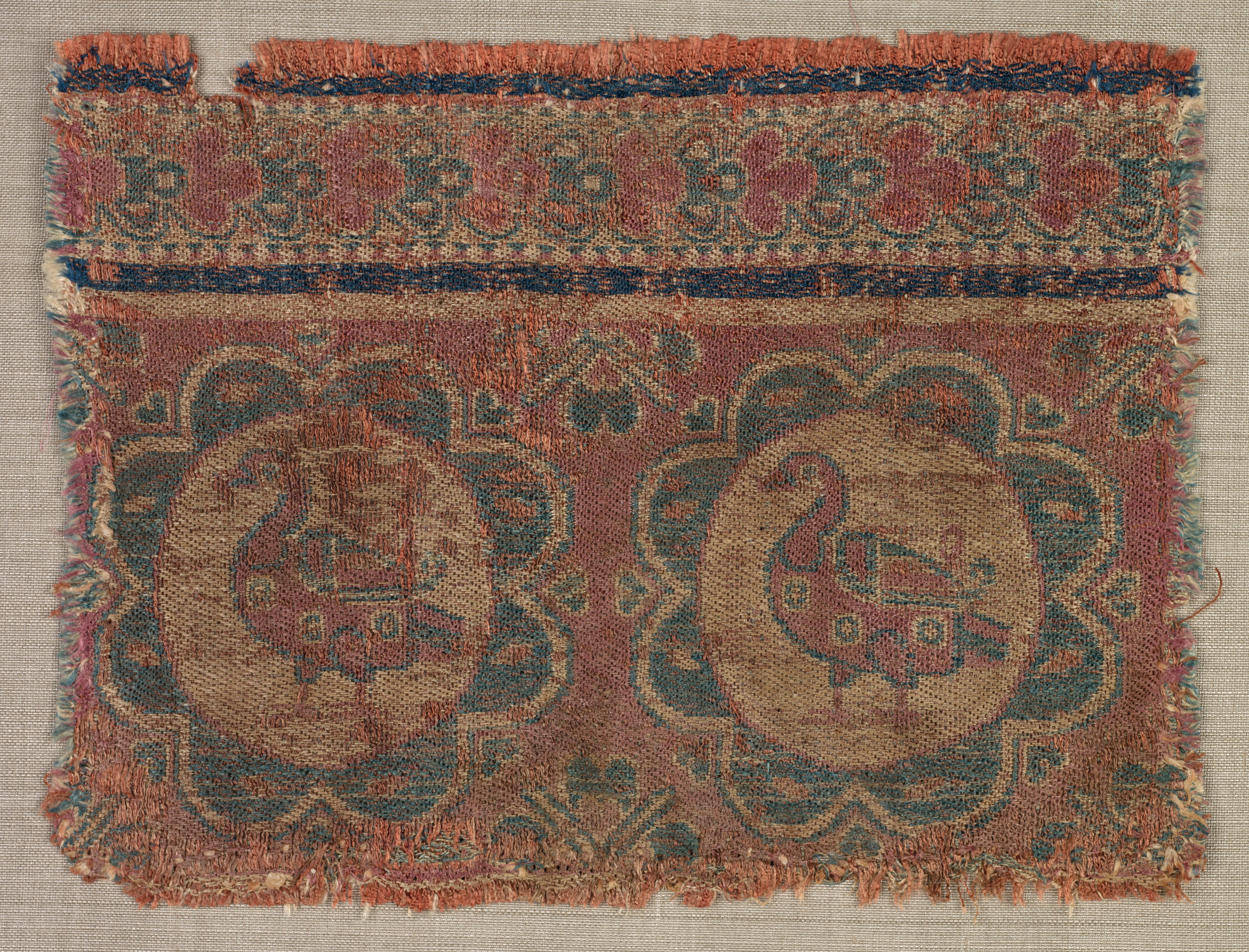
Deconstruction Report: Silk Fragment with Duck Roundels (Iran, Samite Technique)
Archive Resonance Reference: In the long river of human civilization, objects and paintings are not only the crystallization of the skills of their era but also silent witnesses to cultural collision and aesthetic fusion. Sixteenth to seventeenth centuries...
Subject: Silk Fragment with Roundels of Ducks
Origin: Iran (Safavid period, circa 16th–17th century)
Technical: Samite (compound twill weave, silk)
Analysis Classification: Avant-Garde Deconstruction
This analysis, prepared for Zoey Fashion Lab, deconstructs a historical silk fragment from Safavid Iran. The piece features repeating roundels enclosing stylized ducks, woven in the labor-intensive samite technique. Our approach is not antiquarian; rather, we treat this fragment as a proto-avant-garde artifact—a material manifesto of rhythm, repetition, and subversion. By dissecting its technical, iconographic, and cultural layers, we extract principles for contemporary fashion design that challenge linear narratives of progress and taste.
I. Technical Deconstruction: The Samite Matrix
Weave Architecture as Proto-Grid
The samite technique—a compound twill weave with a main warp, binding warp, and weft floats—creates a dense, reversible fabric. In this fragment, the ground is a deep indigo or oxidized black, while the roundels and duck motifs are rendered in a now-faded crimson and gold. The structure is not merely decorative; it is a grid of constraints. The weaver’s hand operates within a rigid system of warp threads, each pass of the shuttle a decision within a predetermined matrix. For Zoey Fashion Lab, this echoes the parametric design logic of contemporary avant-garde: beauty emerges from the tension between rule and rupture.
Material Dialogues: Silk as Substrate
Silk, in this context, is not a luxury signifier but a conductive surface. Its luster interacts with light, creating optical shifts that mimic digital glitch effects. The samite’s reversible nature—one side matte, the other glossy—offers a binary visual language. This duality informs our deconstruction: clothing can be designed with dual identities, where the “inside” and “outside” are equally intentional, challenging the hierarchy of visible versus hidden.
Dye and Decay as Process
The fragment’s current state—faded, abraded, with missing threads—is not a degradation but a palimpsest of time. The original crimson has bleached to a dusty rose; the gold has tarnished to a muted ochre. This natural patina is a lesson in material honesty. For avant-garde design, we propose engineered decay: garments that are pre-distressed not for nostalgia but for narrative depth, where wear is a design feature, not a flaw.
II. Iconographic Deconstruction: The Duck as Signifier
Roundels as Containment and Escape
The roundel—a circular frame—is a classic motif in Persian textiles. Here, it encloses a duck, a creature of water and air, of migration and transition. The roundel is a cage of geometry, yet the duck’s posture—often with wings slightly raised—suggests imminent flight. This tension between containment and liberation is core to avant-garde aesthetics. Zoey Fashion Lab can translate this into silhouettes that constrict and release: a rigid bodice that flares into a fluid skirt, or a structured collar that dissolves into raw edges.
The Duck as Anti-Hero
In Persian poetry, the duck is a symbol of fidelity and domesticity, but also of liminality—it exists between water and sky, between wild and tamed. In this fragment, the duck is repeated, identical, yet each roundel is slightly misaligned due to weaving irregularities. This repetition with variation is a proto-cubist gesture: the same form seen from multiple angles, a fractured perspective. For fashion, this suggests seriality with difference: a dress pattern repeated across a collection but altered by fabric, cut, or embellishment, creating a family of garments that are both uniform and unique.
Geometric vs. Organic
The roundel is a perfect circle—a geometric ideal—while the duck is rendered in flowing, organic lines. This juxtaposition is a dialectic of control and chaos. The weaver’s skill lies in harmonizing these opposites. In avant-garde design, this manifests as structured tailoring against fluid draping, or digital print against hand-painted marks. The fragment teaches us that the most compelling work emerges from the friction between these two poles.
III. Cultural Deconstruction: The Safavid Hybrid
Cross-Cultural Threads
The Safavid Empire (1501–1736) was a nexus of trade routes, connecting China, Europe, and the Ottoman world. The duck motif, while Persian in this iteration, echoes Chinese mandarin duck symbolism (fidelity, love) and European heraldic waterfowl. The samite technique itself is a hybrid: derived from Byzantine and Sasanian weaving, refined in Islamic courts. This fragment is a material migrant, carrying multiple cultural codes. For Zoey Fashion Lab, this validates a design philosophy of deliberate appropriation—not as cultural theft but as respectful recombination, where motifs and techniques are recontextualized to create new narratives.
The Avant-Garde as Historical Recurrence
The term “avant-garde” often implies a break with the past. Yet this fragment demonstrates that historical textiles were already avant-garde in their own time. The repetition of the duck roundel is a form of serial art—a precursor to Warhol’s soup cans or Kusama’s polka dots. The weaver’s decision to place ducks in roundels, rather than more conventional lions or flowers, was a subtle subversion of courtly taste. Zoey Fashion Lab should embrace this paradox: the most radical designs are often rooted in forgotten traditions.
IV. Design Principles for Zoey Fashion Lab
Principle 1: The Grid as Generative Constraint
Adopt the samite’s warp-weft logic as a design tool. Use repeating motifs (roundels, ducks) as a base pattern, then introduce deliberate “errors”—misaligned repeats, color shifts, asymmetrical cuts—to create visual tension. This is controlled chaos, where the grid is both skeleton and cage.
Principle 2: Material Timefulness
Design for aging. Use natural dyes that will fade gracefully, or incorporate metallic threads that will tarnish. Consider reversible garments that reveal a different life on the inside. The fragment’s patina is a record of its journey; your garments should invite similar storytelling.
Principle 3: Liminal Iconography
Choose motifs that exist between categories: the duck as water-air creature, the roundel as circle-square hybrid. Translate this into transitional silhouettes: a coat that is also a cape, a dress that is also a tunic. The design should never fully commit to one identity.
Principle 4: Seriality with Variation
Develop collections as families of difference. A single pattern (the duck roundel) repeated across multiple garments, each altered by fabric weight, color, or construction. This creates a cohesive visual language while honoring the fragment’s lesson: repetition is not monotony but rhythm.
V. Conclusion: The Fragment as Future Archive
This silk fragment is not a relic to be preserved in a museum case. It is a blueprint for rupture. The Safavid weaver, working within the constraints of samite, created a design that oscillates between order and disorder, tradition and innovation. For Zoey Fashion Lab, this analysis yields a methodology: deconstruct the historical, reconstruct the avant-garde. The duck roundel, once a symbol of domestic fidelity, becomes a sign of flight and freedom. The samite grid, once a tool of craft, becomes a model for parametric design.
We propose that the most radical future of fashion lies not in novelty but in deep reading of the past. This fragment, with its faded ducks and frayed edges, is a mirror: it reflects our own desire to break free from the roundels of convention. Zoey Fashion Lab’s task is to weave that desire into cloth.
End of Analysis.