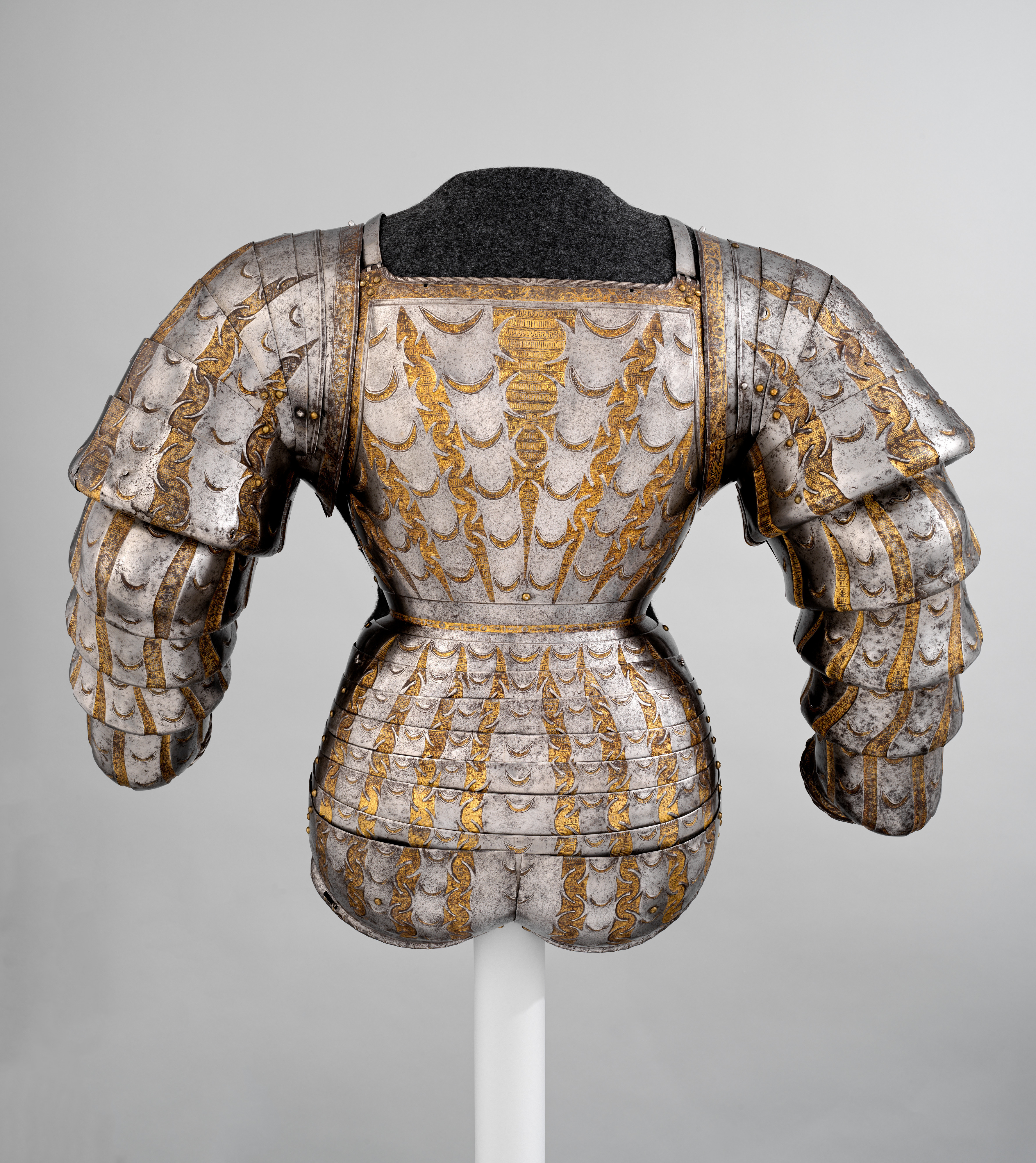
Deconstructing the Carapace: Futuristic Silhouettes and Structural Innovation in Augsburg's Armor Fragments
The study of historical armor, particularly the exquisite craftsmanship of 16th-century Augsburg, offers a profound lexicon for avant-garde fashion. Zoey Fashion Laboratory's investigation into the "Portions of a Costume Armor" transcends mere historical homage. It is a radical re-reading of the human form as a site of protection, power, and architectural potential. For SS26, these fragments—forged from steel, copper alloy, and gold—are not relics of a martial past but blueprints for a future where clothing becomes a second skeleton, a dynamic interface between body and environment. This analysis dissects the structural innovations and futuristic silhouettes that emerge from this deconstructive study, positioning the armor as a progenitor of high-concept garment architecture.
The Steel Exoskeleton: Reimagining Structural Rigidity as Fluid Movement
The primary material, steel, is typically associated with immobility and weight. Yet, the Augsburg fragments reveal a paradoxical intelligence: the articulation of plates at the shoulder, elbow, and knee. For the avant-garde, this is not about replicating a gauntlet or a pauldron. Instead, the principle of articulated segmentation is abstracted into a modular system for SS26. Imagine a jacket constructed from laser-cut, interlocking steel-alloy panels, each piece connected by fine, gold-plated chainmail. The silhouette is not a rigid shell but a responsive carapace that shifts with the wearer’s anatomy. The innovation lies in negative space—gaps between the plates that reveal the body or a secondary layer of translucent, copper-infused mesh. This creates a visual rhythm of solid and void, a futuristic silhouette that is simultaneously armored and vulnerable, a paradox that defines the Zoey aesthetic.
Furthermore, the structural innovation extends to the distribution of mass. The original armor concentrated weight on the torso and shoulders. In our SS26 application, this translates into a deconstructed bodice where steel plates are asymmetrically placed—a single, sculpted shoulder piece that arcs like a bird’s wing, counterbalanced by a cascading skirt of copper-alloy scales. The silhouette is biomorphic, inspired by the exoskeletons of insects and crustaceans, yet rendered with the precision of Augsburg's goldsmiths. The result is a garment that appears to have grown from the body, a second skin of precious metal that redefines the human form as a living sculpture.
Copper Alloy and Gold: The Alchemy of Light and Surface
The inclusion of copper alloy and gold is not merely decorative; it is a strategic manipulation of light and thermal perception. Copper, with its warm, reddish hue, oxidizes over time, creating a patina that tells a story of age and transformation. For SS26, we embrace this living surface. Imagine a dress where copper-alloy filaments are woven into a structural lattice, their color shifting from bright orange to deep brown as the garment is worn. This is not a static design; it is a dynamic, evolving artifact. Gold, applied via electroforming, serves as the accent—a gilded trim on a steel cuff, a thin layer on a copper-alloy clasp. The interplay of these metals creates a chromatic tension that is both opulent and industrial, a futuristic palette that references both the gilded cathedrals of Augsburg and the harsh gleam of a spacecraft.
The structural innovation here is the hybridization of materials. The armor fragments demonstrate a masterful integration of disparate metals—steel for strength, copper for flexibility, gold for corrosion resistance. In our SS26 collection, this translates into composite textiles. A single garment might feature a supportive steel frame, a flexible copper-alloy mesh for articulation, and gold-plated rivets that serve as both fasteners and decorative nodes. The silhouette is faceted, catching light at multiple angles, creating a shimmering, almost holographic effect. This is not armor for battle; it is armor for the catwalk, a declaration of the wearer’s ability to command attention through sheer material presence.
Futuristic Silhouettes: The Deconstructed Carapace and the Inverted Armor
The most radical departure from traditional armor is the deconstruction of the carapace. The Augsburg fragments are incomplete—a shoulder piece, a knee guard, a fragment of a breastplate. Zoey Fashion Laboratory treats this incompleteness as a design philosophy. For SS26, the silhouette is defined by asymmetry and fragmentation. A single, oversized steel gauntlet on one arm, paired with a bare, copper-wrapped forearm on the other. A breastplate that only covers the left side of the torso, leaving the right side exposed or covered in a sheer, gold-threaded organza. This creates a dialectic of protection and exposure, a narrative of the body as both fortress and vulnerability. The futuristic silhouette is not about total coverage; it is about strategic placement, where the armor becomes a punctuation mark on the body’s form.
Another key silhouette is the inverted armor. Traditional armor is worn externally, a shell that encases the body. Our SS26 interpretation reverses this logic. Imagine a garment where the steel plates are mounted on the inside of a transparent, polymer-based exoskeleton. The armor becomes the internal structure, visible through a clear, futuristic shell. The silhouette is ghostly—the body appears to be floating within a cage of steel and gold. The copper alloy is used for the hinges and joints, creating a sense of mechanical life. This is not a costume; it is a wearable architecture, a study in transparency and structural revelation. The wearer becomes a living museum exhibit, their inner support system exposed to the world.
Structural Innovation: Modularity, Joint Articulation, and the Kinetic Garment
The genius of Augsburg armor lies in its joint articulation. The overlapping plates at the elbow and knee allow for movement while maintaining protection. Zoey Fashion Laboratory elevates this principle into a modular system for SS26. Each garment is composed of interchangeable components—a steel shoulder cap, a copper-alloy elbow guard, a gold-plated wrist cuff. These pieces can be reconfigured, removed, or added, allowing the wearer to customize the silhouette and level of protection. This is a kinetic garment, one that changes shape with the wearer’s movements and choices. The structural innovation lies in the connectors—magnetic clasps, sliding locks, and tension cables that allow for rapid reconfiguration. The silhouette is never fixed; it is a living, breathing system of armor that evolves throughout the day.
Furthermore, the weight distribution is re-engineered. Traditional armor was heavy and cumbersome, requiring a supporting belt or harness. Our SS26 versions use lightweight, aerospace-grade steel alloys and carbon-fiber-reinforced copper composites. The weight is distributed via a bio-mechanical harness that follows the body’s natural lines, creating a silhouette that is both powerful and graceful. The gold accents are not merely decorative; they serve as counterweights, balancing the garment and ensuring it moves with the wearer, not against them. This is the ultimate expression of functional avant-garde—a garment that is as practical as it is visionary, a second skeleton that enhances human capability.
Conclusion: The Armor as a Blueprint for SS26
The Portions of a Costume Armor from Augsburg are not historical artifacts; they are prophetic fragments. Their study reveals a future where clothing is not a covering but a structural extension of the self. For SS26, Zoey Fashion Laboratory translates steel, copper, and gold into a new language of silhouette—asymmetrical, transparent, modular, and kinetic. The armor becomes a metaphor for the modern condition: protective yet vulnerable, heavy yet mobile, ancient yet futuristic. This is not a collection; it is a manifesto for the body as architecture. The Augsburg smiths forged armor for the battlefield; Zoey Fashion Laboratory forges it for the future, where every garment is a statement of structural innovation and self-definition.